
Deer are NOT Where You Find Them

muledeer_013
Mule deer buck. Photo courtesy of Utah DWR.

Deer are NOT Where You Find Them

Has anyone ever told you, “Deer are where you find them?”

Maybe it’s a Utah thing, but I’ve heard that:

  • Deer are where you find them…
  • Gold is where you find it…
  • Fish are where you find them…

While scouting last weekend I found a group of big, blocky buck tracks in an unassuming area. Why were the bucks here?, I wondered. Were they moving from bed to feed, or vice-versa? Were they just migrating through? Was there low spot on the mountain that funneled them through here? I’m not sure, but I have my theories. If I can figure out why, then maybe I can intercept them during the hunt.

What does this have to do with hunting? Because wherever a deer is, he has a good reason for being there. Deer don’t take vacations, they don’t explore randomly, and they never wander aimlessly. If a deer is moving, he’s moving for a reason. Maybe he’s coming from feed or bed; maybe he’s trolling for a doe; maybe he was spooked by a predator and is following an escape route. Or maybe–God-forbid–he’s making random tracks just to throw you off! There are many reasons for a buck to move, and it’s your job as a bowhunting detective to figure out why.

Big buck tracks aren’t just pretty; they also hold valuable clues. For instance, if the tracks are meandering around vegetation, then it’s a feeding area. If the tracks are dug in, far apart, or appear to be running, then maybe it’s an escape route.
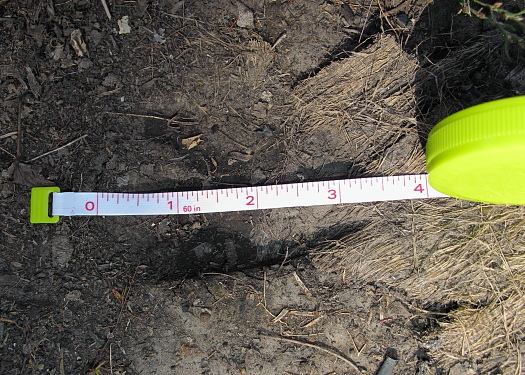
BeaverTrip2of3 003

If the tracks are deep or appear to be dragging, then it’s probably a big, heavy, old buck. Maybe the tracks are old with debris accumulated in them, or new with sharp edges. You can pretty easily guess the age with a little practice. Also, what direction are the tracks pointing? Kinda important to know whether the buck is coming from or going to a certain area.

If I learned anything about deer over the years, it’s that they take things very serious–which makes them very un-human by the way. Everything a deer does, it does deliberately and purposefully. We can use this to our advantage. The important thing is that you get in the habit of asking questions, making logical theories, deductions, postulations, or just plain guesses. It’s better to wonder why a buck is somewhere than to wonder why he’s not. At least you have a starting point for the opener.

Nowadays when I hear someone say that things are where you find them, I cringe. It’s the ultimate cop-out. What I really hear is, “My brain is where I left it.” It means they’ve given up. They rely on sheer luck; no more thinking, no deducing, no more trying. Maybe they’ll stumble upon a big buck, but if not, oh well. It’s out of their hands anyway.

No one knows what really goes on in a buck’s head, but we can make some pretty good guesses which will lead to more success and more venison in the freezer. Feed, bed, water, migration routes, escape routes–all of these things should be running through your head. The next time you run across some big buck tracks, do yourself a favor and start asking questions. Lots of questions.

Big Buck’s Highest Priority

big_deer_A

Big Buck’s Highest Priority

What is a big buck’s highest priority, Food or Safety?

The answer is SAFETY!

In the first edition of my book, Zen Hunting, there’s a slight discrepancy. In one chapter I say the buck’s highest priority is food, and in another chapter it’s safety (or survival). The 2nd edition attempts to separate the two, but it’s really impossible.

The problem comes from real-life observation and experience.

First, a buck can’t survive without daily food intake. I cited David Long’s observation that bucks can’t even stay bedded for the entire day without occasionally getting up to feed. However, while hunting the Utah-Cache unit for three years in a row, I observed that big bucks never up and feeding during daylight hours. As an example, the four times I busted the infamous Droptine buck, he was bedded. Never was he on his feet during daylight hours.

What it comes down to is hunting pressure. As soon as hunters file into the woods, the bucks become completely nocturnal. You’ll still find plenty of tracks and sign because they are indeed feeding at night, but nowhere is a buck found feeding during the day. Bucks simply adapt to a nocturnal lifestyle that negates daytime feeding.

This makes perfect sense. The bucks of Monte Cristo are the smartest I’ve seen. If it comes down to eating or starving to death, the bucks will gladly starve to death. But they don’t really have to because they’re feed at night, and only at night. In this example safety far outweighs eating.

The hunting pressure on Monte is ridiculous and has been for decades, yet there are still trophies haunting the woods (and my nightmares). As I put it in my book, “These are the neurotic decedents of lone survivors.” It’s simple adaptation; survival of the fittest. The bucks that feed during the day get shot!

I’m certain that there are plenty of other areas where big bucks wander around, stuffing their faces with vegetation during the day. I’ve even seen it in Central Utah, but not up north.

Since I’ll be hunting Monte again this year, it’s my job to figure out how to approach these deer differently to beat the odds. I’ve done it before, and here’s how I’ll do it again:

  1. Hunt the opener. In my book I have a whole sub-chapter entitled Never Hunt the Opener! My thinking has changed a little since then. It’s true that on opening day most bucks have already noticed the increased traffic/ATV noise and bailed onto secondary ridges or deep, dark, holes. But I realize now that there are always a brave or stupid few that will wait until they actually see a camo-clad dude before bailing out. These bucks are still in their summer routine and therefore huntable. My best chance is to catch them on the opener.
  2. Hunt mid-week and late in the season. After opening day, my plans change. Since I work most weekends, I can schedule my hunts between Tuesday and Friday. I’ve found that the best day to hunt is Thursday. After the weekenders terrorize the deer, it takes half a week for them to calm down. By Thursday they feel more secure and let their guard down. Therefore your best odds are Thursday and into Friday before the weekend warriors come smashing back into the hills. Also, the hunting pressure falls off dramatically during the last couple weeks of the bowhunt, making September the best time to be out.
  3. Hunt the Beds. The most difficult thing in the world is hunting big bucks in their beds. First you have to find their beds, preferable while pre-season scouting. Big bucks use multiple beds, so you’re not just looking for one bed. Second, these beds are generally found in deep and steep cover and perfectly situated to detect predators from a distance using wind and terrain. It is possible to hunt deer in their beds using ambush techniques or a super-stealthy still-hunting approach, it’s just not probable.
  4. Hunt the Secondary Ridges:  After opening day I will bail off the top and start hunting secondary ridges and deep, steep areas. By then I’ll have multiple backup areas that I’ve cataloged from my diligent scouting trips. It sucks dragging a deer up miles of vertical slope, but there’s no other option.

The methods you use to hunt big bucks is relative to the amount of hunting pressure the area gets. Once again, you must understand the nuances of your prey and adapt yourself as a predator. In high-pressure areas remember, Safety First! Big bucks only care about surviving.

That’s all there is to hunting high-pressure trophy mule deer. Well, that and a ton of luck.

Good luck!

Second Scouting Trip: June 2015

Early Scouting Trip 2015

Okay, less words, more photos:

June-6a

Esther and I hit the top of Monte Cristo over the weekend. The snow subsided enough to get above 8000 feet. We spent the first day beating the mountain to death and exploring a promising new area completely devoid of deer. Driving back to camp we spotted these bucks on a hillside.

june-6b

It’s still early, but the monsoons of May have the bucks growing promising antlers. The two bucks on the left are likely two-year-olds, and the buck on the right is a mature buck with a potential outside spread of 22 inches or more.

June-6c

The bucks didn’t stick around long for pictures, but that’s okay. Just seeing bucks in the Cache unit made us hopeful.

Here’s the lessons we learned on this trip:

  1. The Cache-Monte unit still sucks.
  2. The biggest bucks are still on lower elevations. Although we found signs of large migrating bucks, most are still lower on the mountain and following green-up up. They won’t be high until the heat and mosquitoes push them up.
  3. Promising new areas weren’t as promising as we hoped, even far off the dirt road. You have to cover many miles of empty woods just to locate a few small patches that regularly hold deer.

Just one word of caution: The high elevation roads still have patches of snow and deep mud, and we almost got stuck a couple times. Not far from camp we ran into this abandoned Hummer-in-a-bog, sunk up to the axles. The poor fellas were able to winch it out the next day, but it just goes to show you that no vehicle is safe from the muddy clutches of the mountain.

stuck-in-the-mud

More scouting to come!

First Scouting Trip: May 2015

First Deer Scouting Trip 2015

The Big Game Draw results are in:  unsuccessful for Mountain Goat and limited entry Deer, but successful for general Buck Deer…in my 5th choice unit.

After arrowing the infamous Droptine buck in 2010, I vowed never to hunt the Cache unit (Monte Cristo/Unit #2) again. There are simply too few bucks and hardly any trophies. But with so many hunters in Utah now, I can no longer hunt where I want to, even with a bow. For a guaranteed tag, I always put Cache as my last choice. Since no one in their right mind actually wants to hunt the Cache unit, it’s a guaranteed draw.

Well, I’ll make the most of it. And when it’s all over, I know I will be standing over a huge Pope & Young buck, but man, it’s gonna take some work. In order to succeed, I’ve already begun scouting. I’ll continue scouting this bleak unit every chance I get until opening day in mid-August.

The Cache unit is relatively HUGE. What it lacks in quality deer, it makes up for in quantity area–miles and miles of pristine forest and mountains, mostly devoid of wildlife. It takes a lot of time and effort to thoroughly scout an area this big.

A couple weeks ago, when the higher elevations were still snowed in, Esther and I scouted some obscure lower elevations. I quickly learned that you had to get at least a mile away from the dirt road to find any deer. We finally found a pod of eight deer in a steep feeding swathe between aspens.  It was too early to see antlers, but it looked like a promising new area.

Pre-season scouting doesn’t require actually seeing deer. It’s more important to look for sign:  large tracks, tree rubbings, and especially good feeding areas. Remember the old adage:  Where you find the best feed, you’ll find the best bucks. Grab a topo map and locate potential feeding areas on the east and south-east facing slopes near steep, timbered bedding areas. Bucks love to bed near feed, especially early in the year when there’s little pressure.

Successful scouting means continually seeking out new areas. Hunting pressure quickly pushes bucks out of prime areas, so you’ll need multiple backup areas. Be sure to scout the secondary ridges. These are the lower or middle ridges where bucks feel safe. On Monte Cristo the main roads follow the top and bottom of the mountain. But in the deep, dark interior, bucks feel safe.

Although I wasn’t inspired to pull out my camera and document our first antlerless deer sighting, I considered this trip a good learning experience. The biggest lesson was how much more area I still needed to cover. A second scouting trip was quickly planned and executed (see tomorrows post with pictures!)

Good luck on your own scouting adventures.