Mule Deer Age Progression

Mule Deer Age Progression:  Antlers

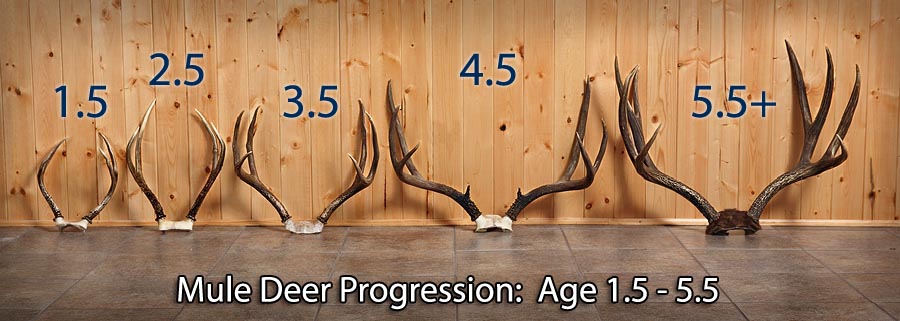
This is pretty neat. I got a bunch of younger deer in for taxidermy this year (including my own) ranging from 1.5 to 5.5 years old. So, I lined them up in order of age for this photo.  (Click to see larger version).
progression2
Mule deer antler age progression based on size.

The reason they are aged in half-year increments is because all mule deer are born in spring, and then harvested in fall, making the youngest legal buck 1.5 years old. Before that, they are fawns without antlers.

The buck on the far right is my late grampa’s largest buck.  It’s a beautiful, symmetric 4×4 without eyeguards. Without seeing the buck’s teeth, I can only guess the age at 5.5, although it could be as old as 7 or 8.

It can be difficult to age large bucks just by their antlers because after they become fully mature (4.5 years), genetics plays a big part in determining antler size.

The best way to age a buck is to look at tooth wear. After 5 or 6 years there will be noticeable wear on the back molars. They become less jagged and more flat. Eventually all the molars flatten down to the gum line while the front teeth (aka biters) fall out one by one.

The next best way to age a buck is to look at antler bases. Old bucks (from 8 to 10) grow similar size racks each year, but they are thicker around, especially at the bases. This is called “mass.”

Very old bucks (10-12 years old) tend to regress in antler size because their teeth become so worn that they can’t get enough nutrition from their food. At that point they slowly starve and/or freeze to death during winter. Mother Nature can be a cruel beast! And you thought hunters were cruel…

The one thing that would enhance this photo is a true giant in his prime, aged 9 – 11 years.  A “superbuck” scoring into the mid-200s would dwarf them all.

The Art of Taxidermy

wood-flat

The Art of Taxidermy

I’ve been busy doing a lot of taxidermy lately, trying to get caught up after a busy hunting and photography season. One aspect of taxidermy that I really enjoy is the meditation. Anyone who’s done taxidermy knows that it can be very time consuming and sometimes a little tedious. This is good because it gives the taxidermist plenty of time to reflect on things such as the animal’s life, which is the taxidermist’s job of reconstructing.

But dissecting and reconstructing a dead animal isn’t for everyone. I believe it takes a certain type of personality to pry the eyeballs and brains out of a skull. Taxidermists can be strange folks…

TaxiClass_078b

The following is a passage taken from my taxidermy website, natestaxidermy.net, that that might help you understand the art and purpose of taxidermy:

Taxidermy often gets a bad rap. The dead heads hanging on people’s walls often evoke negative feelings in non-hunters. They don’t see a glorious and noble beast, but a poor, innocent creature sacrificed purely for sport or to boost the ego of a heartless hunter. I have a hard time understanding this point of view because to me, that noble beast peering out from the wall is a tribute to the animal’s life, not its death.

All year long I admire and photograph both elk and deer in nature. I don’t particularly even like to kill them. But for a brief period in early fall our roles change from admirer and admired, to predator and prey. It’s a natural shift which always shifts back following the hunt. I know that hunting (by any predator) is a good and necessary thing which sustains balance in nature. I think the deer understands this too because all year long, whether I’m stalking with a bow or a camera, I’m treated like a predator, and the animal acts like prey. They don’t know anything else. This is why the biggest and smartest of them are so hard to hunt, and also why they deserve such admiration.

taxi2

When I mount one of my own animals, I feel I’ve preserved not only the memory of a great hunt but the memory of a beautiful and admirable creature. I love wildlife as much as I love to hunt, and through painstaking care I can immortalize that special animal. If it weren’t for taxidermy, millions of beautiful beasts would still be harvested each year, but then discarded and forgotten. A quality taxidermist gives the animal a new home and continued life.

IMG_0299 copy

I won’t lie; I’m fairly new to the taxidermy arts. However, I’ve been doing European skull mounts for friends, family, and myself for more than a decade. My interest in taxidermy began in 2002 when I harvested a very large 4×4 buck and didn’t have enough money for a full mount. Through much research and trial and error, I was finally able to perfect a beautiful European skull mount on a custom-designed wood plaque.

Fall 2012 011

Years later, after mastering the European mount, I developed a keen interest in furthering my taxidermy skills. So in April, 2013, I went to taxidermy school and have been learning and expanding on my education ever since.

TaxiDiploma

Resting on Your Laurels

Resting on Your Laurels

It’s hard to believe it was only a year ago that this giant, 200-inch monster muley stepped out in front of me at 20 yards. It’s even harder to believe how easy that hunt was! Now, how in tarnation can I expect that to happen every year?

superbuck_002

After an incredibly difficult season this year, I have two words to say:  WHO CARES!?  I spent many, many days afield, marveled at God’s natural splendor, and came out with a rejuvenated spirit…many times. And at the end of the season, with hopes and dreams dashed, I still get to come home to a loving wife, a room full of magnificent mule deer trophies, and countless memories of amazing hunts.

A couple years after getting the infamous Droptine Buck, I remember telling my  brother that failed hunts don’t bother me anymore because at the end of the day I can go home, take the Droptine mount off the wall, and snuggle with it in bed. Russ got a kick out of that.

What really happens is I hobble downstairs on sore feet, cramping legs, and with a broken ego and weary back. I slowly look up from the floor and stare at these magnificent creatures. If their glassy eyes could see my face, they’d see a man with many more questions than answers. A minute later, solemnity fades and I force a smile. I think these masters of the woods deserve appreciation, and I think I deserve some satisfaction, even amidst failure.

Anyway, failure is relative. I failed to meet my goal this year, but in the final hour I still brought home some sacred meat for the family. Guy Eastman once wrote that if you fail to harvest a deer, it’s okay. It just makes the ones you get that much more special. These words of wisdom have stuck with me, and I want to believe it’s true.

With only a week left in the extended hunt, I saw the looming clouds of failure building. Then I remembered Superbuck and asked myself, “How long is a trophy good for?” It seems a buck like that can keep a man going for a few years, at least.

This year, I will rest on my laurels. I think I’ve earned it.

superbuck_003

My 2014 Archery Buck

01Nate2014

My 2014 Archery Buck Story

Here it is folks, my 2014 trophy buck!  Okay, it was an off year, but I couldn’t be happier.  With only two days left in the season, I was very fortunate to find this buck up a little side canyon. After Thanksgiving, the area was being pounded by dozens of other hunters (or “dudes” as I call them).

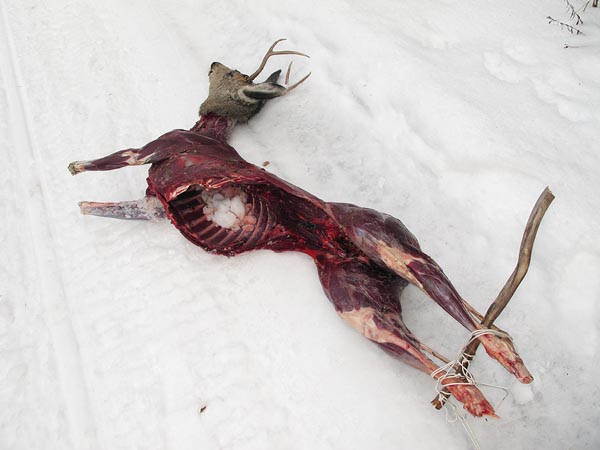
I busted this little two-point halfway up a dense draw. He ran to fifty yards where he stood for a while before returning to feeding. For fifteen minutes I debated whether or not to take a shot. Would I find bigger buck? Highly unlikely. Do I need meat for the winter?  YES!!!

The buck stepped through a narrow opening in the trees. As I shot, he stepped again… I was worried as I watched my arrow hit several inches behind where I was aiming. The buck exploded down the canyon and out of sight.

I hurried over to where he stood and found my arrow: a clean pass through with lots of dark blood. Thank goodness it wasn’t guts!

02IMG_1927

I waited a while then wandered down the canyon. The blood trail was easy to follow as it was coming out of both sides. About 100 yards down the canyon I spied a motionless pile of fur. The shot was good, hitting liver and lots of vital arteries.

Reflections

As I sat in the snowy canyon cleaning my harvest, I couldn’t believe the season was finally over. I thought about the many challenges I endured this year–blown stalks, swirling wind, dreadful heat, blinding blizzards, and a major illness that wiped out half of my November hunt. I also thought about the dozen or so BIGGER bucks I passed up for a chance at a real monster that never came.

Shot on the 28th; my lucky number!

In the end, I wouldn’t be that much happier with a bigger buck earlier on. For the trophy hunter, it’s all or nothing and I never found what I was looking for. But I’m also a meat hunter, and so this little buck means a lot. His death means continual life for me and my family.

Dragging my organic, free-range food back from God’s grocery store
Dragging my organic, free-range food back from God’s grocery store.

The Bigger Picture

It’s easy for the trophy hunter to lose sight of what’s really important. The experience, the opportunity, and the passion supersedes the kill. The reality is, we are extremely lucky to live in a time and place where we can still partake in this wonderful tradition of hunting. I know that without it I would be lost in a world devoid of purpose.

I hope all of you had a great season this year. I’m already looking forward to next year. Good luck in 2015!