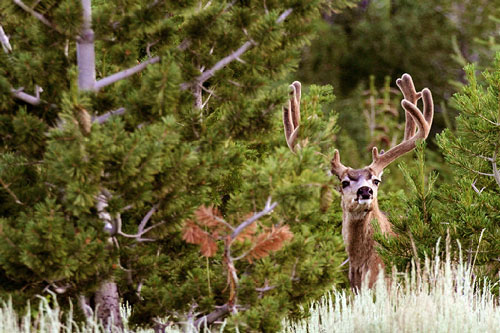
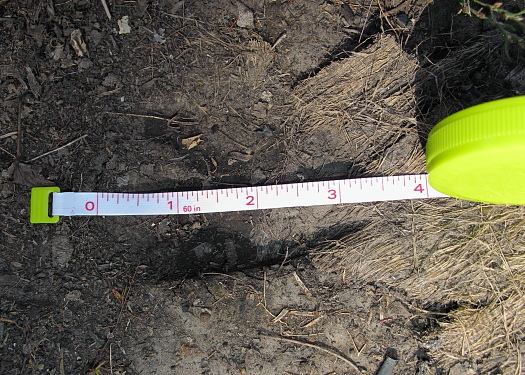
This footage taken shortly after taking my 2016 Boone & Crockett buck in Idaho. It was extremely hot, flies everywhere, I was dehydrated, but very pleased with the outcome of an impromptu bow hunt. I hope you enjoy this short film!
The following is my 2016 Idaho deer story as published in Eastmans’ Bowhunting Journal, Issue 101, May/June 2017:
The infamous Monsterbuck.
The Monsterbuck
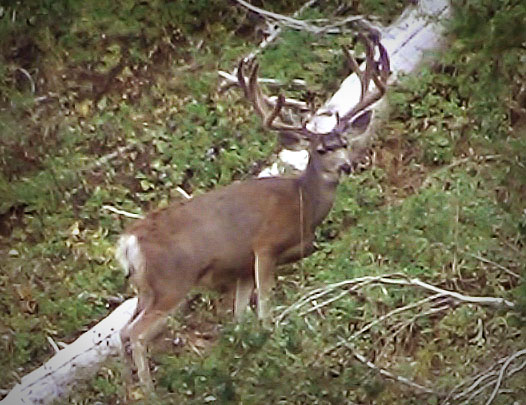
During the 2015 Utah bowhunt I came across a tremendous 200”+ typical mule deer buck which I called the Monsterbuck. At our first meeting, he caught me by surprise. Shaking like a newbie-hunter with buck fever, I promptly sailed an arrow over his back at 50 yards. Later in the season I filmed him at 200 yards on an open hillside. He was in an unstalkable location and surrounded by three other deer, so I let him walk, hoping to get a better opportunity the next day. But he had other plans. Like many big bucks, he disappeared and kept me one step behind him until the season ended.
I promised myself not to obsess over this buck; it’s just too much pressure to bring into the woods. Apparently obsession is not a decision because that amazing buck crept into my mind every day for an entire year! I carried a picture of Monsterbuck around in my planner and reviewed the 2015 video footage often. Needless to say, I went into this year’s bowhunt with high hopes.
About a month before the season opener, I scouted for the Monsterbuck but couldn’t turn him up. No sweat, I thought, he’s a smart buck and will take a little more time to locate. Opening day was hot and dry, but I was brimming with hope and buzzing with energy. I picked up exactly where I left off last year.
Right away I spotted a few forked-horns, but no Monsterbuck. I spent the rest of the day ghosting through thick timber and side-hilling steep slopes without rest. I never covered so much vertical ground in one day. I scoured the ground everywhere I went, but couldn’t find a single heavy-footed track. The evening hunt had me staring dejectedly at the same hillsides where the Monsterbuck had lived, but now completely devoid of deer.
Continuous boot-burning.
And so went the next day, and the next. Eventually I moved camp low and worked upwards. Then north to south, and south to north, but still no Monsterbuck. For two weeks I clambered all over the beautiful and deerless mountains of Northern Utah. Morning, noon, and night I pondered where the Monsterbuck could be hiding, but he never turned up.
Strangely enough, not only was the Monsterbuck missing, but so were seven other 4×4-or-bigger bucks I’d seen the previous year. At that point I was ready to take any mature buck, but all I could find were little ones. The best opportunity I had was a little 3-point buck that bounced into an opening at 20 yards and stared at me. I shooed him away and continued my fruitless search for something better.
Another beautiful mountain morning in Northern Utah.
By the third week I concluded that Monsterbuck had either been killed by a hunter, lion, or poacher, or had moved to another part of the unit, likely due to increased human pressure in the area. All I knew for sure was that the DWR had issued a bunch more tags for my unit, as evidenced by a notable increase in human traffic in the area. And if there’s one thing big bucks hate more than anything, it’s people.
Another crazy morning in the deerless woods.
With less than two weeks left in the season, I was beyond dejected; I was mortified! I love bowhunting than anything, and to see it turn south so quickly was sickening. Each night I dreamed I was on the trail of the Monsterbuck, but he always stayed just out of sight.
Every day I sat in the woods wondering if I was stuck in a nightmare; that any second I might wake to a better reality. Or maybe I was just a lousy hunter. Perhaps I’d just been lucky all these years and deluding myself. As more days passed, my hunting journal became a dark place in which to vent my frustrations. Something had to change…
Halfway through the third week, while trudging across the empty landscape, it hit me: I had a valid Idaho hunting license left over from my spring bear hunt. I stormed back to camp, threw everything in the truck, and headed to Idaho. Having never actually hunted deer in Idaho, I went home collected some maps and notes I’d gotten from an Idaho Fish & Game officer at the hunting expo.
Off to Idaho
My first morning in Central Idaho was memorable, not because I saw more deer, but because I woke up to a terrible head cold. For the next three days I stumbled around strange mountains, sore and coughing while my nose drained continuously onto the dry forest floor.
The first unit I visited was a bust—too open and too few deer. The next unit was heavily forested, but full of other hunters and very little game. The third unit was a little more promising, but just as I began to scare up some deer, my truck broke down and I barely made it off the mountain.
Idaho Part I
The Utah deer hunt came to an end, and with only four days left in the Idaho season I headed out for one last attempt. In reviewing my first Idaho adventure, I concluded that the biggest threat to success was people! Going in, I had the misconception that Idaho was a vast wilderness full of game and opportunity. This is NOT the case. It’s just like Utah: People everywhere, hunting, hiking, camping, and driving ATVs up and down every dirt road. As long as there’s an open road you won’t find a buck anywhere near it. This is why my Utah hunt failed. In order to avoid getting “peopled” again, I broke out my map and found the one place as far away from any city, road or trail. My hunt wouldn’t begin until I covered two miles of steep mountains early the next morning.
Yet another camp.
It was a rough night. Instead of drifting into peaceful slumber, I lay awake staring at the tent ceiling and thinking about the colossal disappointment the season had become. My unhealthy obsession with the absent Monsterbuck had transformed a normally relaxed hunt into a desperate flailing across a dreary landscape. I fell asleep counting the innumerable disappointments of the last several weeks.
Redemption
On September 27th I woke long before the sun and headed up the steep and wooded ridge that separated me from solitude. I trudged like a man possessed, as if fleeing an oppressive regime and longing for new lands. As I approached the ridge top, deer began popping up on the horizon, first some does, then a small band of bucks. I continued on.
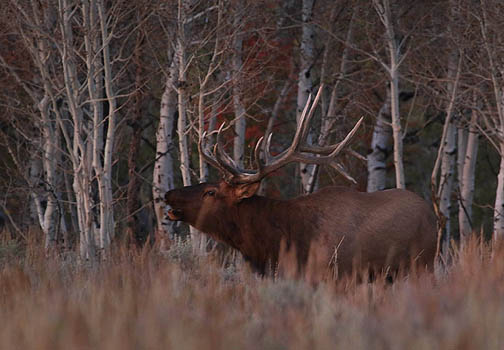
The sun finally broke the horizon, splashing light across a blanket of fresh snow splotched with golden aspen leaves. Pines glistened with melting frost as steam rose lazily from dark logs. Birds flitted about. An elk fired up in the canyon below. Deer tracks crisscrossed the forest floor and increased as I went. The woods pulled me forward, upward, effortlessly. I felt like I was coming home after a long hiatus.
Idaho Part II
Nearer the top, a group of large buck tracks appeared in the snow. They were fresh and meandering, so I sat on a log and listened. I was ready to take any old buck. I just wanted to hunt for myself, and for food, with no pressure to succeed, no worries about inches and scores.
A short time later there was a clacking of antlers and scuffle in the forest. I crept closer. Two bucks pushed and shoved each other with occasional flashes of fur and legs visible in the trees. I pulled an arrow and moved closer. Morning thermals began to swirl, and just as I was closing in, a breeze hit me in the back. I froze as the bucks bounded away, up and over the mountain. Oh well, I was going that direction anyway. It was still a wonderful opportunity.
The sun had been up for some time when I finally crested the ridge and dropped into the thick pines on the shadowy side of the mountain. I had officially arrived at the farthest point from the human pile and was brimming with hope. There was really only one good path through the thick tangle of brush and pines, and judging by the abundance of game tracks in the area, the deer used this route too.
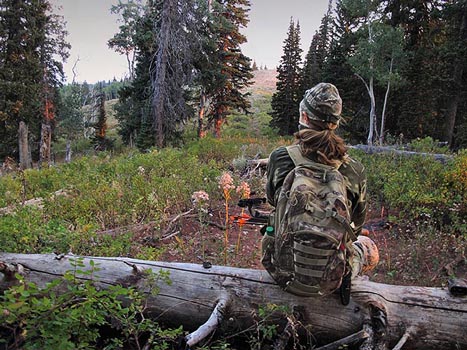
After traveling a ways, my stomach grumbled. I sat down on a huge deadfall log and snacked on trail mix while pondering these new woods. Eventually I fished out my hunting journal and scribbled a short note about hope and opportunity, the only positive words the book had seen in some time. My contentment was short-lived, however, when a swishing sound erupted in the trees. I whipped my head around to see antler tips poking slowly through the trees. In one motion I snatched up my bow and slid off the backside of the log and onto my knees. Smoothly and quickly I knocked an arrow and clamped my release to the string. I crouched low and stared fixedly ahead like a lion in ambush.
Ten yards and closing, the buck’s big, blocky, horse-like head appeared with tall, heavy antlers extending upwards into the canopy. Lazily, he angled down the game trail I had just been on. When his head disappeared behind a clump of trees, I drew my bow. He stopped. My heart pounded wildly, my eyes protruded from my skull, glaring through the bowstring. Time slowed down.
The buck remained motionless and hidden behind the trees just a few steps away. Did he hear me draw? A minute passes. My muscles start to fatigue and my arms begin to shake. Another minute passes. He knows something isn’t right. I beg my arms to hold, but the bow finally collapses, yanking my trembling arm forward.
Looking to completely ruin my day, the buck immediately starts walking again. With all my might, I crank the bow back again. His head appears five yards away, then his shoulder. My eyes, strained and blurry, fight to settle the pin as it dances all over the place. My release triggers and the arrow flies; but it flies clean over the buck’s back and my heart sinks into my stomach.
The buck bounds into another opening just seven yards away and looks back. Crouching lower I pull another arrow and load it as quickly as I can. He’s still there, muscles taut, ready to blast out of my life forever. I can’t watch. My eyes squeeze shut as I draw the bow again and rise up on my knees once more. When the string touches my nose, my eyes flash open. He’s still there and my second arrow is on the way.
Success!
My tall-antlered 2016 Idaho buck.
Final Thoughts
Success has taken on a new meaning for me now. Many nights of delicious venison backstraps have passed while trying to figure out how to tell the story of my tall-antlered Idaho buck. Is it a story of a failed Monsterbuck hunt, or is the miraculous success of an incredibly short hunt in new lands? Perhaps neither. I think it’s really a story of self-examination, of finding my true passion again.
As a hunter I’ve come full circle. Long ago I just wanted a deer—any deer—with my bow. It seemed like such an impossible task back then. These days are spent tirelessly chasing 200-inch monsters around the hills. But “trophy hunting” has lost some of its magic. In trying to prove myself, I’ve gradually reduced my greatest passion down to inches and strategy. My once insatiable love for the woods feels more like work now. Perhaps it’s time to hunt for the love of hunting again… We’ll see.
All I know for sure is that I keep relearning the same lessons I’ve been learning all along: That success is so much more than just killing a deer. Success really lies in the journey. Success comes from pushing yourself to your physical and spiritual limits, and then letting nature take over from there.
This story, then, is a simple one to tell: One man, one mountain, one morning, and a second chance.
Finally, a year later I’m letting the buck out of the bag. Actually I never bagged this buck to begin with, so unless someone else has, he’s still out of the bag.
Either way, this amazing 200″+, Northern Utah mule deer buck haunted me every day since the 2015 season. I promised myself never to obsess over a buck again, but not a single day went by for the entire year that I didn’t think about it.
The pictures in this article were taken from a video I shot at from 200 yards away. At the time, he was surrounded by three other deer and there was no way to get closer. So I let him walk, thinking I might get a better opportunity the next day. But he had other plans and disappeared.
A sentinel buck that accompanied my buck.
Like most big bucks, he changed his routine and kept me one step behind him until the season ended.
Hoping to get a second chance in 2016, I spent nearly 20 days looking EVERYWHERE for him–high and low– but he was nowhere to be found. He’s gone.
If you happen upon this tremendous buck, please give him my regards and tell him I miss him.
A look from behind.
P.S. Despite the great heartbreak and strife of my 2016 bow hunt, I was still able to score on an impressive Idaho buck. Here’s the story link ——–>>> http://zenbowhunter.com/a-second-chance
The next two articles address the future of hunting and the changes I predict will happen to both hunters and their prey through the natural process of adaptation and evolution.
The Future of Hunting (Part 1)
Rest assured hunting will change in the future, just as it has been changing rapidly over the last 30 years or so. The three primary factors driving these changes: a) an exploding human population, b) the development of super high-tech hunting equipment, and c) the hyper-adaptation of prey-animals which is necessary for their survival, especially concerning elk and deer.
What’s been occurring, and will continue to occur is a split–or chasm–between hunters and super-hunters. Hunters will either do what it takes to get a buck, or they will fail most of the time. Most hunters can be divided into two camps depending on their priorities. These two camps are: a) Super-hunters dedicated to the sport and willing to spend tremendous resources for trophy-class animals, and b) Fair-weather hunters who spend little time afield, hunt mostly for fun rather than food, hunt mostly on weekends, and are happy with any deer, whether a spike or a 4-point.
A similar split is occurring between regular deer and super-deer. This means there will be isolated groups of less experienced and less pressured animals that react much like their ancestors did and get shot. The rest will adapt quickly to modern hunters, developing much more specialized bodies and evading the average hunter for life.
Here are some of the changes I predict will occur, or are already occurring, in today’s deer and elk:
Future Changes in Deer
Deer will become completely nocturnal. The reason you see more deer at evening and morning is because they’re most active at night. But if left undisturbed, deer will occasionally rise and feed during the day. In the future, not so much. Deer’s eyes are already adapted to see well at night, but in the future I predict that their eyesight will become further specialized to low-light conditions. The trade-off is that their eyes will become highly light-sensitive, causing them to bed even farther into super-deep/dark timber and never emerge until it’s completely dark. I’ve already witnessed deer doing this in high-hunter pressure areas. So much for seeing deer early and late.
Deer will grow narrower racks. This is already the case in places like Oregon and Washington where bucks live in dense timber full time. Since the popularization of the long-range rifle, I’ve noticed that deer in the Intermountain West the previously fed in the open are now spending more time in the thick timber. And since a wider rack impedes their movement, their antlers are already becoming narrower.
Deer will grow longer legs, similar to elk. Deer naturally have a difficult time moving through deep snow; basically anything over 30 inches. Thus, they are forced to winter on lower elevations. The problem is that humans are developing on most winter range elevations, especially here in Utah. This makes them highly susceptible to death via highways, dogs, poachers, destruction of native forage, and other wintertime stresses that force them to burn through fat reserves. As this is a fairly recent phenomenon, deer haven’t had time to develop bigger bodies and longer limbs which would allow them to winter at much higher elevations; but they will, eventually!
Deer will grow bigger hooves. Until recently, deer haven’t had to live in very cliffy or rocky terrain. But they are starting to. With increased pressure, dwindling habitat and the threat of long-range rifles, deer are increasingly forced into some very unnaturally rugged terrain. My brother-in-law Josh actually found bucks living in and around caves in the unit where he hunts. Have you ever noticed how small a deer’s hooves are compared to cliff-dwelling species such as sheep or goats? As a taxidermist I’ve had the opportunity to compare various characteristics between species. Sheep and goats have approximately the same body mass as deer, but their hooves are nearly twice as big. Other than size, another interesting difference between deer and goat hooves is the foot pad. The footpad of any hooved animal is made of a softer, cartilage-like material. But the goat’s hoof is much softer than the deer’s which allows goats to grip onto rocks easier. I predict that deer will develop not only bigger hooves, but softer ones too.
Deer will grow bigger brains. Any trophy hunter already knows how incredibly smart today’s bucks are, but they will become smarter yet! This is a simple law of nature: survival of the fittest. As humans develop smarter hunting technology, the deer will be forced to adapt. In a previous article I wrote about the different and ingenious ways that deer have adapted to hunters in just my lifetime. Big bucks are using higher levels of intelligence to evade hunters. Some examples include using does as security buffers between open feed and tree line, moving into non-deer habitat such as caves, and using complex sentinel-based security systems.
Future Changes in Elk
Now let’s look at future changes in elk:
Elk will become mostly silent, like deer! After just a few decades of calling to them, big bulls are becoming increasingly less vocal. This is the basis of the relatively recent “silent calling” technique, wherein modern bulls often approach a caller without calling back. Thirty years ago it was easy to bugle up a bull. Now that bulls have wizened up to bugling techniques, we’ve switched over to primarily cow calling. But even this technique is becoming increasingly ineffective. Smart bulls now distrust any calling and rely instead on wind and scent before coming to a call. Simultaneously archery equipment has become far more efficient, forcing bulls to hang up farther and farther back. Now I predict a time when elk are completely silent and use scent and wind direction to rut around, just like deer already do.
Elk will grow narrower and smaller racks. Just like deer, elk will move deeper and deeper into thick timber and will therefore be forced to grow narrower racks for easier travel through dense timber.
Elk will grow bigger ears. Relative to their body, elk ears are fairly small, albeit efficient. But just like their mule deer cousins, there’ always room for bigger ears. Since elk will become more timber-dwelling, and since sound doesn’t travel nearly as far in thick forests, elk will need bigger ears to locate both danger and other elk.
Elk will develop better vision. Elk and deer eyes are practically the same: good night vision, wide field of vision, and sensitive to movement. But deer species’ eyes have two major weaknesses: a) they can’t see the color red, and b) they can’t see fine detail. This is why an elk can’t see you standing five feet away, unless you move. Of course they use their noses to make up for this shortcoming, but their eyesight has room for improvement. In the future I predict elk and deer will either develop the ability to see a broader color spectrum, and/or their eyes will evolve to see better detail.
Elk will have smaller bodies. During the last ice age, animals had much bigger bodies which allowed them to survive better in low temps, move through deep snow, and evade larger predators like the saber-toothed tigers. After the ice age, animals got smaller. Today’s elk are much larger than most other western big game animals. This is advantageous during winter, but for the rest of the year it hinders them in two ways: a) they need to water more frequently, and b) they need to eat more food more often. As any predator knows, it’s much easier to ambush an animal that’s feeding and watering. Unlike deer, this makes hunting elk over water a viable option. Also, because elk are grazers rather than foragers, it’s easier to predict food sources and travel routes. In the future, smaller elk won’t need to water as often and will likely adapt their stomachs to include browse-type foods such as forbs/shrubs/etc. As a result, they will bed earlier, rise later and probably become completely nocturnal as well.
Elk will grow smarter. I suppose they’re already kinda smart, but they’re getting smarter yet. Last year, while hunting with my wife, we called up a herd bull by using an estrus call. The bull came stomping in, and then, just before showing himself, pushed two cows right through us. When the cows passed the shooter they picked up her scent and bolted taking the bull with them. This well-thought-out security measure worked perfectly. In the future I predict elk will develop even more sophisticated security techniques to avoid hunters.
Conclusion
For all of evolution, both predator and prey were forced to adapt to each other to survive. In today’s world, finding and harvesting a trophy animal is getting increasingly more difficult each year. Today’s deer are ingenious survivors capable of adapting to us and evading us no matter what we throw at them. It just proves that technology isn’t the answer.
On the flip side, we should be thankful that our beloved deer are such brilliant survivors. Otherwise there wouldn’t be anything left to hunt.
Stay tuned for the next article where we analyze the future of hunting and the division between hunting camps. I think you’re gonna like it.
Novice hunters think there are two kinds of deer: spooked deer and un-spooked deer. What they learn over time is that there are many different levels of alertness.
If you get a chance to watch a relaxed deer in his summertime routine, you’ll notice that his ears are low, his eyes are calm and staring straight ahead, and he holds his head in a low and relaxed fashion. An alert buck is the opposite: his eyes are wide, his ears are forward and his head is erect and staring. Now, somewhere between these two opposites is where bucks reside most of the time.
As opening day rolls around, the majority of bucks already know it before the first shot is fired. They’ve heard the trucks and ATVs rolling in and can smell the campfires. Even before hunting season, a buck’s internal clock alerts him to impending danger of upcoming hunting season just by the angle of the sun. Any buck who has survived a few hunts knows that danger starts showing up at the beginning of autumn. Even worse, if there are lots of natural predators around—like cougars and coyotes—then a buck is already living in a state of high alertness at all times. This makes them even more difficult to hunt.
On high-pressured public lands, big bucks live full-time on a heightened level of alertness. Therefore, an accurate assessment your target buck’s alertness level will dictate your approach. For example, if a buck is bedded and alert, then you must be more cautious than when he is dozing off.
Over the years I’ve developed a rating system for assessing a buck’s different levels of alertness. A level 0 means the buck is carefree and happy with no pressure from predators. A level 5 means he’s turned inside out and running for his life. Your job is to figure out what level the buck is on, and adjust your approach accordingly. The following is my alertness level assessment system:
Levels of Alertness in Deer
Level 0
Level 0 is very rare, and basically means the buck isn’t alert at all. This only occurs in totally unpressured areas—such as unhunted private property or very remote country. It can also occur pre- or post-hunting seasons after the buck has calmed down and is in a relaxed routine. Level 0 also assumes that there are very minimal natural predators in the area.
Level 1
The hunting season has begun, but the buck is bedded in a far-away, secure area with the wind at his back. His eyes are closed, ears are pinned back, and he’s chewing his cud. Or maybe he’s sleeping with his chin flat on the ground. Otherwise, he’s up and feeding with a small group (for security). His head remains buried in the bush for long periods of time and he expects little or no threat of danger. Or perhaps he’s completely pre-occupied while rubbing a tree or sparring with another deer in a pre-rut state and doesn’t bother to look around for danger. This is an ideal situation for a stalk.
Level 2
The buck is bedded but his head is up and watching for danger. He may have heard or smelled something, but he’s not 100% sure. Maybe there are predators in the area. Or maybe he’s feeding sporadically and lifts his head frequently to scan for danger. Also, any buck that’s on the move–like when he’s traveling to a bed or feed—will be on a level 2 (or above) because deer are always alert when traveling.
Level 3
This is an alert buck scanning for danger. The buck heard, smelled, or saw something out of the ordinary. He’s staring in a particular direction for a prolonged period of time. This is often the case when a squirrel fires up, when forest birds go silent, or when there’s increased road noise in the area. He might be standing up in his bed to have a look around. His head is high and his muscles are tense. In the back of his mind he’s planning the safest possible escape route. However, if the threat doesn’t materialize he’ll likely go back to bed or feed.
Level 4
The buck is tense and ready to bolt. His eyes are wide, head is high, and his ears are pinned forward. A hunter who has sky-lined himself—even at a great distance—almost always triggers a level 4 response. Or maybe he caught your movement or scent, or heard an un-natural sound nearby, like the clanking of an arrow or a breaking twig. Either way he’s not sticking around. The hunter is pinned down and unable to move. If you can’t get a shot soon, he’s gone.
Level 5
The buck explodes from his bed at close range, scaring you half to death. It’s all over; dust and butts are all you see. The buck saw or smelled you and confirmed the danger. He probably hunkered down in terror at first—until you were almost on top of him—his nose twitching, eyes watering—then blasted out of bed. He’ll likely run non-stop for a mile and you won’t see the buck again this season.
Final Assessment
In the future I urge you to practice assigning levels of alertness to the bucks you encounter. It’s fun and can be a handy tool in judging a situation ahead of a stalk. When watching deer with my wife, I’ll frequently assess a deer’s current level of alertness. She probably thinks I’m some kind of obsessive buck-nut, but I find it helpful nonetheless.
I’m a trophy hunter. On average I spend around 25 days per year beating myself up in the mountains just for a shot at a giant trophy buck. Most years I come home empty-handed, but what can I say; I just love hunting giant bucks! In this article we’ll explore the pros and cons of trophy hunting.
Trophy hunters sometimes get a bad rap, especially from non-hunters who sometimes refer to us as “head hunters.” Their assumption is that we hunt down and kill these majestic critters in cold blood, and then saw their head off and go home. This might be the case for a misguided few, but the hunters I know value the meat as much as the head.
This negative attitude isn’t just held by ignorant anti-hunters, but by other hunters as well. I was conversing with a fellow hunter once about the decline of big bucks over the years. Knowing that I was a trophy hunter he said, “Well, if people wouldn’t shoot all the big ones, there would be more around.” At first I thought he was kidding, but he wasn’t. I responded, “Isn’t that the point? To take the biggest buck you can?” I don’t remember his ignorant response.
A Case for Trophy Hunting
Aside from the large quantity of meat that trophy bucks provide, I don’t think there is anything more beautiful and majestic as a trophy mule deer buck with a massive rack. And since I only get to hunt one deer each year, why not make it something special?
But the best part of chasing trophy bucks with a bow is the extreme challenge it offers. Nothing tests a hunter’s skills like chasing trophy bucks on public land. The reward is so great that I won’t even think about pulling an arrow until I’ve verified a genuine superbuck. Each year my mantra is “One tag, one year, one superbuck.”
A while back I began pondering the ethics of trophy hunting. What were the pros and cons of trophy hunting? Is it more helpful or harmful to target trophies? As it turns out, trophy hunting is very beneficial, not only to deer herds in general, but to non-trophy hunters as well. Here’s what I discovered.
Trophy hunting does the following:
Provides more meat to fill the freezer and feed the family. Trophy heads come with trophy bodies and that means lots of venison. A mature buck weighs twice as much as a yearling.
Removes old, declining, and territorial bucks from the herd. This in turn allows more opportunities for young buck to reach maturity.
80% of bucks five years and older will die of old age, not hunter harvest. Since these bucks are essentially unhuntable for the average hunter, then the trophy hunter doesn’t compete directly with non-trophy hunters.
Even veteran trophy hunters fail to harvest a trophy buck more often than not. Because trophy hunters aren’t shooting as many deer, it leaves more animals in the field which in turn provides greater opportunities for other hunters.
Trophy hunters spend more days afield than the average hunter. This equates to a richer hunting experience, in my opinion. This is probably the best part of being a trophy hunter.
Don’t be a “baby killer!” Being a trophy hunter means you’re not killing yearling or two -year-old bucks. Unlike older bucks, young bucks haven’t learned the art of evasion, so killing them isn’t really “fair chase” in my opinion. Several years ago there was a kill-anything mentality around our elk camp. On the last day of the season I had a young elk calf walk by at 20 yards. I drew my bow, but after looking at his cute, fuzzy face I just couldn’t bring myself to release my arrow. I got some razzing back at camp since “calves have better meat,” but shooting babies doesn’t seem fair to me.
Let’s not forget the greatest benefit of trophy hunting: A big, beautiful rack displayed on the wall in magnificent glory to serve as a life-long reminder of an unforgettable hunt! Nature really makes the best art.
Conclusion
In the end I can’t think of a single disadvantage to trophy hunting, well, aside from frequent failure. But oft-found failure is easily overshadowed by the occasional harvest of true monster-buck.
Has anyone ever told you, “Deer are where you find them?”
Maybe it’s a Utah thing, but I’ve heard that:
Deer are where you find them…
Gold is where you find it…
Fish are where you find them…
While scouting last weekend I found a group of big, blocky buck tracks in an unassuming area. Why were the bucks here?, I wondered. Were they moving from bed to feed, or vice-versa? Were they just migrating through? Was there low spot on the mountain that funneled them through here? I’m not sure, but I have my theories. If I can figure out why, then maybe I can intercept them during the hunt.
What does this have to do with hunting? Because wherever a deer is, he has a good reason for being there. Deer don’t take vacations, they don’t explore randomly, and they never wander aimlessly. If a deer is moving, he’s moving for a reason. Maybe he’s coming from feed or bed; maybe he’s trolling for a doe; maybe he was spooked by a predator and is following an escape route. Or maybe–God-forbid–he’s making random tracks just to throw you off! There are many reasons for a buck to move, and it’s your job as a bowhunting detective to figure out why.
Big buck tracks aren’t just pretty; they also hold valuable clues. For instance, if the tracks are meandering around vegetation, then it’s a feeding area. If the tracks are dug in, far apart, or appear to be running, then maybe it’s an escape route.
If the tracks are deep or appear to be dragging, then it’s probably a big, heavy, old buck. Maybe the tracks are old with debris accumulated in them, or new with sharp edges. You can pretty easily guess the age with a little practice. Also, what direction are the tracks pointing? Kinda important to know whether the buck is coming from or going to a certain area.
If I learned anything about deer over the years, it’s that they take things very serious–which makes them very un-human by the way. Everything a deer does, it does deliberately and purposefully. We can use this to our advantage. The important thing is that you get in the habit of asking questions, making logical theories, deductions, postulations, or just plain guesses. It’s better to wonder why a buck is somewhere than to wonder why he’s not. At least you have a starting point for the opener.
Nowadays when I hear someone say that things are where you find them, I cringe. It’s the ultimate cop-out. What I really hear is, “My brain is where I left it.” It means they’ve given up. They rely on sheer luck; no more thinking, no deducing, no more trying. Maybe they’ll stumble upon a big buck, but if not, oh well. It’s out of their hands anyway.
No one knows what really goes on in a buck’s head, but we can make some pretty good guesses which will lead to more success and more venison in the freezer. Feed, bed, water, migration routes, escape routes–all of these things should be running through your head. The next time you run across some big buck tracks, do yourself a favor and start asking questions. Lots of questions.
What is a big buck’s highest priority, Food or Safety?
The answer is SAFETY!
In the first edition of my book, Zen Hunting, there’s a slight discrepancy. In one chapter I say the buck’s highest priority is food, and in another chapter it’s safety (or survival). The 2nd edition attempts to separate the two, but it’s really impossible.
The problem comes from real-life observation and experience.
First, a buck can’t survive without daily food intake. I cited David Long’s observation that bucks can’t even stay bedded for the entire day without occasionally getting up to feed. However, while hunting the Utah-Cache unit for three years in a row, I observed that big bucks never up and feeding during daylight hours. As an example, the four times I busted the infamous Droptine buck, he was bedded. Never was he on his feet during daylight hours.
What it comes down to is hunting pressure. As soon as hunters file into the woods, the bucks become completely nocturnal. You’ll still find plenty of tracks and sign because they are indeed feeding at night, but nowhere is a buck found feeding during the day. Bucks simply adapt to a nocturnal lifestyle that negates daytime feeding.
This makes perfect sense. The bucks of Monte Cristo are the smartest I’ve seen. If it comes down to eating or starving to death, the bucks will gladly starve to death. But they don’t really have to because they’re feed at night, and only at night. In this example safety far outweighs eating.
The hunting pressure on Monte is ridiculous and has been for decades, yet there are still trophies haunting the woods (and my nightmares). As I put it in my book, “These are the neurotic decedents of lone survivors.” It’s simple adaptation; survival of the fittest. The bucks that feed during the day get shot!
I’m certain that there are plenty of other areas where big bucks wander around, stuffing their faces with vegetation during the day. I’ve even seen it in Central Utah, but not up north.
Since I’ll be hunting Monte again this year, it’s my job to figure out how to approach these deer differently to beat the odds. I’ve done it before, and here’s how I’ll do it again:
Hunt the opener. In my book I have a whole sub-chapter entitled Never Hunt the Opener! My thinking has changed a little since then. It’s true that on opening day most bucks have already noticed the increased traffic/ATV noise and bailed onto secondary ridges or deep, dark, holes. But I realize now that there are always a brave or stupid few that will wait until they actually see a camo-clad dude before bailing out. These bucks are still in their summer routine and therefore huntable. My best chance is to catch them on the opener.
Hunt mid-week and late in the season. After opening day, my plans change. Since I work most weekends, I can schedule my hunts between Tuesday and Friday. I’ve found that the best day to hunt is Thursday. After the weekenders terrorize the deer, it takes half a week for them to calm down. By Thursday they feel more secure and let their guard down. Therefore your best odds are Thursday and into Friday before the weekend warriors come smashing back into the hills. Also, the hunting pressure falls off dramatically during the last couple weeks of the bowhunt, making September the best time to be out.
Hunt the Beds. The most difficult thing in the world is hunting big bucks in their beds. First you have to find their beds, preferable while pre-season scouting. Big bucks use multiple beds, so you’re not just looking for one bed. Second, these beds are generally found in deep and steep cover and perfectly situated to detect predators from a distance using wind and terrain. It is possible to hunt deer in their beds using ambush techniques or a super-stealthy still-hunting approach, it’s just not probable.
Hunt the Secondary Ridges: After opening day I will bail off the top and start hunting secondary ridges and deep, steep areas. By then I’ll have multiple backup areas that I’ve cataloged from my diligent scouting trips. It sucks dragging a deer up miles of vertical slope, but there’s no other option.
The methods you use to hunt big bucks is relative to the amount of hunting pressure the area gets. Once again, you must understand the nuances of your prey and adapt yourself as a predator. In high-pressure areas remember, Safety First! Big bucks only care about surviving.
That’s all there is to hunting high-pressure trophy mule deer. Well, that and a ton of luck.
Esther and I hit the top of Monte Cristo over the weekend. The snow subsided enough to get above 8000 feet. We spent the first day beating the mountain to death and exploring a promising new area completely devoid of deer. Driving back to camp we spotted these bucks on a hillside.
It’s still early, but the monsoons of May have the bucks growing promising antlers. The two bucks on the left are likely two-year-olds, and the buck on the right is a mature buck with a potential outside spread of 22 inches or more.
The bucks didn’t stick around long for pictures, but that’s okay. Just seeing bucks in the Cache unit made us hopeful.
Here’s the lessons we learned on this trip:
The Cache-Monte unit still sucks.
The biggest bucks are still on lower elevations. Although we found signs of large migrating bucks, most are still lower on the mountain and following green-up up. They won’t be high until the heat and mosquitoes push them up.
Promising new areas weren’t as promising as we hoped, even far off the dirt road. You have to cover many miles of empty woods just to locate a few small patches that regularly hold deer.
Just one word of caution: The high elevation roads still have patches of snow and deep mud, and we almost got stuck a couple times. Not far from camp we ran into this abandoned Hummer-in-a-bog, sunk up to the axles. The poor fellas were able to winch it out the next day, but it just goes to show you that no vehicle is safe from the muddy clutches of the mountain.
The Big Game Draw results are in: unsuccessful for Mountain Goat and limited entry Deer, but successful for general Buck Deer…in my 5th choice unit.
After arrowing the infamous Droptine buck in 2010, I vowed never to hunt the Cache unit (Monte Cristo/Unit #2) again. There are simply too few bucks and hardly any trophies. But with so many hunters in Utah now, I can no longer hunt where I want to, even with a bow. For a guaranteed tag, I always put Cache as my last choice. Since no one in their right mind actually wants to hunt the Cache unit, it’s a guaranteed draw.
Well, I’ll make the most of it. And when it’s all over, I know I will be standing over a huge Pope & Young buck, but man, it’s gonna take some work. In order to succeed, I’ve already begun scouting. I’ll continue scouting this bleak unit every chance I get until opening day in mid-August.
The Cache unit is relatively HUGE. What it lacks in quality deer, it makes up for in quantity area–miles and miles of pristine forest and mountains, mostly devoid of wildlife. It takes a lot of time and effort to thoroughly scout an area this big.
A couple weeks ago, when the higher elevations were still snowed in, Esther and I scouted some obscure lower elevations. I quickly learned that you had to get at least a mile away from the dirt road to find any deer. We finally found a pod of eight deer in a steep feeding swathe between aspens. It was too early to see antlers, but it looked like a promising new area.
Pre-season scouting doesn’t require actually seeing deer. It’s more important to look for sign: large tracks, tree rubbings, and especially good feeding areas. Remember the old adage: Where you find the best feed, you’ll find the best bucks. Grab a topo map and locate potential feeding areas on the east and south-east facing slopes near steep, timbered bedding areas. Bucks love to bed near feed, especially early in the year when there’s little pressure.
Successful scouting means continually seeking out new areas. Hunting pressure quickly pushes bucks out of prime areas, so you’ll need multiple backup areas. Be sure to scout the secondary ridges. These are the lower or middle ridges where bucks feel safe. On Monte Cristo the main roads follow the top and bottom of the mountain. But in the deep, dark interior, bucks feel safe.
Although I wasn’t inspired to pull out my camera and document our first antlerless deer sighting, I considered this trip a good learning experience. The biggest lesson was how much more area I still needed to cover. A second scouting trip was quickly planned and executed (see tomorrows post with pictures!)