The Learning Meadow: My Son’s First Deer

jake

My Son’s First Deer

Three years ago I took my son Jake to the Sawtooth Range in Northwestern Utah for his first muzzleloader deer hunt. It was a bust. There were too many people and not enough deer.

While bowhunting on Monte Cristo last year I stumbled upon a promising new area that few people know about. There’s a secret meadow there, on a steep slope surrounded by dense woods. The  first time I came across this meadow I found a nice 3-point buck feeding leisurely along. I passed up this buck in hopes that he would still be there for Jake’s fall muzzleloader hunt.

In September of 2011 I took Jake to that little meadow, but lo, there was no 3-point. Instead, there was a giant, heavy racked 4-point bedded on the opposite side of the meadow’s edge. At the same instant we spotted him, he spotted us and stood up, offering a perfect broadside shot at only 75 yards.

Well, Jake had only practiced shooting square targets, and as much as he struggled to get this mighty beast in his sights, he just couldn’t do it. Frantically, I whispered, “SHOOT, SHOOT, SHOOT, SHOOT…” But didn’t. Instead, the buck turned and disappeared into the trees.

At that point I almost blew my lid. “Why, WHY didn’t you shoot?!” I implored. Jake replied, “I couldn’t see it in my sights good enough.” I wasn’t entirely sure what that meant, but what could I do? I was a frazzled mess as we trudged back down the hill towards camp. The next day was a bust and we went home empty-handed.

The following year, in spring of 2012, I went to Sportsman’s Warehouse and bought Jake a life-size, cardboard deer target. Never again would we shoot at a square paper target. A square target looks nothing like a deer or anything else you might find in the wild. So, he practiced on that deer-shaped target during the summer as we made plans to return to Monte Cristo and our secret little feeding meadow in fall.

On the second evening of the hunt, we climbed up the mountain and sat in the trees at the edge of the meadow. Just as the evening light was fading, we heard a rustling in the brush. Sure enough, a respectable 3×4 buck with tall antlers slowly materialized at 75 yards away. It wasn’t the same great buck as last year, but it was just fine for us.

Jake got into shooting position, but the cover was too thick for a shot. Fortunately, the buck continued feeding along right towards us. At fifty yards the buck suddenly jerked his head up as it recognized us as humans. Jake was ready and shot. As the smoke cleared we could see the deer prancing down the hill unscathed.

We walked over to where the buck was standing and there was no blood. Jake missed, plain and simple. This time I wasn’t upset and just asked him what went wrong. After thinking about it for a minute, he figured he must have dropped the gun at the shot, causing the bullet to travel beneath the buck. In other words, he didn’t follow through. At that moment, the feeding meadow would forever be called, “The Learning Meadow,” as Jake was learning valuable lessons there with each trip.

The next day, there were no bucks anywhere near the Learning Meadow. Another lesson: You can’t shoot at a deer one day and expect him to return the next.

On Monday, we sat in a promising new area with lots of deer sign. But Monte is a tough place to hunt and we saw not deer. Shooting light was fading fast when we decided pack it up and move uphill towards the Learning Meadow. Maybe we’d catch a last minute buck in the open. As we approached the top of the draw opposite the Learning Meadow, a deer suddenly jumped out of the trees in front of us and bounded across the open sagebrush hillside.

Right away, I could tell it was a buck; a small buck, but a legal buck nonetheless. I asked Jake if he wanted to shoot it, and he said yes. Unfortunately, the buck was bounding directly away from us and offered no shot. Jake dropped to one knee while I set up the shooting sticks in case it stopped. Near the top of the ridge, 120 yards away, the buck paused and turned broadside to look back at us. Jake was ready. Through a cloud of white smoke we watched the buck drop straight down like a sack of potatoes. Neither of us could believe it!

Jake’s eyes were wide with excitement as he stood over his beautiful trophy. I congratulated him and told him I was proud. The buck fell only a hundred yards from the Learning Meadow. Later that night, we dragged that little buck right through the Learning Meadow on our way back to camp. We took a break there. The meadow was dark and mysterious, but the lessons Jake learned were still there, burning bright as day.

Step #4: Releasing the Arrow

How to Release an Arrow:  Traditional Recurve and Compound Bow

In this lesson you will learn how to properly release an arrow.

Nocking an Arrow with Traditional Bows

The end of the arrow has a notch in it called an arrow “nock”. The nock attaches to the string just below the “nocking point.” The nocking point is a fixed point on the string that aligns the arrow with the bow for every shot. On most bows, the nocking point is a small brass bead clamped onto the string. The arrow attaches–or nocks–onto the string right below the nocking point. (see photo below)

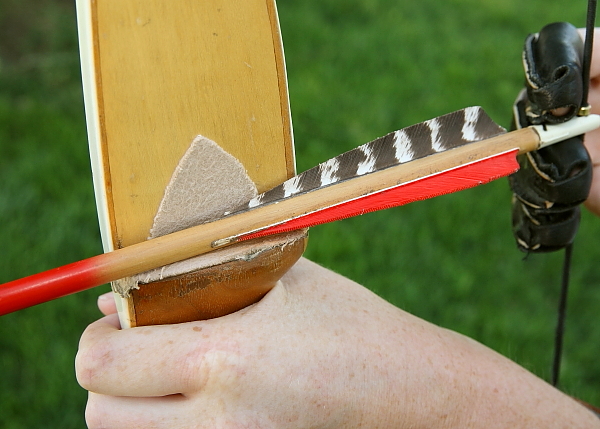
With traditional archery (longbows and recurves), the arrow has three feathers One feather is a different color and is called the “cock” feather. When you nock an arrow, be sure the cock feather always points out, away from the bow. This keeps the feather from deflecting off the bow. (see photo below)

003
Odd-colored feather always points out.

Nocking an Arrow with Compound Bows

With compound bows, the orientation of the cock “vane” (compound bows have plastic vanes instead of feathers) depends on your arrow rest. The most common arrow rest for compound bows is the drop-away rest. With drop-away rests, the orientation of the cock vane isn’t important as there is no contact with the bow.

With shoot-through, containment style rests like the Whisker Biscuit (as seen below), the cock vane must point upwards. The Whisker Biscuit has stiff bristles on the bottom that support the arrow.

031
Compound bow with a Whisker Biscuit arrow rest. Notice how the cock vane points upward to avoid contact with the lower stiff bristles.

Anchor Point

The next step is to acquire an “anchor point”. Anchor points are two or more spots on your face where your release hand or string comes in contact with your face. Anchor points are vitally important to consistent shooting and accuracy. Therefore you must establish consistent anchor points from the outset.

Anchor points are different for everyone, but most commonly are:

  • the string on the tip of your nose
  • a finger touching the corner of your mouth
  • side of thumb touching your jaw bone
  • arrow fletching touching the face

When shooting a compound bow I make sure the string touches the tip of my nose and the side of my thumb touches the back of my jaw.

On traditional bows, the string touches the side of my nose and my first (or middle) finger touches the corner of my mouth.


023
Compound bow anchor points are: String on nose and thumb at back of jaw bone.
007
Traditional recurves bow anchor points are: String touches die of nose, finger touches corner of my mouth.

Note: Many beginner students are afraid to have string contact with their face. This is totally unwarranted because when you release the arrow, all the energy leaves your face unscathed.

Now we are ready to shoot an arrow!

How to Release the Arrow

Here are the steps to releasing an arrow:

  1. Nock an arrow on the string below the nocking point. You should hear a soft “click” as it locks onto the string. On compound simply attach the mechanical release aid to the D-loop.
  2. Grasp the string with three fingers. Your three fingers will hook onto the string at the first joints of your fingers.
  3. Pull the string across your chest, not towards it, and align the string with your eye. Essentially you should split the target with the string and look down the arrow to aim, but keeping your focus on the target, not the arrow.
  4. Back tension release: As you draw the bow, your back muscles are doing all the work. Squeeze your shoulder blades together as you bring the string to your face. At the same time, you are pushing the bow forward with your bow arm.
  5. Establish your anchor points on your face.
  6. Aim with the point of your arrow while looking through the string at the target. With a compound bow, place the appropriate sight pin on the target.
  7. Release the arrow by simply relaxing and opening your hand. With compound bows you simply touch the trigger of the release.
  8. Follow through. Follow through means that both arms (bow arm and release arm) continue in opposite directions on the shot. This is called “finishing the shot.” Your release hand should continue straight back towards your ear. The last thing you should feel is your release hand brushing past your face and touching your ear. This will reduce oscillation and increase accuracy.
007
Anchor, release, and follow through.
011
Traditional bow follow-through: Hand brushes face and stops at your ear.

 Final Thought

Archery is a complex skill that cannot be mastered in a day, any more than other muscle-memory skills such as golf or skiing. In the movies they make it look easy, and many of my students have the misconception that they can simply pick up a bow and start hitting bullseyes. But without spending a lot of time on the basics, you’ll immediately develop bad habits which will take a long time to break.

Accuracy comes by focusing on each step, one at a time. After many hours–maybe even months–these steps will gradually become one subconscious step called form. Once proper form is established, your only focus will be on aiming. This is should be your goal.

For previous steps on the archery shot sequence, see:

Step #1: Proper Archery Stance

Step #2: Gripping the Bow

Step #3: The Release