As a dedicated bowhunter, the thought of driving dirt roads and looking for deer runs counter to everything I love about deer hunting. It took a dreary year like 2020 to push me to such detestable methods.
I beat myself ragged trying to find a buck in Utah that season. My usual public land area was swarming with stir-crazy city-folk fleeing the pandemic. All that commotion in the mountains drove big bucks back to their private land haunts and my hunt ended in failure.
Off to Idaho
When the hunt ended I turned my attention to Idaho where five years earlier I took an incredible trophy buck. With high hopes Esther and I loaded the truck and headed to Southern Idaho for last two weeks of bow season.
Upon arrival I was dismayed to see my beloved deer unit overrun by thousands of sheep. Severe drought and waves of sheep had decimated the deer habitat, and for ten days I couldn’t to turn up a single good buck. With only three days left and desperate for meat, I decided to take a doe.
Doe Hunting
I’d seen plenty of does running around, and I expected an easy, one-day endeavor. Boy was I wrong. On the evening of the 28th I hiked up a ridge with plenty of deer sign. A group of six does appeared feeding on a steep, wooded slope.
Just as I entered bow range, a woodpecker flew into a dead pine tree next to me. There was a small crack, and then a large branch came crashing to the ground next to me. Not surprisingly, the entire doe group spooked out of the area.
No problem, I still had two days left.
More Bad Luck
In the morning I headed back up the mountain. I was slowly picking my way through a patch of dry brush when a group of does appeared in front of me. I crouched down quickly and pulled an arrow. The wind was perfect and the does were oblivious to my presence.
Suddenly, the whole herd exploded in all directions and ran away. Flabbergasted, I stood up to see a pack of coyotes filtering through the brush. I was enraged and I launched an arrow at one of the intruders, but my arrow skipped off a branch and missed.
Perhaps I was trying too hard. It’s just a doe, after all! That evening I set up ambush on a roadside waterhole. Earlier in the hunt I’d seen deer near the water and figured it would be a good ambush spot.
The mountain was falling into shadows as I sat motionless 30 yards from the water’s edge. The pond was surrounded by trees, so a deer could approach from any direction.
I was lost in thought when I heard a light crunch behind me. Slowly I turned my head and saw a big doe pop out of the trees just 10 yards away. Before I could raise my bow, the doe snorted and bounded off. Of all the places to sit; what terrible luck! With only two hours of light left I called Esther to pick me up.
A Time to Road Hunt
No more mister nice-guy; desperate times call for desperate measures. Creeping around the cruel woods and sitting water had proved fruitless. It was time for some good old-fashion road hunting. Everyone knows that deer are much less concerned by slow-driving vehicles than camo-clad hunters.
We pulled onto a side road next to a big mud puddle left over from a past rainstorm. I didn’t think much of it because there was a camp full of drunken miscreants nearby blasting hip-hop music over their smoky campfire.
You can imagine my surprise when I spotted a lone doe standing on a hillside 100 yards away and looking longingly at the water. Clearly she was waiting for darkness to make a quick water run. With this in mind, we drove a short distance up the road. Once out of sight I hopped out and instructed Esther to drive further up the road and wait.
Racing against nightfall, I dropped into the timber and backtracked towards the water. It was so quiet that I couldn’t even shift my weight without crunching pine needles. Now I was stuck. I balanced my feet on two dried cow pies to muffle my footing and waited.
With only minutes of light left I began to wonder if the doe was going to show. Suddenly she appeared, silently weaving through the trees 15 yards in front of me. In a steady, slow movement I raised my bow and drew back.
The doe caught the end of my draw and jerked her head up in fright. Before she could whirl, my arrow was off, catching her in the shoulder. She spun around and crashed headlong into a Christmas tree, then got her feet and bounded away.
After confirming a good blood trail, I radioed Esther. Before I could get a word out she told about a doe she just saw by the truck.
“I don’t care about that, I just shot one! Come help me track it.”
Tracking Effort
The doe ran away so fast that the blood trail petered out quickly. The dug-in tracks led through the sagebrush and then crossed the dirt road, it’s hooves touching only once in the dust on the road before disappearing in some rocky terrain.
Three hours passed as we continually backtracked and crawled forward on hands and knees trying to find the next track or sign. We split up and wandered in ever-widening circles, but to no avail. How could this mortally hit animal elude us?
There was no choice but to back out and return in the morning. Coyotes howled in the distance as we walked back to the truck making me uneasy about leaving the deer overnight. Esther suddenly stopped and asked, “Hey can we just check one thing first?”
“What?”
“I wanna check where that doe popped out by the truck?” Could it be the same deer, she wondered?
I was doubtful, but the timing was uncanny. We turned around and walked back to the truck turnaround spot. On the way I interrogated Esther. “What was the deer doing? Was it running? Did it look hit?”
“No,” she replied, “It just walked out of the trees, saw the truck, and went back into the trees.”
“Well, we better take a look.”
Happy Ending
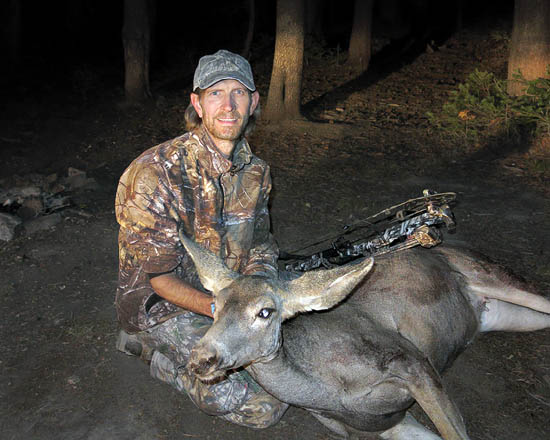
A minute later we arrived at the flat spot where Esther had parked. She showed me where the deer was standing, but there was no blood. Discouraged, we began walking in circles and you can imagine my surprise when I nearly tripped over the doe lying less than 20 yards from where she’d parked. What were the odds of my deer running 300 yards and expiring right next to the truck?
It’s been a long time since I’ve been proud of taking a doe, but that deer got us through the winter and was just what I needed after 37 fruitless days afield. As it turns out, adventure can be found just off the side of the road. Perhaps I won’t be so quick to disparage the fine art of road hunting in the future.
In 2016 I switched from a fixed pin sight to a one pin “slider” sight. That year I harvested a bear, deer, and an elk. I was sold on a one-pin sight, and for good reason. (Here’s the link to that article).
Then, in 2017, halfway through the deer hunt, my slider broke. The gears simply stripped out. Thankfully I had my backup bow in camp and was able to swap back to my old multi-pin sight.
When I got home I bought a slider sight and used it for a while, but it didn’t stick. Eventually I went back to my fixed pin sight and never looked back. In this article we’ll look at the pros and cons of using a fixed-pin (multi-pin) bow sight.
My TruGlo fixed-pin, composite bow sight.
Fixed Pin Sight Pros:
Fixed pin sights work with all bows and draw weights. But lower poundage bows aren’t always compatible with sliders. Especially at longer distances (usually over 60 yards) the sight housing adjust lower and lower until it actually comes into contact with the arrow or fletchings. What good is a single pin sight that can’t be dialed over 60 yards? This was the main issue I had while using a single-pin sight on my 60-pound hunting bow.
Unlike single pin sights, multi-pins don’t require extra hand movement when adjusting for moving targets. One-pin sights are great for stationary targets, but in the thick stuff you have to be ready for anything. Once you draw your bow, it’s not possible to readjust the sight if the animal moves, especially if it’s moving rapidly toward or away from you. Animals that move a lot—like bear, javelina, and turkey—are especially problematic with one pin sights. When hunting open terrain or when dealing with longer yardages—say 40 yards or more—movement isn’t a big issue because the animal is less likely to notice.
Fixed-pin sights don’t have moving parts. Once you’re sighted in, you just tighten down the screws and go. Moving parts can wear out or break easier than stationary parts. That’s what happened to me; my slider simply stripped out from normal use. And on a hunt no less! This is not acceptable.
Fixed-pin sights tend to be lighter than single pin sights. Slider sights with lots of working parts tend to be heavier than fixed pin sights. Of course accessory weight isn’t a big issue unless you’re already lugging around a heavy aluminum bow, or if you’re a backcountry bowhunter where weight is always an issue. Both apply to me, so using a lighter sight is better. My bare bow already weighs nearly 4.7 pounds, so accessory weight is a real issue. BTW, my favorite lightweight sight is the TruGlo Carbon XS Xtreme carbon-composite bow sight. At 4 ounces it weighs half as much as my old slider.
Now for the cons.
Fixed Pin Sight Cons:
The pins in a fixed sight take up more space in the sight picture. A long row of pins is not only distracting, but can block much of an animal’s vitals. It’s much easier to place a single pin on a small target than to wade through multiple pins, especially in a high-stress situation. However, using smaller diameter pins (.019 or smaller) mostly solves this problem
Shooting between the pins (aka pin gapping) takes practice. If you’re shooting heavy arrows and/or pulling a light draw weight, the pins on a multi-pin sight will be spaced widely apart. So shooting odd-yardages means shooting between the pins. This takes some practice to get use to. It’s much easier to just dial up the exact yardage and hold the pin on the target.
Selecting the right pin under pressure can lead to mistakes. This was the reason I switched to single pin sight in the first place. It’s rare that I select the wrong pin, but it can happen. And the more pins you have, the easier it is to make mistakes. That being said, mistakes are just as common with a slider sight. Anyone who has used a slider will admit to forgetting to move the pin from time to time. Mistakes happen with both sights.
Conclusion
There are pros and cons to using single- or multi-pin bow sights. The decision should be based on the type of hunting you do, your personal bow setup, and most importantly the sight you’re most comfortable using in real hunting situations.
In tournament or target shooting, I prefer a slider. In open country where long shots are the norm, I would definitely go with a slider. But in heavy cover or backcountry use, I’m more comfortable with a multi-pin sight.
Six years ago I swore I’d never go back to a fixed pin sight, yet here I am. What’s the lesson here? Never say NEVER.
I’ll never forget. Ten years ago I rounded a large fir tree and spotted a 180-class buck bedded in some deadfall at thirty yards and facing directly away from me. But before I could even pull an arrow, a nearby squirrel lit up with a world-class barking fit. The buck instantly stood up and walked into the deep woods without offering a shot. Since then, I’ve had innumerable stalks thwarted by these cursed tree rats, some ending entire seasons in failure by a single squirrel.
Aside from using other deer as sentinels, big bucks use a myriad of other forest creatures for safety too. As you travel through the woods you might notice that squirrels, chipmunks, and a variety of birds are continually announcing your presence. They do this to warn their own species of danger, but the deer pick up on their calls and use them to their advantage. Big bucks, especially, are completely aware of their surrounding and pick notice anything out of the ordinary.
How Deer Use Squirrels
If you’ve had the chance to observe many deer in the deep woods, then you’ve probably noticed that every time a squirrel fires up, the deer will stop whatever he’s doing and stare in that direction. Squirrels don’t bark randomly; there’s always a threat, even if it’s just another squirrel in their territory. Either way, if you agitate a squirrel, then just know that any deer within earshot is now looking for danger. Conversely, squirrels bark at deer as well as people. Several times I’ve found deer in places where I’ve heard a squirrel fire up. So don’t be afraid to investigate random squirrel barks.
Like elk, big bucks enjoy the security of bedding in thick, over-grown conifer forests. The problem with conifers is the abundance of squirrels and chipmunks that inhabit them. Like most animals, squirrels are territorial. Long ago I noticed that the whole conifer forest is gridded in squirrel territory. When you leave one barking squirrel behind, you’ll likely run into another and another as you move through the woods.
Squirrels aren’t too noisy early season, but it gets progressively worse in September as the squirrels begin to amass food stores (pinecones) for winter. In my neck of the woods, August 25th is the beginning of mayhem.
Chipmunks Too?!
If you have an abundance of chipmunks in your area, you might notice they’re equally bad, erupting with a myriad of alarming noises that deer pick up on. One time I stumbled upon a crabby 4×4 buck feeding off a trail at 15 yards. Immediately, a cantankerous chipmunk situated between us erupted into a machine gun-like, high-pitched chirping fit. The buck stopped feeding and spent the next five minutes scanning the woods for danger. Eventually he marched nervously away. Just last year my eight-hour, once-in-a-lifetime mountain goat stalk was nearly blown by a single chipmunk who threw an alarming fit in a nearby tree.
Knowing that squirrels and chipmunks are such threats to bowhunting success, what do you do? I’ve tried everything, but here are a few tried-and-true techniques that might help you.
Squirrel Avoidance Techniques
Unless you are sitting in a fixed ambush position, your best strategy is to just get up and move. Once out of sight, squirrels will soon shut up and go about their business. Fortunately, not all squirrels are bad. Some will even allow your presence, like if they’re too busy gathering pinecones to notice you.
A second option is to wait the squirrel out. Squirrels will generally bark for 30 minutes or less, during which time no deer will enter the area, guaranteed. After 30 minutes squirrels will tire out and go back to their business. Another effective technique is to walk directly towards the squirrel’s tree. Most squirrels will get nervous as you approach and shut up—but not always. Some just get louder! Fortunately chipmunks are more skittish and scare easily.
As a last resort, feel free to shoot the wretched beast. You don’t necessarily have to kill him, just whiz an arrow past his head. When he realizes he’s in danger, he’ll likely run off. For this reason, I always carry a cheap, aluminum “squirrel arrow” in my quiver—because you’re not likely to get your arrow back; believe me, I’ve shot at a lot of squirrels. My Spanish name is actually Squirlero! Okay, it’s not, but it should be.
Again, it depends on the squirrel you’re shooting at. Some just climb higher and bark louder. For this reason, a more lethal method might be in order. I know one hunter who carries a lightweight BB pistol in his pack…just in case.
Conclusion
If you hunt long enough, you’ll inevitably have an entire hunt go down the toilet thanks to a random tree rat. So be prepared by using the aforementioned squirrel-avoidance techniques. On a side note, I’ve actually eaten more squirrels than the average person. It was a long time ago, but eat them I did. They’re actually quite tasty; like chicken but with a nutty overtone. Bon appétit!
A laser rangefinder is an absolute necessity for compound bow shooters. Whenever possible I implore you to range the distance of any animal. This is especially important over flat ground and long distances.
That being said, all bowhunters must learn to judge distance without the aid of a rangefinder. When hunting in heavy timber, bucks can appear and disappear quickly, so you need to be ready for fast action. The majority of my trophies were taken on the fly with no time to range. Learning to judge distance without a rangefinder is something that can be easily practiced at home. Here are some techniques.
Practice Makes Perfect
Set your target in the weeds at an unknown distance, and then shoot from random yardages without ranging. After your first shot, verify the distance with your rangefinder. Do this exercise at every practice session and your distance-judging abilities will increase rapidly.
When you’re hunting in the woods you can take advantage of the vast amount of downtime by guessing random yardages of distant trees or rocks, and then verifying the distance with your rangefinder. This is both a fun and productive way to kill time afield.
Another exercise is to figure out the farthest distance you can throw a fist-size rock (it’s usually 40-50 yards). In the field, ask yourself if you could hit a certain object with a rock. Your brain already knows, through muscle memory, how far you can throw a rock, so you can pretty much gauge whether or not you could hit something with a rock by just looking at it. Then use that estimation as a reference. This method is surprisingly accurate.
Judging distance can be especially difficult over longer distances and flat ground. In these situations try using the twenty-yard addition method. You already know what 20 yards looks like, so you can figure out longer distances by finding a spot 20 yards away, and then another spot 20 yards beyond that until you reach your target. Keep adding 20-yards until you reach the target. It works!
In reviewing notes for my last 25 years of bowhunting, I decided to compile a list of my ten tips for bowhunting success.
Hunt where the deer are, not where you want them to be. Use the off-season to study, scout, and explore promising new areas. Always have multiple areas for opportunities.
Be a wilderness athlete. At the very least maximize your physical fitness—especially cardio—so you can actually make it to where the deer are. Minimize your body weight and field gear so you can go farther and move with stealth.
Learn everything about your prey. Study books, videos, and actual deer behavior. Become obsessed with the daily lives of deer, not just hunting.
Avoid people at all costs (it gets harder every year). Deer hate people more than anything! As a rule, you need to put as much energy into avoiding people as you do hunting. Nothing good ever lasts, and eventually you will lose your secret spot to the crowds. So be adaptable and mobile, ready to cut your losses and find a new area at any time.
Maximize time afield. Hunting is equal parts skill, luck, and time. The longer you hunt, the higher your chance of finding or lucking into a big buck. Spending a more time afield is the only way to attain the experience you’ll need to hone your hunting skills.
Scout effectively. Whenever possible, locate your target buck before the season starts. Off-season scouting begins the day your hunt ends.
Get as close as possible, and then let things play out naturally. Rarely can you force the situation with big bucks. They are extremely wary and fragile. Hunt them on their turf and on their schedule. Success is simply the result of many good decisions plus time and luck.
Flawless shot execution. Shooting your bow must be effortless and subconscious. If you can’t shoot straight under pressure then nothing you’ve done up to this point matters.
Hunt alone. The ultimate goal in bowhunting is not to even exist., to become invisible to the deer. Hunting alone reduces your scent, sound, and visibility. More importantly it allows you to focus on your instincts and innate skills rather than hunting by committee.
Be eternally open-minded and humble. Great hunters learn something new every single day they spend afield. The moment you become an “expert” is the moment you stop learning.
A dire warning jumped from the pages of last year’s hunt journal: “Plan to hunt the entire 28-day season or plan to fail!” Midway through the 2017 season, the daunting task of arrowing a trophy buck inspired me to write these words. So my goal in 2018 was to hunt the entire season no matter what. I never had this luxury before, mostly due to work obligations. Last year was my longest stint in the woods at 18 days. In order to reach my goal I had to shirk work at every turn, turning down a myriad of jobs, not to mention several fishing trips and other opportunities. I was in for the long haul.
A Quest for Knowledge
I dedicated the first week of the hunt to helping Esther. I would set her up in prime ambush areas while I went off to explore new places and learn everything I could about big buck behavior. This strategy worked out great. Esther finally got a shot at a mature buck, and I got in the habit of collecting data and scouting rather than just hunting.
While exploring a new area one morning, I spotted an old 30-inch wide 3-point buck. I wasn’t completely sold on shooting a 3×3, but he was well out of bow range anyway. Instead I followed his tracks in hopes of learning where big bucks go during the day. The tracks wrapped around the mountain and eventually dropped off a dreadfully steep, shale-rock slope. It was hard to believe a deer would travel so far just to bed down. His route was confirmed by very large tracks and big, green droppings measuring three-quarter inches. They were such large pebbles that I’d always assumed they were elk droppings in the past.
Just when I was about to give up pursuit, the old buck stood up from his bed in a clump of trees 30 yards ahead. He, along with another big buck, took one look at me and hopped away. I stared blankly for a minute, and then had an epiphany: I’ve been hunting wrong my entire life! In 27 years of big game hunting I never realized just how far unpressured deer were willing to go just to bed down for the day. Sure I had my suspicions, but now it was confirmed.
The steep country.
In most of the hunting books I’ve read, the author categorizes big bucks the all same way, whether they are young-mature bucks (3+ years old), older bucks, or old trophy bucks. But young bucks act very differently than old bucks because deer learn exponentially each year they survive. They adapt rapidly to hunters with each encounter, so much so that old bucks (in the 6-10 year range) essentially become unhuntable. Biologists have theorized that 80% of bucks aged 5 years and older will never be harvested, and die natural causes instead. The great majority of bucks taken by hunters are only one or two years old. These “toddlers” have some basic survival instincts, but with so little experience, they cannot effectively avoid hunters. Old bucks on the other hand basically evolve into a completely different animal, so you need to hunt them differently.
Perfect Creatures
Mule deer are the most perfect creature I know of, even better, I dare say, than humans, at least from Nature’s perspective. Here’s what I mean: Deer ears are 10 times larger than ours; they hear everything. Their 310-degree field of view and night vision overshadows our own narrow focus. Their nose is tremendous, shaping their entire head into an olfactory funnel capable of smelling danger a mile away. Every big buck is built like a linebacker; muscular and lean, with the strength and agility to blast away from hunters for miles before setting up shop on some distant, near-vertical slope. Then there’s intelligence—but a different kind of intelligence. It’s widely known that intelligence is the human’s only advantage over the buck (weapons, optics, camouflage, etc. are all products of our intelligence). Yet 80% of bowhunters fail each year because they cannot beat the deer’s seemingly simple intelligence.
From first to last light the hunter gathers information and formulates a series of well thought-out plans to ambush his four-legged foe. The deer, on the other hand, catches the slightest human scent, and without actually seeing the hunter, completely alters his behavior so he’ll never cross our path again. Instantly he goes nocturnal; his evening routine becomes a night routine. He moves from bed to feed on a completely different route and schedule. Simultaneously, he decides to go a few days without water just to keep a low profile. And for the rest of the hunt that buck is never seen. All of this occurs in the buck’s little brain with lightning strike brilliance and hardly a conscious thought.
In hunting stories, people often state that “the buck made a mistake that morning,” or, “I just had to wait for the buck to make a mistake.” The truth is that big bucks don’t make mistakes, they just get unlucky. Every step a deer takes is deliberate, with the purpose of conserving energy and surviving. It’s people who make mistakes—continuous mistakes, actually—and then once in a while we get lucky. The buck is not only “smart” at surviving, but mentally tough from living in the cruel woods 365 days a year. He’s accustomed to constant pain, fear, and discomfort. So it’s hardly a chore for him to avoid a bow-toting hunter who can barely get own his lazy butt up the mountain. Worse yet, while we clamber around the mountain, complete with frustration, the buck sits in the shade of a seemingly random tree, half-asleep, and chewing his cud. Simply put, he’s vastly smarter at surviving than we are at hunting him. Thus, the mighty mule deer buck is God’s perfect creature, perhaps even better than perfect.
The Draggerbuck
Speaking of frustration, week one brought me face to face with a pair of velvet-clad bull elk. For years I fantasized about harvesting a bull in velvet, but these elk spotted me first and blew out of the area…permanently. Esther went home after the first week and I was left alone; just me, my tent, and the mountain. One day, while driving up a nasty dirt road in the velvet elk area, I glimpsed a wide deer butt in the trees. I backed up and was befuddled to see a massive antler glued to the head of an enormous sway-belly buck just 10 yards off the road! Long story short, I spent the next four days tracking that buck through heavy timber.
The Draggerbuck
Back and forth he went with no apparent pattern. All I could glean from this fruitless endeavor was that he dragged his right, rear leg, likely the result of a past human encounter. So I called him the “Draggerbuck.” I set up a trail camera in the area and eventually caught the old warrior on film. Thank goodness he was only a 3×4, because I was beaten and abandoned the pursuit altogether.
Putting it All Together
By the third week I’d seen a lot of new country and a lot of mediocre bucks; so many bucks that I gave up counting them. I’d fallen into a monotonous rhythm: Hunt prime feed at first light, then after 9:30 or so, when the deer had bedded, I’d go on an intel-gathering mission, following big tracks along travel routes while searching for likely feed, water, and bedding areas. Knowing that bucks will go to any horrible place just to avoid hunters, I really pushed myself. Around midday I would drag my sore feet back to camp for lunch and try to catch a “crap-nap” before setting out again. (Daytime sleep was rare and often interrupted). Then, in the early afternoon I’d head back out to explore prime areas and work bed-to-feed routes.
Through it all I never had a bad day because I was learning so much. Each day I returned to camp with a handful of clues—puzzle pieces if you will—that I’d picked up, photographed, or noted in my field journal. During periods of downtime, I meticulously pieced things together until a picture gradually developed. Sure there were gaps here and there, holes to remind me that the pieces are infinite, and can’t all be found. But we’re not meant to know everything; we can only get close. Some pieces probably got vacuumed up, and the dog probably ate some. But the picture was becoming clear and just what I’d hoped for: A monster buck, God’s most perfect beast, standing majestically in the timber, stoic and powerful, with a gleaming coat of coarse-gray fur, his massive antlers glistening above his muscular neck and wizened face. Dramatic, pastel-painted clouds loom overhead, and there’s a title at the bottom, barely visible in gold calligraphy etched in a boulder below his hooves. One word: UNTOUCHABLE. What a picture.
Glassing
In one of my secret areas I can glass an adjacent mountain peak where a band of bucks often feed late into the morning and then take a predictable route through the pines towards a known bedding area. I had the wind right one evening, so I took my time carefully working into the timber in hopes of ambushing the bucks as they came up to feed. I worked carefully through the thick timber until I found the perfect ambush point between two deer trails and set up there for the evening. I sat motionless until the whole mountain and even the squirrels forgot I was there. I listened intently and glassed often, but nothing happened. As darkness fell I stood up in dismay and wondered deeply, how can I be better than perfect?!
My Mountain Home
A lot happens in 27 days of hunting. I found a couple broken arrowheads and what appears to be a spear tip fashioned of pale blue flint. One night a horrible, screeching witch-monster (or something) walked past my tent at 2:00 am. 27 years of hunting and I’d never heard such an awful noise in the woods! It woke me from a nightmare and I lied there frozen in terror, listening as the monster moved through the trees. I slept with my revolver close that night, and then, undeterred, resumed normal hunting activities the following morning.
Spearhead?
The woods are cruel, I’ve decided. They may seem benign to the uninitiated, but to the veteran hunter they’re downright mean. Big buck areas are often protected by a near impenetrable network of barking squirrels, doe snorts, and crackling ground cover. Trying to navigate these obstacles is a daily exercise in futility. Squirrels are the worst and can effectively ruin a hunt. Observe any buck when a squirrel fires up with its relentless, mindless barking. The buck whips his head around and stares in that direction. The older bucks won’t even look, they just walk away.
It gets worse in September when the squirrels have amassed a collection of pine cones and become territorial. The entire pine forest becomes gridded out as squirrel territory. But there’s more going on than just random barking. Oftentimes, the obnoxious rodent simply ignores me until I’ve crawled into bow range. At that point, he seems to have a moral responsibility to alert the buck to my presence. I suspected this before, but now I believe it. Here’s one example: I’m sneaking down a trail when I hear some rustling 20 yards ahead. I crouch down as a mature 4×4 buck steps into view. As I raise my binos for a closer look, a nearby squirrel loses his mind. Then a chipmunk joins in. The buck turns around and glares at me before nervously moving off. This happens all the time, and now, at risk of sounding insane, I fully believe the squirrels are protecting the deer from hunters.
Week 4: Hell Week
Twenty days afield wears on a guy. Days and days go by without speaking to anyone. I stave off loneliness well enough, but then there are the constant bugs, heat, dust, and the crappy air mattress taking its toll on my spine. Weary exhaustion from waking too early, hiking all day, and getting to bed late makes time go by in a blurry haze. Days are very long and time is perceived differently. What day is it, I often wonder.
A day in the woods.
Summer gradually changes to fall; mornings grow cooler and evenings grow shorter. Suddenly it’s a new month, a new moon, and a whole different season. Then there’s dinner: a can of soup, the same kind every night, alone in the dark, sometimes with moths floating in it. But you get used to it. Still, this hunt feels tougher than most, probably because work- and home-life were so stressful preceding the hunt. It was a record year for ripped off, even by good friends, so I carried a lot of negative energy into this hunt. But I suppose it’s easier to spend a month in the woods when you’re disgusted with humanity.
As I sit in the dark, rhythmically slurping my soup, I suddenly realize that everything back home is a luxury. I ask myself, what do I really need to survive? The forest mind, now focused by chronic stinging silence, sees clearly that the vast majority of what consumes our lives is totally unnecessary. The constant din of technology—the TV, phone, internet, ads—is all distractions, even dangerously distracting, because these digital devices distract us from what really matters—purpose, meaning, friends and family. These are digital toxins, stealing away our precious time and scattering our minds. Modern man is becoming an aberration, the byproduct of over-consumerism and selfishness perpetuated by technology and too much information.
That ubiquitous phone-device we poke at all day is the portal from whence the monster comes. It feels like tentacles around my neck. Being self-employed, I live project to project, not by a wage. I haven’t had a paid vacation day in almost fifteen years, so time is valuable. But my phone rings and beeps all the time, interrupting my focus and wrecking my productivity. 90% of the time it’s no one I want to talk, or worse yet, scammers and crooks, seething vultures prying at my wallet and vying for my life’s energy. Even the device itself is constantly trying to sell me something, begging for updates or demanding upgrades. Like I need an upgrade; if anything, I need a downgrade!
Technology has gone too far. It’s a detriment to natural life. It’s ridiculous and abhorrent. Sci-fi predicted our fate a long time ago, and now, here in the future, the machine really has killed us, we just don’t know it yet. I shudder at the thought of returning home. I love the mountain; it’s my rescuer.
The Big One
By week four I’d seen nearly a hundred bucks and only two were worthy of my arrow (180 inches or better). 2% sucks, but it’s still better than most places in Northern Utah. Week four is also fraught with regret. That big 4×4 I passed up early in the season suddenly doesn’t seem so small. I busted him low, then high, and that was the last I saw of him. He changed mountains altogether, went nocturnal, and practically stopped existing. The following week I went looking for him and in his stead was a beautiful 4×5. I passed him too, first at 15 yards and again at 40. Now I’d be happy with either one. But I was convinced there was a bigger one lurking somewhere.
Well, I met that bigger buck with only five days left in the hunt. I estimate him at 190 gorgeous inches. I left camp early that morning, heading to the same far-off ridge where I chased the 30-inch buck early on. Just as the sun began streaming through the trees I heard a swishing sound in the dry brush, and out popped a monster buck 50 yards away. He was a majestic 4×4 tank-of-a-deer, beautiful and old. He was feeding broadside on a steep slope, barely visible in the thick pines. I pulled an arrow, but there was no shot. The buck was working steadily towards the only opening in the forest when a squirrel fired up. Then the wind began to swirl. The buck looked around nervously.
Realizing my only chance at a great buck was about to fall apart, my adrenaline surged and I began shaking like a little girl. The buck continued, slower now. I was coming unglued; my heart pounded and my hands shook. When he finally sauntered through the shot window, I settled my dancing sight pin best I could and hit the release. The arrow took a last minute nose dive into the dirt and the buck smashed away unscathed. After a minute of disgust, I raised my binos and lo and behold, there he was, deep in the woods, antlers sprawling through the trees. He was scowling at me—really scowling—like I’d never seen a deer do before. We stared at each other for several minutes before he finally turned and melted away.
With only four days left I hammered the monster buck area relentlessly. I found two prime feed areas and two prime bedding routes all bearing huge, pebble droppings. I put in full days afield, ghosting through the woods tirelessly, but I never caught up with that buck again. The great, unsolvable problem was navigating the “gauntlet” each morning. The whole area was booby trapped with does, squirrels, swirling winds, and lesser bucks sprinkled around perimeter. The bucks had the decency of just B-lining out of there, but the does were evil. They snorted, stomped, and sprinted around in circles alerting the entire forest to my presence. By the time I got to the big buck area, everything was blown out. With only three days left, and painfully aware of my empty freezer back home, I lowered my standards. Now any mature buck was good enough.
Day 27
Friday, September 13; only two days left. There was a short sentence scribbled on my bow hand in heavy ink: This is IT! Everything I’d endured all year came down to this. Besides, you never know which hunt might be your last. I took the same route that morning and by some miracle made it through the gauntlet. But as expected, the prime area was empty.
Reminder.
The secondary area was a third-mile away, so I needed to hurry. I was trotting through the woods at 7:45 when I spotted two small bucks feeding a short distance ahead. When I paused, a squirrel lit up like its tail was on fire. The two bucks looked back at me, and then promptly shuffled away. To the right a large bush swayed back and forth. A third, unseen buck was raking a bush with his rack, too distracted to hear the squirrel’s alarm. I pulled an arrow just as the bush stopped moving.
The buck, suddenly alarmed by the squirrel, began walking briskly to the right. Through the first opening he came to I glanced at his headgear, four points, good enough. His shoulder appeared and I launched the arrow without a second to spare. The shot felt good and the buck blasted up the near-vertical slope like a cannonball and disappeared in the trees. I stood for a while trying to get my bearings. It all happened so fast.
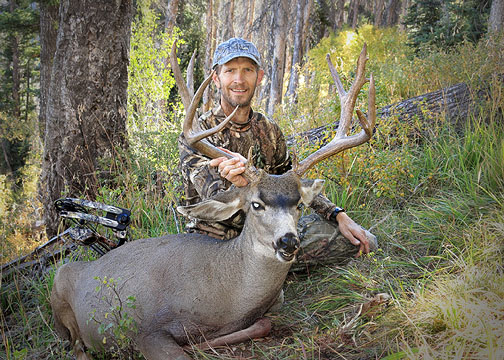
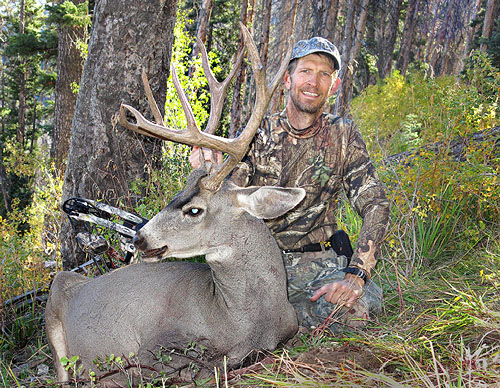
The blood trail was instant, crimson splashes on both sides of dug-in tracks blasting uphill. After a short bit I found my broken-off arrow covered in bubbly blood. Fifty yards up the mountain, his tracks veered sharply right and there he was, his grey body piled up in some yellow bushes with a heavy antler protruding upward. I knelt down by the beautiful buck and grasped for understanding.
My 2018 archery buck.
Everything had transpired too quickly to process it. All these years of intense learning had led to this sudden, surprising encounter. I was kind of expecting a grand crescendo to an epic hunt, but instead got an abrupt end to a chance meeting. Nevertheless I was happy; my spirit was full.
Conclusion
The story is really a short one. On a far-off mountainside, somewhere between two prime deer areas, a bowhunter met a random buck, and that’s all. A person can dedicate his whole life to learning about these wondrous creatures—collecting data, photographing, admiring, and pondering—but they’re really beyond comprehension and almost beyond reach. My buck appeared when I needed him to, 27 days into a 28-day season. But the real trophy was knowledge. In just two seasons I’d put in 45 days afield and went farther than ever before while simultaneously expanding my mule deer knowledge ten-fold.
My buck wasn’t really old, nor was his rack really wide, nor tall. He was just a solid 4×4 buck with good mass and some extra cheaters. But considering all I’d been through and how little time was left, I’d say he was perfect, maybe even better than perfect.
Over the past several years I’ve had the privilege of teaching hundreds of people basic archery. Due to the nature of the organization I work for, the majority of my students are left-wing oriented people in their early twenties. Most have never hunted before, and some are even ardent anti-hunters! As you can guess I’ve had quite a few passionate conversations over the years.
As it turns out, the majority of the anti-hunters are regular meat-eaters. This obviously adds a lot of weight to my arguments, the most effective being, “If you eat meat then you’re directly responsible for the killing of hundreds of animals; you just hire someone else doing the dirty work for you. Hunters, on the other hand, are directly responsible for their meat.” This point usually brings the offended into the realm of reality.
The Anti-Hunting Archer
Learning archery doesn’t necessarily mean a student wants to kill anything. To them it’s just a fun activity. But I often wonder what drove a flaming anti-hunter to walk over and pick up a bow-and-arrow in the first place. There seems to be an instinctual allure to archery for almost everybody.
Historical data reveals that every civilization around the world has—at one time or another—used the bow-and-arrow for survival. I believe the reason so many modern-day non-hunters are attracted to archery is a hidden connection ingrained in their DNA. (Well, that and popular television shows.)
About 1-in-10 of my students are naturals; they shoot masterfully within minutes of picking up the weapon for the first time. The bow seems to awaken something deep inside, and they beam with excitement. For this reason, teaching archery to this new generation has been the most rewarding job I ever had. It’s my calling.
Reality Check
Many first-time students view bows-and-arrows as recreational toys. If I don’t insist on teaching safety first, some will just grab a random bow and start flinging arrows errantly and dangerously. I’ve even seen stragglers pick up a bow and proceed to pull the bow backwards (toward themselves)!
Before going over safety rules, one of the very first questions I ask is, “Can anyone tell me what the bow-and-arrow was originally designed for?” There’s always a short pause, and then someone sheepishly responds, “Killing???”
“Yes!”
There’s always a few despondent faces, but they won’t be deterred.
The Truth about Hunting
City folk often have a skewed vision of hunting. They think that hunting is as easy as pulling off the side of the road and shooting some helpless creature to death. This misconception is reinforced by hunting shows that portray every hunt as a short jaunt through the woods, followed by chip shot from a blind on private property. I’ve even had people say, “How hard could it be? Heck, I saw a bunch of deer on the side of the road this morning!”
“Well, it’s spring…” (Sometimes it’s an uphill battle).
Actually, I won’t push hunting on anyone; I won’t even bring it up unless someone asks…
…but someone always asks.
Without getting too crazy, I explain how bowhunting is my greatest passion, and it provides the majority of the meat for my family. I tell them that hunting is a completely different skill than shooting. Hunting–especially bow hunting–is very difficult and takes a lifetime to master.
I go on to explain that, in the end, I really don’t want to kill anything; that there’s little glory in shooting a creature to death in cold blood. But I don’t want to starve to death either! Moreover, I really don’t want to wander down the meat aisle at the supermarket and sift through carefully packaged, hormone-infused, mass-produced, inorganic, salmonella-oozing farm garbage. My body is my temple, and the only meat I allow in is purely organic, free-range lean meat that once walked the earth freely as God intended.
For the most part my arguments are met with great respect, probably because I’m so passionate about it. I get comments ranging from, “Wow, I never looked at it that way…” or “I could never shoot an animal, but I really respect the way you do it.” Even the most ardent anti-hunting vegan will politely “agree to disagree,” and then go back to flinging arrows.
Conclusion
I believe these conversations with non-hunters have been mutually beneficial. On one side, I’m constantly reminded to take a closer look at the ethics and morals of my sport. On the other, I’m grateful for the opportunity to shed some good light on the delicate subject of killing.
Hopefully this article has been beneficial to both hunters and non-hunters alike. The best way we hunters can preserve our precious sport for future generations is by hunting ethically and arguing our side in a thoughtful and respectful way.
This is one little–but all-too-important–hunting skill that bow hunters should be practicing. It might seem intuitive that, immediately after your first shot, you should be pulling and loading another arrow. But it’s not.
The wait-and-see approach can make all the difference between success and failure. This is why you hear guides on hunting shows always pleading, “Shoot again, shoot again!”
Bow hunting is different than gun hunting insomuch that the animal often doesn’t realize you’ve shot, especially at longer distance where he doesn’t hear the shot. Sometimes the animal doesn’t even know he’s been hit, which can afford you a follow up shot!
Hit or miss, your non-bow hand should be immediately grasping and loading another arrow. It’s one of those skills that’s acquired over time through real-life hunting experiences, but rarely practiced.
Now, I don’t want to pick on my wonderful bowhunting wife, but here’s a classic example:
On our first archery turkey hunt, we called up a group of mature toms. Forever they gobbled while cautiously circling us, so we moved in on them. When the biggest tom broke the treeline, I whispered the yardage and Esther let an arrow fly…and missed. The tom jumped, then meandered off. Desperately I whispered, “Shoot, SHOOT!”, but when I turned around, I saw that Esther hadn’t loaded another arrow. What seemed intuitive to me was not intuitive to a newbie-hunter.
Practice Makes Perfect
To avoid this mistake I recommend incorporating a simple shoot-and-pull technique into your regular practice routine. Note: It’s best to use a real-life 3D animal target to help train your brain for real-life scenarios. Here’s how it’s done:
Shoot your first arrow. Hit or miss, you have five seconds to…
Pull, load, and shoot a second arrow.
Repeat.
Pretty simple, huh? Given enough time afield, I guarantee that practicing this technique will one day save your hunt. Hit or miss, having a second arrow ready can make all the difference between success and failure.
When it comes to modern bow accessories, your options are unlimited. Some parts move–like slider sights and drop-away rests–and some are fixed–like stabilizers and quivers. Today we’re going look at the potential drawbacks of having moving parts on your bow setup.
I’ve tried a myriad of accessories in my time, but last season really forced me to reconsider some of my choices. Here’s what happened:
In 2017 I got a brand new, high-performance speed bow to replace my old single cam bow. This new “speed” bow shot field points wonderfully. Then, about a week before the hunt, I screwed on my time-proven broadheads and they flew all over the place! After many fruitless hours of trying to re-tune the bow, I gave up and switched to mechanicals. And all was well…until…
Half-way through my deer hunt–and 300 miles from home–I was taking some practice shots at camp when my slider sight stripped out and no longer functioned. Try as I might, I couldn’t fix it. Fortunately I had an old multi-pin sight on my backup bow. I bolted it on and all was fine.
But this got me thinking…
Since its invention in 1969, the compound bow–and every accessory that can be attached to it–has been reinvented or re-engineered over and over again. The old “stick-and-string” has become an extremely complicated instrument of death…which is good…but maybe too good. Why? Because the more complicated something is, the more can go wrong.
Bow Accessories to Consider
In this article I’m going concentrate on the four major moving parts of your bow setup that you may want to reconsider before heading into the backcountry:
The Arrow Rest: There was a time when the arrow rest was just a shelf cut into the bow. Before that, it was your knuckle. Now it’s up-and-down-swinging tuning fork contraption tied to a buss cable. Almost every bowhunter I know uses one. But not me; I use a Whisker Biscuit. The Whisker Biscuit is a shoot-through containment rest (aka capture rest). It bolts into position and holds your arrow securely in place. Unlike popular drop-away rests, the Biscuit has no moving parts. The arrow simply shoots right through it. The only drawback is an infinitesimal reduction of arrow speed caused by friction between the arrow vanes and the whiskers. I use the Whisker Biscuit because it’s reliable and simple. It’s also inexpensive; about half the cost of a decent drop-away rest.
The time-proven Whisker Biscuit.
The Bow Sight: You have two options: Fixed pins or movable pins (aka slider sights). I used a fixed pins for twenty years, and then one day I fell in love with the slider sight. The slider sight was simple: one movable pin that doesn’t block your target. You just dial up the yardage and shoot. Then one day my slider broke right in the middle of my hunt! Now I’m back to fixed pins. I sure like the idea of a slider sight–and may go back to it someday–but for now I’m sticking with the multi-pin.
Bow Cams: Almost every modern bow is powered by either single cams or dual cams. Cams are the power engine of your bow, so this is a major consideration when choosing a bow. Basically, single cam bows are more simple and easier to tune than dual cams. The major drawback to single cams is they produce a slower arrow speed. Dual cam bows (aka speed bows) are faster, but harder to tune because, a) both cams must roll over in perfect synchronization, and b) the extreme velocity of the arrow accentuates slight imperfections in bow tuning, broadhead design, and shooting form. These days bow manufacturers claim to have conquered tuning issues by tethering the dual cams, but in my experience dual cam bows are still more difficult to tune. I’m sure it has a lot more to with blistering arrow speed than tuning, but just remember, accuracy suffers when adding extra speed. This leads us to broadhead selection.
Broadheads: Almost all broadheads fall into two categories: Fixed blade or mechanical (aka expandable). Simply put, mechanical blades fold into the tip during flight, and then expand on impact. Because the blades are hidden, they are less affected by wind resistance and planing. Thus, mechanicals are more accurate than fixed broadheads, especially on speed bows. The major drawback of mechanicals are twofold: a) more moving parts make them susceptible to breakage on impact, and b) less penetrating power due to energy loss during blade deployment.
Mechanical vs. Fixed broadheads
Fixed blades are inherently stronger and have better penetration than mechanicals. However, they can be difficult to tune with modern speed bows. The most important factor in choosing a broadhead is how well it shoots through your bow. Personally, I prefer fixed blades with my single cam bow and mechanicals with my dual cam bow. FYI, the most accurate fixed-blade broadhead I’ve ever used is the Trophy Taker Shuttle T, and my favorite mechanical is the Rocky Mountain Warhead. Note: the Warhead is extremely reliable and inexpensive (only $19.99 per 3 on Amazon).
Conclusion
Compound bows are much more complicated than they used to be, which is good and bad. Bow manufacturers tout speed as their primary selling point, but faster bows aren’t necessarily more accurate. The same concept applies to arrow rests, bow sights, and other accessories. Newer isn’t always better.
When it comes to equipment selection, I recommend keeping it simple. And when it comes to moving parts, less is more.
Consistent success afield comes from skill and woodscraft, not gear. As always, I recommend focusing more time and energy on the process and less on equipment.
Have you set your New Year’s goals yet? It’s not too late. Maybe I can help.
Everyone has different priorities in life: health, career, education, family, etc. For me, bowhunting big bucks is priority one. Nothing in this ridiculous life brings me more satisfaction (and venison) than bagging a big buck with a bow. Therefore, everything must either support that goal, or be discarded. Simple.
My New Year’s goals:
Harvest a 200″+ buck with my bow.
Be healthy enough to hunt giant bucks in giant places. This includes eating healthy, avoiding sugar and processed foods, regular exercise, reducing exposure to environmental toxins, and reducing daily stress.
Earn enough money to take the entire bow season off work.
Avoid distractions as much as possible (TV, Facebook, unsupportive people, loser jobs, unnecessary projects, etc.).
Help others accomplish their New Deer’s goals through education, study, writing, etc.
That’s it folks. Nothing more; nothing less.
The best way to accomplish your greatest goal is to keep it present in your mind at all times, keep it simple, and make sure all other people and activities in your life also supports that goal.