
Tag Archives: once-in-a-lifetime

The Good, the Bad, and the Beautiful: My 2025 Deer Hunt Story

The Good, the Bad, and the Beautiful
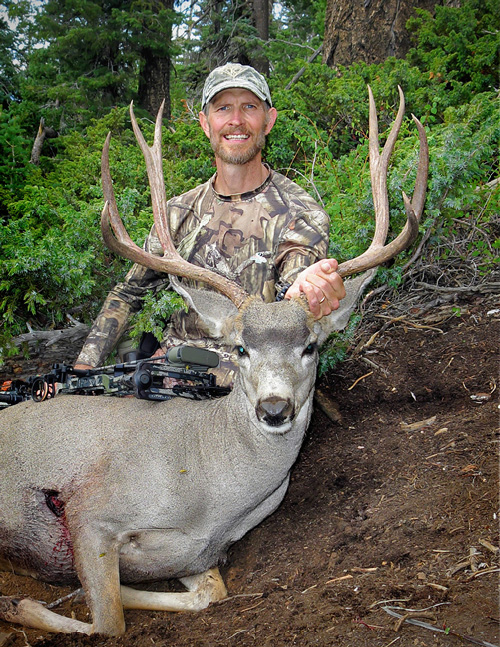
Same Goal, Different Year

Now in my 29th year of bowhunting mule deer, the annual ritual remains the one thing I look forward to every year. I suppose it’s a combination of high mountain adventure and escapism, but mostly I love the extreme challenge of chasing tough, cagey animals through extreme terrain with my bow and arrow. And if I’m successful, it provides the meat that sustains my life all year long.

What I don’t love is a sport that degrades with each passing year. I don’t want to complain here—especially about hunting—but the diminishing quality of the modern hunt has become the overriding theme of my hunting experience. The once magical woods that brought me so much joy over the years—even rescuing me from my darkest times…well, it’s changed.

Primarily, there are far less deer now, and far fewer great bucks. There are many reasons for the mule deer’s decline, but it’s mostly the result of human encroachment coupled with gross mismanagement by the state game department. Of particular note, the public land where I hunt is becoming so overrun with recreationalists—not just other hunters—that most big bucks don’t even bother leaving private land.

A big buck learns quickly to equate people with danger, and whenever he wanders onto public land and encounters a person, he flees back to the relative safety of private land. Worse yet, he usually won’t come back for the rest of the season. This has become the toughest challenge.

Still, my goal remains the same: To harvest a monstrous 200” buck with my bow and arrow. It’s really an unrealistic goal; in fact I haven’t seen a 200” deer in many years. However, the unit I hunt borders the infamous Paunsagunt premium deer unit, so genetically it has  trophy potential.

Unfortunately, very few public land bucks live long enough to reach maturity thanks to poor management by the Division of Wildlife Resources (DWR) whose primary goal is maximizing revenue by issuing excessive permits for a deer population that hangs on by a thread.

Despite all of this, my love for the hunt doesn’t change even if the quality does. Nor does it stop me from devoting an entire month to my beloved endeavor…

That is, unless I don’t draw a tag. For the first time in my life I didn’t draw an archery deer tag in 2024. I was nearly traumatized. However, that meant I would be guaranteed a tag in 2025.

What could possibly go wrong?

Stroke

In January, Esther—my wife and hunting partner—had a major stroke. Long story short, I found her paralyzed on her right side and unable to speak. We spent most of January in the hospital trying to recover.
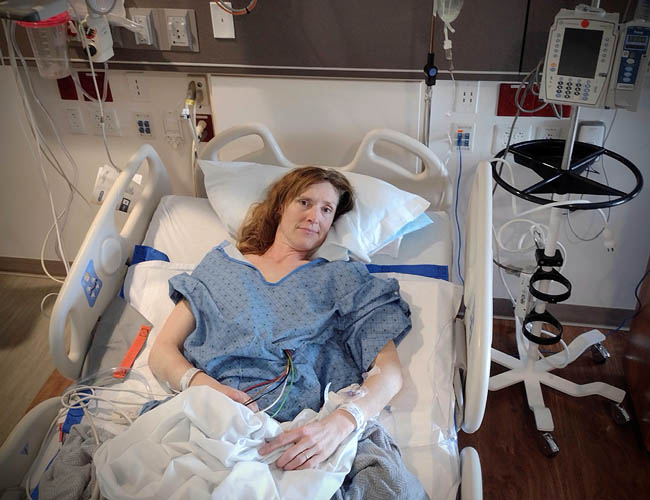
Esther’s first day in the hospital following a major stroke.

During the extended stay, I spent much time reading and learning about stroke recovery. What really got my attention was the brain’s incredible ability to heal itself by creating new neuro pathways around damaged areas through a process called neuroplasticity. It’s not as easy as it sounds.

The human brain demands an inordinate amount of energy and focus to do simple tasks, like eating, walking, talking, etc. Humans spend their formative years programming these simple motor skills to memory, after which we just take it for granted. A stroke forces you to start over.

Esther’s recovery was slow and steady. She would fall into exhaustion and despair on a near-daily basis, but the goal of getting back to the mountains remained steadfast, and we fought onward.

Turning tragedy into action, I brought a youth bow to Esther’s hospital room where she spent weeks relearning the basics of archery, as well as walking and talking. With the bow hunt just seven months away, returning to the steep mountains seemed like an impossible goal.
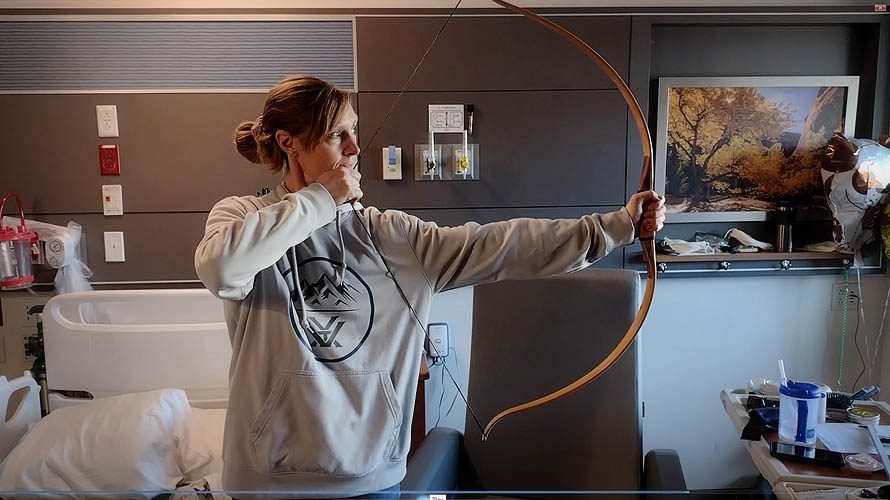
Esther relearning how to draw a bow in the hospital.

Upon returning home, Esther continued to recover while I struggled to stay caught up with work. Summer came and we went hiking often. Esther stumbled and fell through the woods, but eventually prevailed and no longer needed a leg brace. She worked daily to pull her 60-pound hunting bow back, and could even shoot a few wobbly arrows before collapsing.

And before we knew it, the hunt was on.

Not My Woods

Butterflies tickled my stomach as we set up camp ahead of the hunt opener. We made it! I had a tag and some hope, and that’s all I needed.

As with past years I picked up where I left off. But right away I could tell things were different. Days ticked by as I moved from area to area searching for big bucks and tracks, but with no luck. The likely culprit was the severe drought. It hadn’t rained in months and the woods were sickly dry with minimal forage and water. Such conditions tend to suppress deer movement and confine them to tiny home ranges near water.
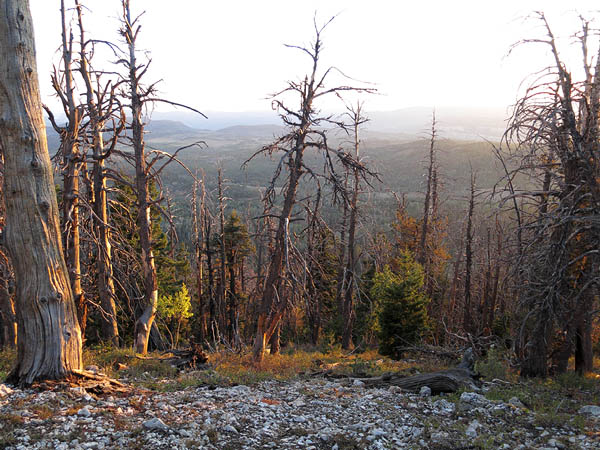
Deer woods 2025.

Big brother Brent was hunting a few miles away in a secret area he calls “The Ribbon.” We would meet up for lunch every once in a while to compare notes and commiserate about the lousy hunting conditions. Joking about our growing “forlornness” was common.

We both went into the hunt with visions of 200-inch bucks, but neither of us had seen anything over 160. Worse yet was the realization that, according to our personal statistics, we were only averaging one shot opportunity per 28-day season. This lied in stark contrast to three decades ago when you’d regularly shoot every arrow out of your quiver in a single weekend. In the end all we could do was put in the time and wait for conditions to change. Man, we really needed some rain!

After waking and hiking at 5am every day, it was nice to spend the long, hot, midday hours resting back at camp. But it was far from relaxing. The sun beat down from cloudless skies, turning the tent into an oven and making napping miserable. Worse yet, there was a crazy band of perma-campers nearby who spent all day getting high and yelling obscenities, or blaring rave music from the car stereo. This continued throughout the entire hunt!

I don’t understand the people who’ve taken over my woods. On one particular night someone fired a high-powered rifle over our camp at 2 a.m., likely elk hunters trying to run us out of their “secret” area. They’d done this before, so it wasn’t a surprise this time. Still, I never feel so much hate as when I’m doing what I love the most.
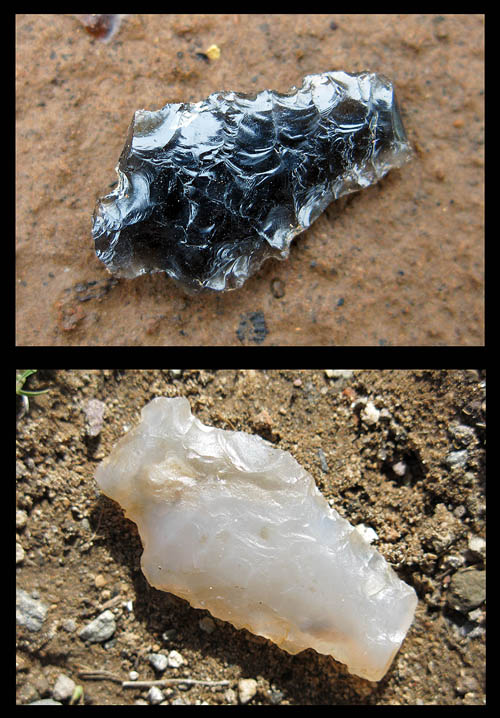
Arrowheads found during the hunt: remnants of ancient man.

Esther had her own struggles. She spent most of the time exploring our old, traditional haunts that still held an occasional deer. However, stalking quietly and shooting accurately eluded her due to residual effects from her stroke.

On one occasion I accompanied her as she stalked after a group of three mature bucks feeding unawares. She got close and drew her bow a couple times, but didn’t have a clear shot. When a buck finally stepped into the open, she tried to draw again but couldn’t get the string back. In a panic I grabbed her arm and pulled it to full draw. But then she was too shaky and missed the deer widely.

At that point I realized I couldn’t help her. I couldn’t be there every moment to pull on her elbow. The best thing I could do was offer some advice. Here’s what I told her:

“There was a great karate master who could chop through thick boards with seemingly little effort. His students were perplexed by his skill. Try as they might, their boards stood strong against their strikes, leaving their hands bruise and broken. The master finally explained: “Don’t focus on the board. See your hand already through the board, and put it there.”

That was the secret: To see past the obstacle.

I continued, “Don’t focus on the draw; focus on the deer. Visualize the bow already drawn. You’re stronger than you think.” And with that we parted ways; I hunted my woods and she hunted hers.

Two weeks into the hunt, the mountain suddenly cooled off with relentless monsoonal rains. The woods mysteriously cracked and popped all day and night—something I’d never experienced before. I figured it was the sound of parched timber rehydrating and expanding at a rapid rate.
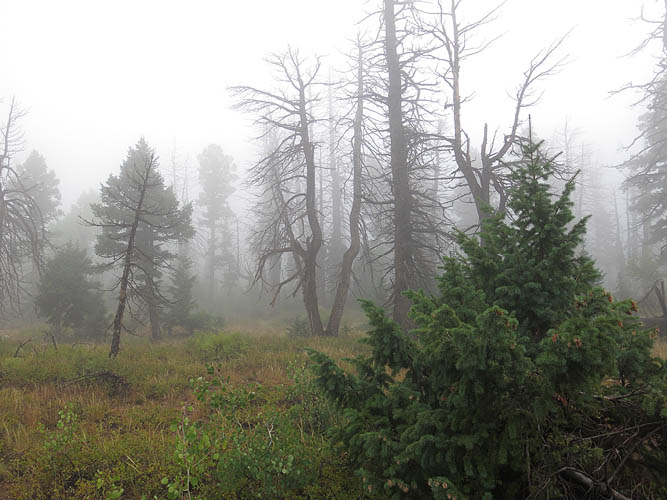
Finally, a high-mountain cool-off with rain.

I was much more hopeful with the cool-off. Between storms I slogged along, sometimes with a big golf umbrella in hand, hoping to catch new deer coming up from the vast private lands below.

The Desert

One day I was sitting in my truck waiting out a storm when I got a call from a local about some taxidermy work he needed done. When I told him I was hunting, he got excited and told me about some large bucks he’d see in the low desert country near the Arizona border. Needless to say I was elated to learn this, and immediately drove to the desert alone.
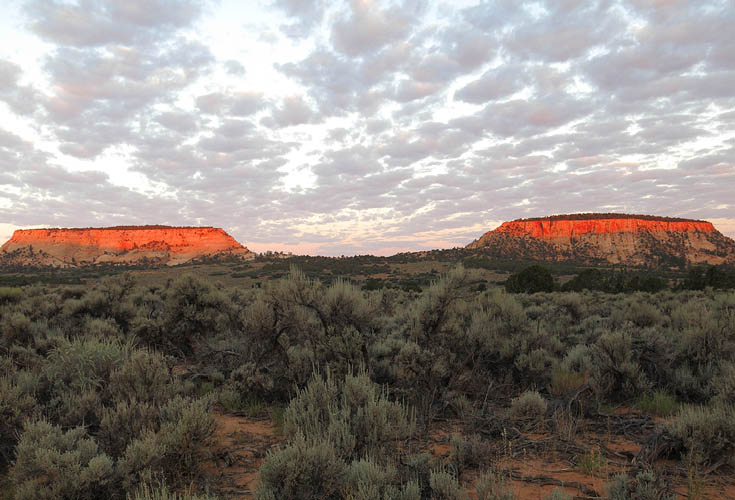
The low-land desert country.

Long story short, I spent two days in the sandy, hot desert. I found the area he described alright, but glassing didn’t turn up any deer and tracking was nearly impossible in the sand. Unlike the high mountains, the desert was hot and dry.

Knowing that nothing could survive there without water, I set out the second day in search of water. I hiked all day, carefully inspecting every possible water source on the map, but there was no water anywhere. By mid-afternoon I realized I’d pushed too hard and was running dangerously low on water myself.

To make matters worse, I got cliffed out while hiking a long plateau back to the truck. There was no safe descent, so I had to backtrack several miles in the afternoon heat. At one point I considered holing up in the shade and traveling at night when it was cooler, but I was already perilously dehydrated.

I pushed ahead at a steady clip and by some miracle arrived at the truck just before dark, drenched in sweat and dust. In disgust I threw camp into the truck and headed back to high country. Better to fail in my cool mountains, I figured, than suffer the horrible desert another day.

Changes

Upon returning to the soggy, 9000-foot mountains, I decided to reinvent the hunt. I started by hunting exclusively on very steep wooded areas adjacent to private land. The hunt was half over and any areas accessible to humans were devoid of deer.
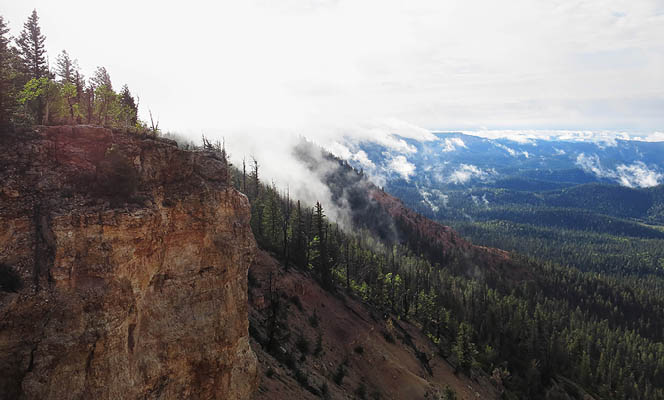
High mountain adventure.

I saw my first big buck on morning #16 while sneaking through some dense timber. Heavy antlers bobbed as he fed fifty yards downhill from me. I pulled an arrow and waited for a clear shot. While standing there, a doe and fawn came wandering through, threatening to blow up the area. I froze up and they continued on unawares.

The buck was still out of view, but if I could just take a couple steps to my right, I might have a clear shot. I whispered a prayer and took a step. Suddenly the whole area blew up. Apparently a smaller buck had wandered in unseen to my right, and when I moved he snorted and blasted downhill, taking the big buck with him. That’s bowhunting, I guess.

Day #20 had me sneaking through dense timber in the gray light of morning; same mountain, just lower. Movement caught my eye fifty yards below. I froze up at the same time an old warrior buck caught my movement. We stared at each other for a good long minute before he got nervous and disappeared into the trees. I pulled an arrow just in case. Sure enough he walked right into my scent stream, and then spun around and bounced back into the opening. I was ready and sent an arrow whistling his way. In a split second he jumped out of the arrow’s path and smashed down the mountain to private, never to be seen again.

Stroke of Luck

Day #25; only three days left in the hunt. No days off, no more camp breaks; just full days afield, sneaking through tangled timber alone; half ninja, half madman. Success or failure hinges on every decision. This is what I work for all year long. One tag, one opportunity, that’s all I ask. Desperate, but grateful, I’m at peace here in the big woods.
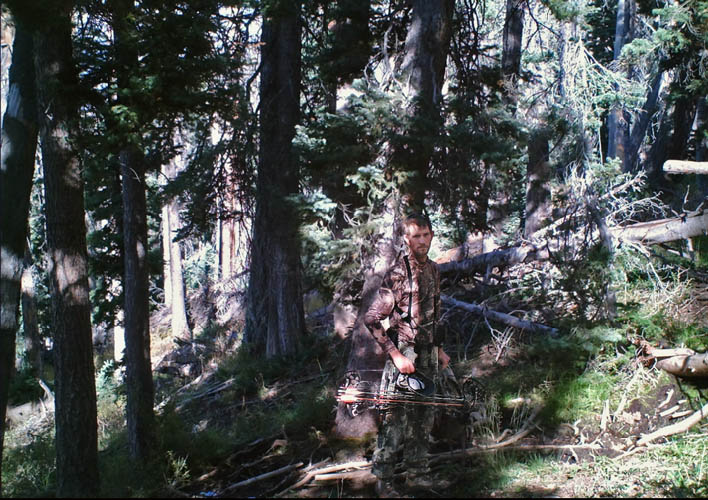
The big woods; deep and steep.

I’d gotten just about as far from the truck and trail as possible when I got a message from Esther. There was a picture of a fine buck lying dead and a text reading “Deer down.” I couldn’t believe it! She had climbed the mountain and took care of business all by herself. For the first time in weeks I sighed with relief. Whatever happens now, the hunt is a success.

It took two hours to power out of the woody hole I’d descended into and get back to my truck. In my haste I ran face to face into a wonderfully wide 4×4 deer, but he was equally surprised and bounded away. No big deal.

Back at the truck, I drove to Esther’s side of the mountain and then scrambled up to find her standing over her deer, all smiles. We took photos, quartered the deer, and loaded it into packs. I almost didn’t notice the crushing weight of the pack as we descended the mountain together.
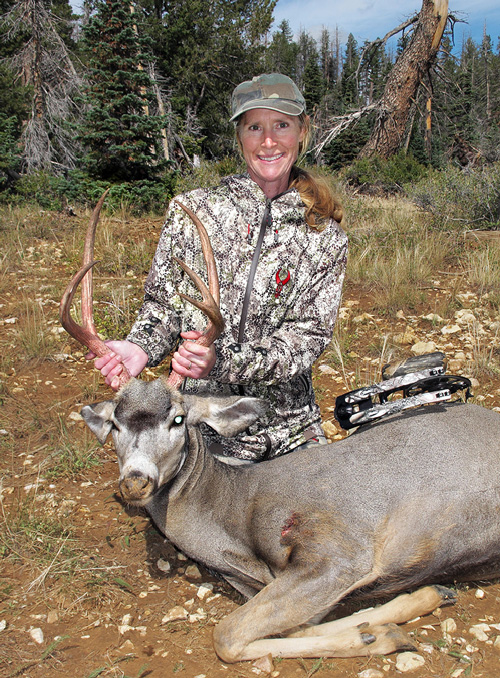
Esther’s deer on day #25.

The next day was a total bow-out…literally. I woke up to gale force winds trying to rip the tent from the ground with me inside. I spent the day afield but saw nothing. Deer don’t move much in high winds because it dulls their survival senses. They just hole up in the thick stuff and wait it out.

Day #27

Day #27 was less windy, and with only two days left it was time to cut my losses. Earlier in the hunt I found a group of average deer living in one of my old haunts. I headed there at first light but found the area completely devoid of deer. With the morning waning on, I scurried over the ridge and dropped down the steep southwest face where I’d busted an unseen buck earlier in the hunt.
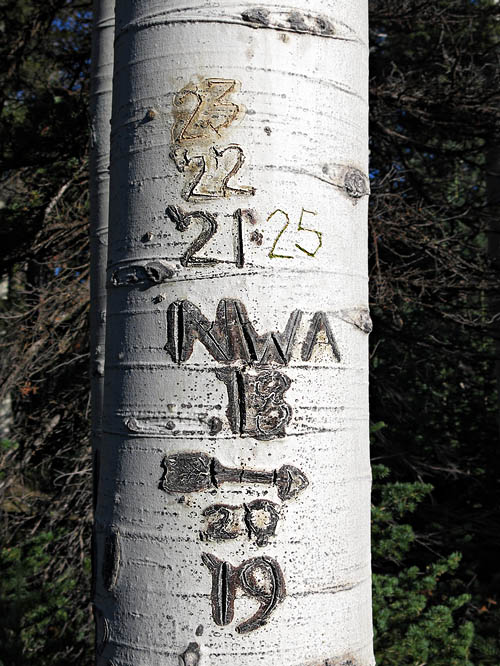
My sign tree.

While working steadily down the wooded slope, movement caught my eye 20 yards ahead. Only the wind swooshing through the trees had obscured my approach. All I could see was bits and pieces as a wide-antlered buck fed in the direction of a dense bedding area. In slow motion I loaded an arrow and scanned ahead for an opening. If he continued his current trajectory, he’d pass through a little window between fir trees.

My unblinking eyes squinted over my bow, tracking the buck’s every movement as he slowly and cautiously stepped towards the opening. Then things happened fast! He disappeared behind a tree, I drew my bow, and he popped into the opening. Just as I was squeezing the trigger release, the buck began turning to go downhill. Simultaneously I noticed I was holding the wrong sight and in a millisecond dropped the top pin behind his shoulder and released the arrow.

The buck blasted away.

I waited a few minutes then crept over to where he was standing. The ground was torn up, but there was no arrow or blood. Fearing a miss, I followed the dug-in tracks. Suddenly a broken-off arrow covered in blood appeared on the ground. A hit!

I continued on. Rounding some trees, the buck came into view standing 40 yards away and looking back up the mountain. I could tell he was hit hard and eventually he lied down. I knelt down too, loaded an arrow and waited. He kept lifting his head, and then pushed up to a standing position. I was ready but rushed the shot just as he stepped forward behind some cover. My arrow deflected off a branch and the buck hopped out of sight.

Not wanting to push the buck down to private, I backed out and made a wide circle below and downwind. That way if he busted, he’d go uphill and remain on public land. Well, I got 100 yards below where I’d taken the second shot and a big buck suddenly jumped up in front of me and bounded down the mountain to private. I was sure it was my buck and was devastated. But as I followed his bounding tracks I noticed there was no blood or indication he was wounded.

Now, standing at the bottom of the mountain I questioned whether it was my buck at all, or perhaps a near-identical one instead. The only option now was to hike back up and follow the original blood trail.

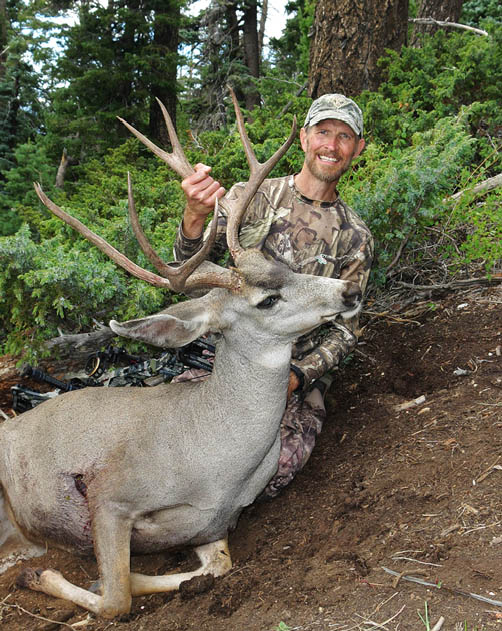
With my legs burning and sweat dripping off my brow, I finally arrived at the original blood trail. I followed the conspicuous trail past the second shot location and side-hilled for about 100 yards. When I looked up again, there he was, laying upside-down in a pile of deadfall branches. What relief! My first shot had been lethal after all.

With all my remaining strength, I wrangled the beautiful 4×4 buck out of the deadfall and dug out a flat spot on which to process the deer. It was a race against midday heat and dehydration to get the deer quartered and hung by myself. Perhaps the best decision I made during the hunt was stashing a water bottle about a quarter mile away on a mountain saddle. It may have saved my life.

The rest of the evening was spent hauling meat back to the truck, just as I had done two days earlier with Esther’s deer. My whole body was hammered, especially my quads from ducking limbs and climbing over deadfall with a heavy pack, but I couldn’t be happier. Somehow, in the final days of a long and difficult hunt, everything came together for both Esther and me.

Conclusion

With all the challenges of modern bowhunting, the quality of the experience certainly has diminished some. Even if you can draw a permit, the few remaining deer continuously adapt to elude us hunters faster than we can keep up with them.

Despite everything, the mountain stands strong against the madness of modern life. What remains is the supreme beauty of nature, the thrill of the hunt, and miraculous success found in the final hours of seemingly impossible hunts.

And there, deep in the shadows of twisted timber, where few men dare go, lies the majestic muley buck, waiting to test every fiber of one’s being.
Nothing’s Easy with Goats: My 2021 Mountain Goat Hunt

Nothing’s Easy with Goats

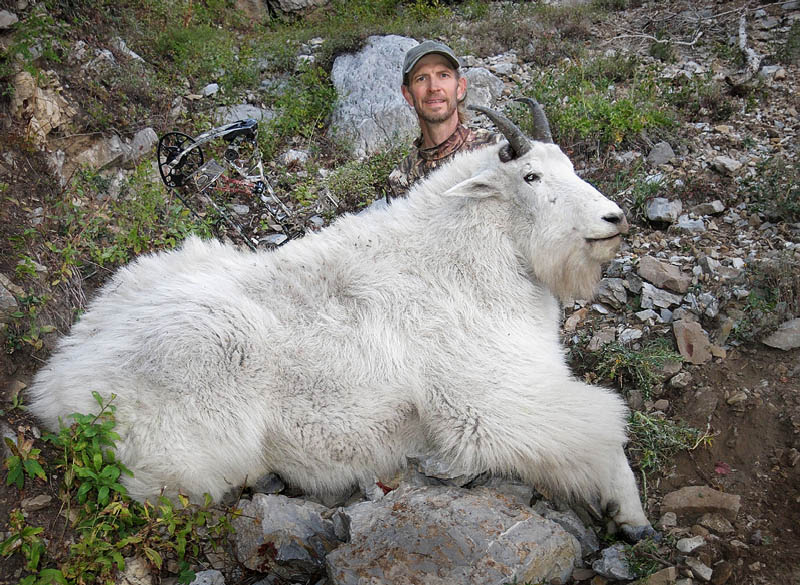
My 2021 archery mountain goat on Mt. Nebo, Utah.

Of all the big game animals I’ve chased over the last 30 years, the Rocky Mountain goat is the most fascinating, strikingly beautiful, and toughest I’ve ever seen. He is a rare creature, living exclusively along a sparse band along the Rocky Mountains, ranging from Alaska down through Colorado and Southern Utah. Because he spends his days climbing vertical mountains, he is likely the strongest animal—pound-for-pound—in North America.

The first time you see him, with his stark white coat gleaming against the gray cliffs, it almost seems unfair that such a rare gem should be so easily spotted as he feeds carelessly on patches of dry grass in the wide open. But as you begin plotting your approach over the deep chasms between you, with thousands of vertical feet given and taken, you soon realize that a simple stalk is actually an all-day, perilous venture into the bowels of hell, and always one misstep away from serious injury or death. As Esther would lament later under the weight of a crushing backpack and half lost in the nighttime gloom of unfamiliar woods, “This hunt unit should have a warning label on it…seriously!”

Goats of Ben Lomond.

What does it take to get your goat? Well, aside from the usual requisites—such as shooting proficiency, general fitness, and patience—goat hunting requires more than you might think. First you’ll need about half a lifetime to accumulate the number of points necessary to draw the once-in-a-lifetime tag. For me it took eighteen years, so I got lucky. Second, to hunt a goat you must be a goat. No matter how much physical training you undertake in the off-season, it won’t be enough—period. Goats live in the worst terrain on earth, places where most other creatures and plants cease to exist. Unless your exercise program involves scaling jagged granite cliffs at 11,000 feet while donning a heavy pack and carrying a cumbersome bow, you won’t be ready. Finally, you’ll need a viable exit plan. Big old billies can weigh up to 300 pounds and fall in places where you couldn’t get a horse. Heck, you might not even get yourself out.

With this in mind, let’s go hunting!

The Complaint Department

My deer hunt was a disaster. In a mere four year span, the ever-increasing gaggle of outdoor enthusiasts have turned my once wild mountain into a clown-town mountain bike and hiking resort; people everywhere, all the time, on every road and trail. The biggest and wisest bucks have since fled back to the vast private lands, now refusing to take part in the public land people party up top. Four hot and exhausting weeks down the toilet, my greatest passion ripped away, another mountain ruined and lost forever.

Realizing failure early on, my mind frequently drifted to the mountain goat tag lying on the kitchen table back home. I couldn’t imagine how this fluffy, conspicuous animal could be anywhere near as difficult as the wily old mule deer buck… Or could he… I was continually haunted by the unknown. All I knew for sure was that I’d never seen an easy hunt before, and wondered what surprises lay ahead.

Perhaps I could have scouted my goat unit if only I had a vehicle. In July my truck motor blew up on the highway and became a permanent fixture at a redneck repair shop 150 miles from home. At the same time, Esther’s car was recalled by the dealership for a three month stint requiring a new engine due to some pretty shoddy engineering. So I did my scouting at home, 200 miles away from the goats.

Scouting

My first call was to a fine fellow named Kendall who’d posted a compelling YouTube video from his Nebo goat hunt last year. He’d done extensive scouting beforehand and was gracious enough to answer all my questions and point me in the right direction. My second call was to a DWR biologist who provided even more information.

Of particular interest was the location of goats. Although Nebo is a large unit, the goats inhabit only a few square miles of the three highest peaks, and you won’t find even a trace of goats below ten-thousand feet. There were only nine archery tags issued for the entire Mt. Nebo unit this year, but it doesn’t take much to blow out an entire peak, as I would soon to discover.

Nebo goat country.

A few days after the deer hunt ended, Esther and I loaded twelve days worth of supplies into our emergency-bought, nineties beater truck and headed north to the bald peaks of Nebo. Fall colors were changing and elk were bugling as we settled into a fine tent camp beneath the great shadow of 12,000-foot Mt. Nebo.

Just around the corner from camp we found ourselves within viewing distance of a myriad of tiny white dots scattered across the sheer, granite cliffs two miles away. Judging by the various sizes of the goats, we determined the majority were family units of nannies and kids. The males, or billies, run about 40% bigger than the nannies and tend to live alone or in groups of two or three. Other than body size, there’s no good way to judge the animals from two miles away. All goats—whether billies, nannies, and juveniles—have sleek, swept-back, dagger-like horns ranging from seven to ten inches long and being all but invisible at long distances. Clearly this would be a boots-on-the-ground hunt. Thus, an all-day hike was planned for the following day.

Day #1

I sure learned a lot about goats that first day. At first light we glassed up some promising goats from the camp overlook, and then set forth on a several mile hike around the canyon to get into position 1500 vertical feet below them.

View from Nebo overlook.

It was around midday when I reluctantly peeled off the trail and headed straight up a steep knife ridge towards them. Much of the hike was spent scrambling on all fours, picking my way around rock walls, and clambering up noisy scree slopes while stopping occasionally to glass. Most of the goats remained bedded all day, only rising occasionally to change beds and grab a quick bite to eat. The biggest billies lived right in the cliffs where a stalk would be impossible.

It was fascinating to watch them traverse the cliffs with nary a concern for sheer drop-offs. Mountain goats have large, wide hooves with hard rubbery soles that cling to rocks. Their short, stumpy legs and compact bodies provide a low center of gravity for balance. There is no mountain too high for goats. If the peak stretched up another 5000 feet they would be at the top.

Eventually three large goats came into view a few hundred yards away, including one very large billy, a smaller one, and a big old nanny wearing a DWR tracking collar. Unfortunately they were bedded in the wide open with a wall of cliffs behind them. With no possible approach I continued higher in hopes of finding a good ambush position when they fed out later.

Goats below the cliffs.

The terrain grew steeper as I went, gradually turning to cliffs in all directions. While working around an outcropping I spotted a goat bedded thirty yards below. He turned and looked up at me but didn’t spook. Instead he unbedded and actually walked right towards me. In a surreal moment, he stood broadside just five yards away and stared at me, framed against a massive fortress of broken cliffs and crags.

Juvenile goat at five yards.

Eventually he wandered off and for the rest of the afternoon I sat on a heavily used saddle and watched the three goats from earlier. At four o’clock they all rose and began feeding in wide circles on the open hillside.

With only two hours of light left, it was time to make a move. The smaller of the three goats fed into some cliffs while the big billy fed downhill 200 yards below the nanny. Based on what I’d observed so far, goats aren’t nearly as spooky as deer. With their funny little elf ears, small black noses, and beady eyes, these animals obviously relied on extreme terrain for protection more than their natural senses. In fact every goat I encountered on this hunt seemed perplexed to see a human sharing his extreme environment.

The only possible route to the billy was through the nanny. She continually watched me as I poked my way down the cliffs and scree slopes. At 70 yards she got nervous and wandered off. Methodically I closed the distance to the billy who must have thought all the noise I was making was coming from the absent nanny. But when I got to 150 yards he looked up while I was looking down and pegged me in the wide open. Goats generally don’t run to avoid predators, but rather march steadily into vertical cliffs; and that’s exactly what he did. For the last half hour of light all I could do was watch him feed out of sight. At that point I knew this could be a very long hunt.

I only got lost twice while walking the three hours back to camp in the dark. When I finally arrived, Esther was on the verge of tears, certain that I’d fallen to my doom somewhere. This would become a regular occurrence for her.

Day#2

I woke the second day with various aches and pains from the waist down. After spending an arduous day on Nebo, I was excited to try an entirely different peak: Bald Mountain, aka Baldy. Baldy seemed a little friendlier than Nebo: not quite as steep and with better access via a dirt road. Unlike Nebo, Baldy has patches of sparse pine trees which would be more conducive to close-quarter style hunting.

The road to Bald Mountain.

We didn’t spot any goats from the road, but there was still a lot of mountain hidden from view. We parked the poor truck shortly after the road turned into a pile of sharp boulders with all four tires spinning and not going anywhere.

A lovely morning hike through the golden aspens and fields of choke cherries soon turned into an all-day, up-and-down leg burner, alternating between cliffs and wide-open grassy bowls corralled by steep rocky ridges. We glassed as we went but no goats appeared.

Shortly after reaching the right goat elevation we ran into a harvested goat carcass, obviously taken by a hunter a week or two earlier. Well, congrats to the lucky hunter, but bad news for us. With the goat’s demise, the remaining goats likely spooked further into the vast reaches of Bald Mountain. We continued on.

A couple old goats in the hills.

Around noon we arrived at a great lookout from an 11,000-foot ridge. Our eyes strained through the glass as we dissected the mountains for miles, but turned up nothing. I could tell by Esther’s demeanor that she was done for the day, and thus put together a new plan. From here Esther would sit and glass the far hillsides until 5:00pm. Meanwhile I would clamber about the cliffs on the main peak in hopes of turning up a hidden goat. All the goats I’d seen thus far would feed until about 10:00am, bed down, and then rise again at precisely 4pm to resume feeding for the evening.

Glassing from Bald Mountain.

Clamber as I might, I turned up nothing but old beds and sign. At 6pm I got a message from Esther that three big goats were feeding a mile north of her lookout. It was too late for a stalk, so we planned a return trip in the morning to chase after them.

Three billies that Esther spotted.

At last light we were able to glass up the goats from the road and verify that they were in fact billies based on their “urination posture.” (Billy goats pee like horses with their legs spread apart, while nanny goats squat like dogs). I was lulled to sleep that night by a combination of excitement, anticipation, and dread.

Day #3

Fearing the weekend would bring more hunter competition to the mountain, we woke well before light and hit the road. Our previous days’ effort turned up a better road jump-off for quicker elevation gain. But I suppose it’s all relative; what’s a 500-foot advantage in these mountains?

Hurrying to reach the goats before they bedded, I hiked like a mad-man up the dark hills, leaving Esther far behind. My lungs burned and heaved in the cold morning air while a metallic blood taste filled my mouth. Still I refused to rest, knowing only one thing for sure: there’s nothing easy with goats.

I reached the lookout ridge around seven and spotted two of the goats feeding leisurely along the next ridge a mile away. Just one more canyon to go. I burned up an entire hour descending a perilous avalanche chute, sliding and clinging to roots while dislodging various boulders that went crashing down the mountain. I kept glancing up at the goats and was glad they were still too far to hear the great cacophony.

Happy to still be in one piece at the bottom, I began an immediate ascent toward the goats. From this point everything came unraveled. The shifting thermals began sweeping upward towards the goats who were now obscured by the curvature of the hill. To reduce my scent I ripped off my sweat-soaked shirt and stuffed it in my pack.

Next I made a wide arc to get above the goats before they winded me. While doing so I was absolutely horrified to see three other camo-clad dudes—a hunter with two buddies—suddenly appear on the horizon above me. “[Insert raging string of expletives here].” My worst nightmare come true; and such wonderful timing! Still, the compassionate inner Nate wondered what hell these guys must’ve gone through to get where they were; certainly there was no better route than the one I’d taken. Nevertheless, here we all were on the same peak, pursuing the same once-in-a-lifetime opportunity against all odds. May the best hunter win!

My carefully calculated stalk was now a flailing bee-line in the direction of the goats. But when I arrived, they were gone. In their stead was a big 5×5 mule deer buck staring at me with a familiar look, as if to ask, “What the heck is a person doing in this place?”

The three dudes looked equally frustrated as they continually scanned the hills in all directions. Either the goats had seen their approach and bailed, or they’d winded me. Either way they were gone. While the competition poked around a few hundred yards above, I pursued my only option, working lower and lower down the mountain while intermittently peeking over the cliffs where the goats must have fled. Still nothing.

At ten o’clock Esther radioed me from the lookout. She was still full of hope until I informed her of the dudes and the disappearing goats, at which time she blew a fuse. After everything we’d been through, we got duded; always more people! After a murderous rant, she asked with exasperation, “So, what’s your plan?” I looked up from the radio and slowly scanned the miles of emptiness in all directions. The wind whistled by and the sun beat down from a cloudless sky.

“There is no plan,” I finally growled. Then, after another pause, “I’ll call you at eleven…” Expecting nothing more from the day but blisters, I kept working down the mountain and glassing clumps of trees in vain hope that one of the goats had bedded nearby.

Movement suddenly caught my eye a 100 yards down in a dark tangle of trees on the cliffy north face. Through the glass my heart leapt at the sight of two white patches milling about and hooving the ground to make day beds. One goat bedded down facing me and I froze in the wide open for a full hour while he chewed his cud and stared in my direction. He finally got up, kicked the smaller goat out of its bed and laid down facing away. At this time I carefully crawled twenty yards lower to some shade and that’s where I sat for the next five hours, 80 yards above the goats and unable to make a peep.

I passed the time writing in my notebook, eating snacks, fighting off flies and bees, and periodically checking the goat as he lay bedded. Was it a mature billy? It was hard to tell from this angle. Maybe a nanny…? My lack of experience with such beasts kept me guessing, but it really didn’t matter. Considering what a person must go through to get within bow range, any mature goat is a good goat and I was intent on making something happen. But for now there was no move. He was bedded directly above some tall cliffs, and even if I had a clear shot, the goat would likely take a flying leap, as is their nature. No, I would wait them out, all day if necessary.

Meanwhile Esther sat patiently on her high perch crouched in some shadows. At one point a nearby rock slide crashed and echoed through the hills. Being out of radio communication, Esther feared I’d fallen to my doom, and thus sat helplessly wondering of my fate all day long.

The Stalk is On!

At 3:30pm I was elated to see movement. The smaller goat soon popped into the open and fed out of sight. I lifted my bow, ready for the bigger one, but he remained bedded for another hour. As the mountain fell into shadows, the wind cooled and began shifting up and down. I winced each time it changed, expecting the goat to suddenly jump out of his bed and disappear. At 4:30 he finally stood , but was in no hurry to enter the open. Instead he just stood there sniffing the air and looking around, waiting for the shifting winds to give away any lurking danger.

Somehow he missed me and eventually walked into the open. Unable to move, all I could do was range him at fifty-six yards before he disappeared out of view. The moment of truth was finally upon me as I began a low-odds stalk into the great wide open.

Stalking my goat, as seen from Esther’s vantage.

Each footstep was carefully placed around loose talus rocks that rattled like bits of broken chinaware scattered across the slope. As I crept closer, the big goat began to materialize; first a white shoulder, then a rump. I ranged again—forty yards, but no shot.

I inched ever closer while crouching low and holding my loaded bow in my left hand, my right arm held out for balance. More of the goat came into view as he fed perpendicular to my approach. My heart beat quickened, drumming louder and louder in my ears. Something was about to happen, here in this vertical wilderness on the shadowy side of nowhere.

Haunted by Rodents

In the middle of an awkward step, a sudden high-pitched chirping pierced the night. Seventy yards below me in a patch of trees a chipmunk, who was apparently upset with the whole spectacle, erupted into an uncontrollable barking fit. My eyes flashed back to the goat who was feeding no more, but staring intently in the direction of the chipmunk. I froze in a hunched position and stared fixedly upon the top half of the goat’s head. His face shifted left and right, then back at the chipmunk. He suspected something was wrong.

After several minutes the goat began alternating between short feeding spells and looking around nervously. I was still stuck at forty yards with no shot and no way to get closer. This went on for untold minutes, but was finally cut short by a loud snort above me, followed by total pandemonium. While watching the big goat, the smaller one had wandered in above to investigate. I read somewhere that goats don’t run, but this little billy stirred up a cloud of dust as he rumbled downhill past the big goat.

Just as the whole evening was imploding, I raised my bow and launched a forty-yarder as the big goat whirled and ran after his buddy. Not accounting for his rapid acceleration, my arrow missed cleanly. Both goats thundered towards the cliffs, and then paused suddenly to look back at me. I was ready with another arrow and in a split second drew my bow, settled the pin for what I figured to be sixty yards, and released.

THUD.

My arrow’s orange fletchings shone brightly where the arrow hit: squarely in the goat’s massive shoulder. Not much penetration, but perfect trajectory. Instead of running into the cliffs, the billy scrambled into the chipmunk trees, staggered for a moment and lay down. His young apprentice, clearly unhappy with the whole situation, walked over and stood by his fallen leader and stared up at me. I sat down and stared back.

After a minute I glanced up at my invisible wife on the ridgeline, still sitting in the dirt after a silent, eight-hour ordeal. I wondered how much of the spectacle she had seen. It turns out a lot. With trembling hands, I fumbled my radio out of my pocket and hailed her. “Hello?”

“Did you hit it?”

“Yeah, he’s bedded below me,” I whispered. “I can’t talk now; I’ll call you back.”

Light was falling fast as the big billy lied motionless in the shadows. I couldn’t tell whether his head was up or not, but a decision had to be made. This isn’t the kind of place where you just back out and return in the morning. If a follow-up was needed it would have to be tonight. Reluctantly I began scooting closer. The smaller goat shifted uneasily, and when I got within forty yards he walked over and kicked up the wounded goat who slowly stood, took two steps, and staggered.

Both goats began a rapid descent straight down an avalanche chute, but the big one couldn’t keep his feet and fell over. He slid a short distance, then got back up, and fell again, this time barrel-rolling down the mountain and out of sight.

I sighed with relief; it was finally over. I hiked up to get my pack and personal effects and then made a careful descent down to the goat. But after a hundred yards he was still MIA. Did he get up and leave? I called Esther on the radio, but she couldn’t see anything. Figuring it was going to be a long night for everyone, I told Esther to start making her way down to me, preferably while it was still light.

It was evident that the goat tumbled more than once, likely rolling each time he tried to stand. Another hundred yards down the ravine and there he was, caught up in some small boulders, one slip away from launching down another series of never-ending cliffs.

The goat where he fell.

A flood of feelings rushed over me, mostly relief, but also gratitude for a clean kill and recovery of this magnificent animal. In near disbelief I reached down and stroked the coarse white hair on his massive shoulder. The great barrel-shaped beast was bigger than I thought, nearly impossible to maneuver for pictures and always threatening to slide into the abyss. Upon his noble horse-like head was a pair of stout, black horns measuring nine inches, albeit missing a few pieces due to his long tumble.


The Retrieval

I wish I could end the story right here—a lovely three day hunt in paradise—but it was far from over. The next forty-eight hours went like this:

Esther arrived two hours later by headlamp and in tears. Not tears of jubilation, mind you, but genuine tears of mountain terror and exhaustion. “I don’t think I’ll be able to get myself out!” she exclaimed.

We cut up the iron-tough goat until 4:30am, hung the manageable parts in the trees, and then hiked out via the least horrible route. We arrived back to camp completely hammered at 8am and slept for an hour before waking to a multitude of flies buzzing around camp. I knew it was way too hot to leave meat hanging, even at 10,000 feet. We were on a serious timer; anything less than full bore meant losing the whole goat.

There had to be a better route back to the goat. Poring over maps, we discovered a low road running a mile and a half (as the crow flies) and two-thousand vertical feet below the canyon the goat was in. No trail meant busting timber the whole way in, but at least it would be downhill on the way out.

It took all day to get to the goat, at which time we loaded half the monster into our packs and began our downhill trek. The out-route had to be altered due to some dangerously steep slopes and heavy packs. Soon we found ourselves hiking down a slippery, boulder-strewn stream for a mile in the dark. This route proved far too time-consuming, and so a new one was plotted for morning.

Seven hours later we were back, this time coming in from above. This high route was definitely shorter, but also a gamble. Sure enough we got cliffed out and spent half the morning side-hilling dangerous terrain. Just before arriving at the goat, Esther spied a black bear sow with cubs across the canyon. One of the game bags containing a hind quarter was torn open on the ground, the meat partially consumed and swarming with flies. Fortunately we’d hung the rest over some north-facing cliffs and it was fine. In the end, though, the lighter load probably saved both us, as well as the remaining meat.

Despite being cooked out by the midday sun, I was energized at the prospect of ending the ordeal once and for all under the strain of a final pack out. However, no amount of pep talks could get Esther jazzed as she struggled continually to keep up. One word of wisdom for any future goat hunters: You must elicit help from at least three of your biggest, burliest buddies before undertaking such an endeavor. Goat hunting is not an ideal couple’s activity.

Our final out-route ended up being the same one I’d taken the day I got my goat: a ridiculous up-and-down scramble over terrain that would make an elk queasy. Still, we plowed ahead, determined to save our hard-fought meat. We finally arrived back at the truck around 1pm in a grossly over-distressed physical state.

It still wasn’t over. The incessant heat of “endless summer” had taken its toll on our ice supply. So without rest we busted camp and barreled down the road, past the tourists in flowery shirts photographing fall colors, past strings of RVs catching the waning weeks of summer, past weekend fishermen leisurely tossing flies at a mountain stream, and finally into town for a pile of dry ice. For the first time in five days we were able to stop and take a relaxed breath of air. The goat was saved.

Conclusion

A week later, as I sit back and enjoy a delicious goat steak, complete with sautéed onions and mushrooms in a delicious wine sauce, my body is healed and my spirit is full. My mind drifts back to the good parts of the hunt: the awesome sight of Nebo’s granite peaks, the enchantment of fall’s brilliant colors, the wide variety of wildlife seen along the way, but especially the heart-pounding excitement of the final stalk.

Bald Mountain

There is no animal quite like the Rocky Mountain goat, neither in beauty nor toughness. With an ever-increasing number of hunters vying for the coveted tag each year, only a handful will ever get the opportunity to chase the great white king of the peak. For those lucky few, this hunt should be considered an honor. The chance to match wits and might with such a beast is to test oneself in every way. My gratitude for this hunt will stay with me forever.

For the record my goat green scores just shy of 49 inches, placing him in the top 20% of goats ever taken with a bow and arrow. Though I’m thoroughly pleased with the outcome, I’m equally glad it will never be repeated.

It can’t be said enough: There’s nothing easy with goats! And maybe there shouldn’t be. Aside from the fine table fare and the beautiful taxidermy mount-to-be, I think the greatest gift from this hunt is perspective. For as long as I live nothing will ever seem all that difficult again.