Zen in Hunting: Part 1

Aug_Hunts 080

You must feel the Force around you. Here, between you…me…the tree…the rock…everywhere!  Yoda

Zen in Hunting Part 1

Where do you think the idea for ‘the Force’ came from? When you first saw Star Wars as a kid, you knew it was fiction, but didn’t you also feel some connection with the concept of the Force? Could there be some validity to the existence of a Force? Did you ever point to an object and command it to you? The idea of the force–in many ways–parallels the very real concept of the Zen force.

For me, the concept of this magical force makes up a three-part triangle: 1) The fictional/fantasy/magic force that exists in movies and our imagination, 2) the religious force that uses the power of God to “move mountains;” something we learned from our parents, church, or society, and 3) the Eastern Zen Buddhism force (or just Zen) that is understood and used mostly in the East, but exists universally everywhere.

In this article I’m writing strictly about the Zen-force and how it can be used for practical things like archery and hunting.

For more than a decade I’ve been researching and implementing Zen into my life in practical ways. Specifically I discovered a Zen-force via hunting and my deep connection with nature. Today, I continue to use the Zen-force to achieve greatness in archery, bowhunting, and almost anything else I do.

For all intents and purposes, Zen is similar to religion, but also far from it. Zen is not in conflict with any religion; it is simply a higher level of conscious awareness.

To give you a better understanding of Zen, think of it as a natural force that flows through all things…just like Yoda said. Then, think of life, or “the miracle of life,” and the life energy or spirit that exists in all living things. Aside from religious texts, no one really knows what life is or where it came from. We just accept that we’re alive and go about our business. But we must never forget that life is both a miracle and a mystery, no matter what dogma says about it.

What we do know about life is that everything is made up of energy. And yet again, no one knows what energy is; we only know some basic properties of it. For instance, we know that energy is conductive and it’s constantly moving or flowing. The idea of Zen is that we can align ourselves in a way that we connect with the infinite source of energy and conduct more energy through ourselves than we could otherwise. In this way we can do incredible things. For example, we can attract other energy to us.

This is all theoretic of course, but so is life, so let’s move on.

Have you ever noticed that Yoda looks like an old Japanese Zen master? Do you think it’s a coincidence? Zen Buddhism originated in China in the 6th century A.D. and was later adopted, perfected, and practiced in for centuries in Japan. Zen is continually taught through various meditational methods including swordsmanship, calligraphy, dancing, and even flower arrangement. And surprise, surprise, one of the most revered Zen disciplines is archery. But what is Zen exactly, and what does it have to do with archery?

In 2002 I had a major paradigm shift. A few days after harvesting an impressive trophy deer, I had a sudden realization that my success came neither from my hunting skills nor from luck. I seemed as though some mysterious force was guiding me toward success. Years later, when I learned about Zen, I was amazed at how perfectly it coincided with my unorthodox hunting meditations and practices.

For today, think of Zen as a oneness with the Universe. Oneness comes from humility. Zen can only be achieved through humility. Humility comes from realizing you are infinitesimally small relative to the infinite universe. You are not an ocean, but a single drop in a vast ocean. The ocean you are part of is unfathomably large and powerful. Your little life might seem important, but it’s really just a tiny part of an infinite universe.

And that’s where Zen comes in. What if you could take your tiny, insignificant life and harness the infinite power of the universe. There’s nothing you couldn’t accomplish. Zen simply provides the key to unlocking that immense power.

On a final note, Zen is far easier to achieve in Nature because there are so few distractions. Zen is associated with meditation because meditation is a practice of quieting the mind. In my early years of hunting, I couldn’t quiet my mind. I spent the days frantically flailing around the woods looking for a deer to shoot before I ran out of time. Consequently, I achieved little success.

In later years I spent more afield and hunted alone. I also spent more time just sitting and breathing. I noticed after about three or four days my mind would quiet down to the point of total awareness. There was no future or past. This state of being is sometimes referred to as the infinite now. Time is meaningless. Desire melts away. It was in these moments that I achieved wonderful success in the woods.

Nowadays, my spirit enters the woods long before my physical body. My physical body is here, working, driving around, answering calls, etc., but I’m just going through the motions. In reality, I’m already gone. My energies are focused on the impending bowhunt. I am living in a continual state of meditation and mental preparation; I am preparing the way for Zen in hunting.

This topic is further discussed in part 2 of this three-part series:
Zen in Hunting: Part 2

How to Aim Traditional and Compound Bows

IMG_3467

How to Aim Traditional & Compound Bows

In this short article I’m going to explain the proper way to aim both traditional bows and compound bows.

Aiming Traditional Bows

Traditional bows (recurves and longbows) are aimed in the following sequence of steps:

  1. Nock the arrow onto your string. Grasp the string with three fingers. You can place three fingers beneath the arrow, or two under and one over. Either way is fine, however, placing all three fingers beneath the arrow will bring it closer to your eye and increase accuracy.
  2. Pull the string towards your face so the arrow is directly beneath your right eye (or left eye if you’re left-handed).
  3. Find your anchor points. Anchor points are spots on your face where your string and hand touches. You must touch the same points with every shot. The best anchor points are a) the string touching the side or tip of your nose, and b) a fingertip (usually the middle finger) touching the corner of your mouth.
  4. Look though the string, or just to the side of it, while aiming down the arrow shaft at the target. Some archers literally look through the string, while others pull the string slightly to the outside of the eye. It’s a matter of personal preference. The important thing is that the string is close to your eye and pulled to the same spot every time.
  5.  Point the tip of the arrow at the target and release. Your bow’s draw weight and distance to the target will dictate where the tip of the arrow is in relation to the the target. The farther you get away from the target, the higher you must hold the tip of the arrow to account for the arrow’s arc. The distance at which the arrow tip is on the bull’s-eye is called “point-on.” Point-on is the best reference for aiming. At distances further than point-on, you’ll hold the arrow tip higher. At closer range, hold the tip lower on the bullseye.
The distance at which the arrow tip is on the bulls-eye is called "point-on."
The distance at which the arrow tip is on the bulls-eye is called “point-on.”

A different style of aiming is known as intinctive shooting. With instinctive shooting your focus is solely on the target rather than the arrow tip. After dozens and dozens of arrows, you will gradually fall into a natural shooting rhythm in which aiming is unnecessary, similar to throwing a baseball.

Either aiming technique is fine. In time you’ll figure out which works best for you.

Aiming Compound Bows

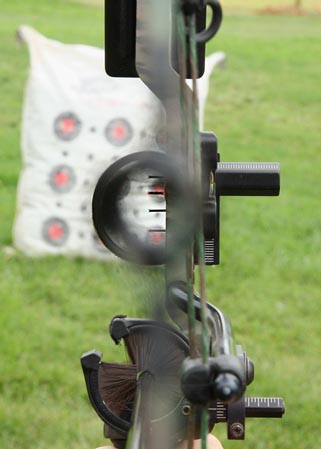
Modern compound bows generally use a round front sight and a round, rear peep sight built into the string. As you draw the string to your aiming eye, the small peep sight becomes a larger, dark, blurry circle approximately the same size as the round sight on the front of your bow. The bow is aimed by bringing the circles together, similar to a rifle scope.

Inside the front sight there are fiber-optic, glowing pins (anywhere from one to seven). The pins are set at measured distances from top to bottom. The top pin is usually set at 20 yards and each lower pin is set at ten yard increments. So at 30 yards you would use the second pin down, at 40 yards you’d use the third pin, and so on.

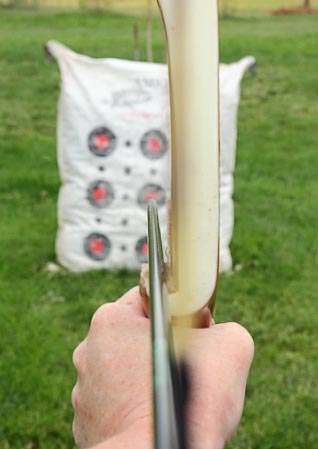
It’s important to remember that you are aligning the two circles into one circle, and then placing the sight pin on target. Beginner archers sometimes make the mistake of aligning the rear sight with the front pin instead of aligning both sights together (see examples below).

CORRECT sight picture.
INCORRECT sight picture. Align both circles BEFORE placing the pin on target.

Conclusion

For the beginner archer, compound bows can be more difficult to shoot than traditional bows (recurves and longbows) because of all the extra parts. But once you get accustom to the extra step of aligning the two circles,  you’ll quickly learn to shoot compound bows just as accurately or more.

All you have to do is align the front and rear sights, put the pin on the  bullseye and touch the trigger release (or let go if you’re using your fingers). The bow really does all the work for you.

The basic fundamentals of archery apply to both traditional and modern bows. The main difference is how they are aimed. In my beginner classes I always start my students with traditional bows and work up to modern compounds. After that, it’s up to the student to decide which weapon he/she feels most comfortable with.

Secret Bowhunting Tip #6: Put in the Time

deer_4

Secret Bowhunting Tip: Putting in the Time

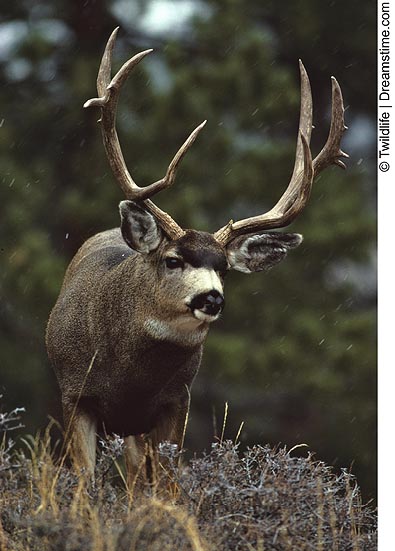
Bowhunting in August sometimes feels like doing time. Spending sixteen hours straight in the woods can be incredibly boring, hot, and seemingly futile. Because deer are most active in the morning and evening, most hunters return to camp for lunch and a nap during the day, and then head back to the field in the afternoon. But hunters beware: your odds of bagging a big buck at midday might be low, but your odds of bagging a buck at camp are near zero. However, if you learn a little bit about mule deer daytime habits, you can increase your odds of success.

In low hunter pressure areas, bucks bed down for the day around 9:00 a.m.  Between 11:00 a.m. and 1:00 p.m. deer get up for a short time to stretch, grab a quick bite, and maybe change beds to avoid the changing sun angle. Then, between 3:00 p.m. – 4:00 p.m. they unbed again to use the restroom. Depending on factors such as temperature, cloud cover, and pressure, bucks will either continue to feed or bed down until evening.

The reason we can count on these times is simple: Mule deer are browser-feeders and their digestive systems run like clockwork. Since a buck is most vulnerable when he rises from bed, we can watch for them to move during the slower midday hours.

When the hunters roll into high-pressured public areas, deer change their behavior quickly. The worst place I know of is Monte Cristo in Northern Utah. I’ve hunted this area for several years and never saw a big buck up and feeding during the day. Eating may be the primary drive for deer, but sheer survival is more important than eating.

When their lives are on the line, deer will bed before daylight and remain bedded all day until the sun goes down. They simply adopt a temporary nocturnal lifestyle in order to survive. When hunting nocturnal bucks, don’t get discouraged. They still exist somewhere; you just have to find them.

When the hunting pressure is on, bucks leave open country where they might live all summer and move to steep secondary ridges where there’s more protective cover. When looking for pressured bucks, begin your search in the steepest and thickest terrain possible. Sometimes they move to heavily wooded north-face, dark timber where elk like to live.

Learning a little about a deer’s diet will help you pin-point good secondary areas. Depending on the time of year, the primary food sources for deer in the West are bitterbrush, cliff rose, aspen leaves, and sage brush. It’s imperative that you learn you identify key food sources in your area. The best method to determine a deer’s primary food source is to cut the stomach open. Of course, you’ll have to harvest one first.

Once you’ve located these secondary ridges and hideouts–based on actual deer sightings, tracks and droppings, or other sign–the next step is to get there before first light. Deer that aren’t feeding midday still have to eat at night, and they won’t be traveling far to bed down for the day.

When hunting secondary ridges, start by still-hunting the steepest and thickest terrain you can find. Move very slowly and glass every ten steps or so. There’s nothing more difficult than hunting bedded bucks, but remember you have all day to do so!

It’s also a good idea to locate nearby water sources. Deer don’t require daily water because they get most of their moisture from the plants they eat. But they still need to water every few days, and even more frequently in hot, arid regions. Any small seep or spring will do. One way to locate water is too look for willows. Willows are easy to spot because of their tall, reddish stems. As an aside, deer also love to eat willow branches.

In my time, I’ve seen some real monster bucks up and feeding during midday, however, this is rare. Whenever possible, spend the entire day in the woods and it will eventually pay off. Hunt smarter, not harder. The fastest way to increase bowhunting success to put in more time afield.

For other “secret tips” to bowhunting success, refer back to these previous articles:

Secret Tip #1: Weight is Everything

Secret Tip #2: Success is a Decision

Secret Tip #3: Be Patient

Secret Tip #4: Hunt Alone

Secret Tip #5: Enlarge Your Consciousness

Secret Tip #6: Put in the Time

Secret Bowhunting Tip #5: Enlarge Your Consciousness


arrowheadEnlarge your consciousness. If your consciousness is small, you will experience smallness in every department of your life.
  –Robert Pante

Secret Bowhunting Tip: Enlarge Your Consciousness

I always wanted to find an arrowhead. I always felt a great romanticism in stumbling across an ancient bowhunting artifact that paralleled my own plight as a modern hunter. Well, in 2013 it finally happened. On opening morning I headed out across a steep ridgeline on my annual quest for deer. I laid my bow on the ground and pulled up my binoculars to view the new surroundings. When I reached down to pick my bow up, I noticed a small, shiny, black object lying right next to my bow. My heart leapt! For a second I imagined an ancient hunter following his instincts—just as I had that morning—and walking the same path that I was on. It was a wonderful, serendipitous moment.

Big bucks are like arrowheads. What I mean is, you might hunt for years and years without seeing a truly giant buck. But given enough experience, inevitably you’ll stumble across one. Still yet, it may take several more years before you actually get an arrow in one. But if you persist in strengthening your skills and keeping an open mind, one day you’ll wrap your hands around some trophy antlers. After that, it won’t feel impossible anymore, but inevitable. It’s all about enlarging your consciousness.

Two weeks after finding my first arrowhead, I found a second one. I was hunting an entirely different section of the unit, and after setting up camp I hiked to a nearby stream for some water. Just before I got there, my eyes locked onto another black, shiny object. This arrowhead was even bigger and more perfect than the first one. I’m not sure it was entirely coincidence.

Bigger bucks are like bigger arrowheads. It might take many years to finally bag a big buck, but once you do, they come easier. That was also the case in 2013 when I found two arrowheads and bagged the biggest buck of my life, dubbed Superbuck. The story I wrote for that deer was based entirely on building greater success off of previous success.

Entrepreneurs frequently tell a similar story: It took them years and years to earn their first million dollars, but only a short time and a lot less effort to earn their second million. As it turns out, success has more to do with our state of mind than anything else.

So, what does it mean to “enlarge one’s consciousness? When I first read this quote, I asked myself the same thing. Was I infinitely UN-successful in my finances, relationships, hunting, etc., because my vision of life was too small? Was I limited by my physical brain capacity to have a small consciousness? Was I limited by negative influences during my formative years? Yes, I think so. But I wasn’t going to let that stop me from having success in bowhunting. What I needed to do was enlarge my consciousness beyond the old-fashioned style of hunting that mostly leads to failure. So I struggled, studied, and fought against mediocrity, and after years of doing my own thing, I was finally a trophy hunter reborn.

When I set my annual goal to harvest a trophy deer, I envision a real monster buck with huge mass and a wide, sweeping set of antlers. I am conscious of the fact that there are at least one of these stud-bucks in every general unit in the state; I just have to find it. I can set this goal because I know I will consciously and subconsciously do things differently than most hunters who are just hoping to luck out on a nice four-point. I am also conscious of the near impossibility of the goal, but instead of getting discouraged, I just try harder. As it turns out, life is about dreaming big and expecting excellence.

I always wanted to find an arrowhead, and now I’ve found two. I always wanted to shoot a 200-inch trophy buck, and now I have two. I’ve always wanted to enlarge my consciousness, and now I have too.

Click here for the next tip, Secret Tip #6: Put in the Time

Secret Bowhunting Tip #4: Hunt Alone

n8_Jake2

Secret Bowhunting Tip #4: Hunt Alone

As a young hunter I frequently hunted with a buddy, whether it was out of fear of being alone or just to have some company. But in most cases we both failed to get a deer. Consequently I quickly learned to hunt alone.

The main reason why you shouldn’t hunt with a partner is because it doubles your scent, noise, and visibility to the deer. And since a partner will probably be chatting about something, it actually triples the noise you’d normally make.

An equally important reason to hunt alone is because another person is prone to challenge crucial decisions you might make when relying on your hunting instincts. Oftentimes, and for no logical reason, I’m suddenly compelled to go left instead of right. But my hunting partner is simultaneously compelled to go right! Or maybe I feel strongly about traveling uphill, but he thinks we should go down. So instead of making a simple, subconscious, instinctual decision to  do anything, you stand in the woods arguing your case. Finally you reach a compromise, and instead of going left or right, you go straight ahead into failure.

The problem with compromising—or splitting the decisions equally—you shoot each other in the foot. Your God-given instincts are rendered useless. You cease to be a predator and become a lemming. That’s the main real reason I hunt alone. Other than elk hunting where you might need a caller, or if you happen to be mentoring a youth or novice hunter, I can’t think of a single situation where it would be beneficial to hunt with another person.

That being said, each year I participate in other people’s hunts, whether it’s my son, my wife, a friend, or a family member. It’s important to pass along bits of the wisdom or woodcraft to the next generation. But these are special cases, and I’m usually not the one hunting anyway.

Sometimes, out of pity or just for fun, I’ll let someone tag along with me on a bowhunt. Some people just haven’t learned to hunt alone, or maybe I’m bringing someone to a new area and want to show them around. What I’ve noticed with most “buddy-hunters” is that they’re usually stubborn know-it-alls. The reason they don’t hunt alone is because they haven’t learned that they should. These people sometimes heed my advice, but for the most part they go right back to doing their own thing, but rarely having success. When I hunt with these people, I have little expectation for success. Sometimes I don’t even take my bow out of the sling.

One of the greatest lessons I’ve learned in life is that you can’t help people who aren’t willing to help themselves. You can lead them to the best areas, but they’re gonna make the same mistakes they always made: underestimating deer, making too much noise, moving with the wind instead of against it, over-packing, resting when they should be moving or moving when they should be sitting.

When hunting alone, safety is a much greater concern. Some areas—such as the High Uinta Mountains—are just too big and rugged to venture into alone. One false step and no one will ever find your body. But that doesn’t necessarily mean I should hunt with another person. I’m really camping with them. In the morning when the hunt begins, I’m going out  on my own. In dangerous areas it’s good to have someone else in the general area—just not right next to you.

In two decades of bowhunting, I haven’t arrowed a single animal with someone standing next to me. Bowhunting is not a team sport. If you have a regular hunting partner, that’s great. Just make sure you set out in opposite directions when your hunt begins.

Click here for the next tip:  Secret Bowhunting Tip #5: Enlarge Your Consciousness