(Story published in Eastman’s Bowhunting Journal, September/October 2013, Issue 79)
Elk Hunting’s Easy – My 2012 Utah Bull Elk Story
Elk hunting’s easy! Well, that’s what I tell my fellow bowhunters anyway. And they usually get a little irritated. But I’m only half-kidding. Compared to spot-and-stalking trophy mule deer, yes, elk hunting is easy. You can’t call mule deer; believe me, I’ve tried. But with enough practice (about ten years worth) you can call trophy elk. I ate ten tags in a row before I finally arrowed my first bull elk…but it was still kinda easy.
In 2012, after ten years of applying for the Beaver, Utah limited entry tag, I finally drew. It was probably the worst year I could have drawn since I’d just purchased a major fixer-upper house that spring. I had absolutely no time to scout the area and spent the entire summer swinging a hammer instead. But I wasn’t about to give up the tag I’d been waiting ten years for. Fortunately, my brother, Brent, had drawn a premium tag for the same unit in 2011. He’s crazy about elk–an absolute fiend–spending 30 days non-stop hunting over the entire unit. I spent a week calling for him that year, and the knowledge I gained from his hunt would prove invaluable for my own.
Surprisingly, my other brother, Russell, drew the same tag after only two years. So the plan was to hunt with him for one week in late August, and if we couldn’t get the job done, we’d return in September and hunt the last week too.
Early Attempts
Elk hunting’s easy! At least that’s what I kept telling myself the first couple days as we hiked all over the high-altitude part of the unit without a single response from the elusive bulls. On the third day, Russ and I split up; I went high and he went low. A light rain started that night as I hiked alone into some high-alpine peaks. As soon as I got there, the downpour started. I couldn’t pitch my tent fast enough as lightning crashed all around me. To say it was a little unnerving would be an understatement. But hey, elk hunting’s easy, right?
The next morning I crawled out of my damp sleeping bag and began hiking and calling. But it was all for naught. There wasn’t a fresh sign in the whole area. As I was packing up my tent to leave, however, I heard what sounded like a half-hearted bugle way back down the mountain near a small saddle. I decided to investigate the area on my way out.
Sure enough I found some big, fresh tracks and droppings headed over the saddle and down the mountain. Since I was headed that way anyway, I decided to follow. I made several cow calls along the way, but got no response. Eventually I lost the tracks in some rocky terrain and gave up my futile chase. A couple minutes later, there was an explosion of elk below me as the whole herd blew out of the area. This confirmed my suspicion: the elk were in the area, but not vocal yet.
Close Calls
I met up with Russ a short time later and he we decided to try yet another area. That afternoon I borrowed the lone ATV to go retrieve my knife that I’d left on a tree stump back down the road. I made it about a mile down the roughest, rockiest trail ever when the ATV tire suddenly jolted off a small boulder, causing the machine to veer hard right and climb the steep bank. In about one second the ATV flipped over. Realizing I was about to be crushed underneath, I did a mid-air swan dive onto the rocky opposite bank while the ATV landed upside down behind me. I was bruised from head to toe, but relieved that I wasn’t dead. One of my ribs took the worst of it and for the rest of the week I couldn’t cough, sneeze, or even sit up in bed without excruciating pain. But, I wasn’t leaving the mountain; not without an easy elk anyway.
After a very discouraging fourth day, I left the mountain. The elk rut was happening yet and I wasn’t going to waste one more day calling to the trees. On my way down the mountain I blew a truck tire on the rocky road. No big deal; I had a spare tire. Then, half an hour later while driving down the highway, my truck began to shake violently as one of my rear tires shredded into a thousand pieces. Now I was stuck. I spent the rest of the day hiking to cell phone range and then getting towed back to town where I had the pleasure of shelling out nearly $1000 for a new set of tires. I thought elk hunting was supposed to be easy!
Second Attempt
I returned two weeks later with my lovely wife (and elk caller), Esther. Since my first trip, I’d gotten a report from my brother that the lower elevation bulls were in full-rut mode. We drove to Beaver on Sunday evening, and on Monday morning we hiked a mile up the mountain and instantly had bulls bugling all around us. See, elk hunting is easy…sometimes. I probably could have arrowed an elk that morning but my poor caller (Esther) got lost behind me while I followed the herd up the mountain. Later that evening I found her back at camp and we were both a little frustrated. After educating her on the finer points of elk calling, we once again headed up the canyon. Only a quarter mile from camp, we blew a couple cow calls and two bulls came screaming in simultaneously. They met across a small ravine, but didn’t seem to care much for each other. They locked antlers and smashed and crashed in the forest for a while, raising quite a ruckus! The biggest and meanest of the two bulls finally emerged and crossed the ravine towards us. Though I didn’t get a long look at the bull, I could tell he was a solid six-point and a shooter in my book.
Keeping his distance, he circled around us while bugling and chuckling at the top of his lungs. I quickly positioned myself in a small clearing between the bull and Esther. It was about 7:45 pm as I knelt beneath a giant pine tree in the thick woods. The bull hung up at 80 yards and refused to come closer. I violently flapped my arms at Esther, motioning for her to drop further back…WAY BACK. The bulls in the area were very responsive, but they were smart and hung up well beyond bow range. Esther continued her cow and estrus calls as she dropped way out of sight.
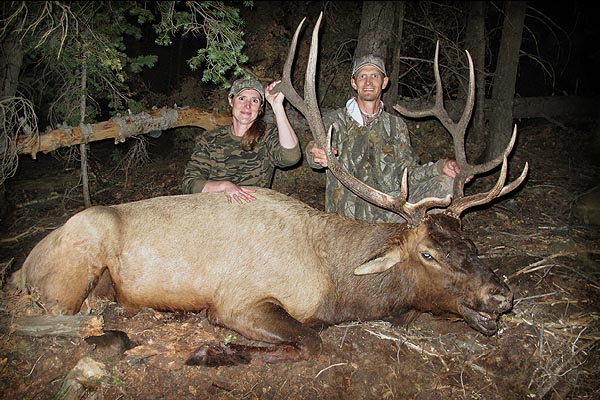
A few minutes later, the big bull couldn’t take it anymore. He suddenly appeared from behind a thicket of pines and came stomping right towards me, his huge rack rocking back and forth as he weaved through the dense trees. He was coming in fast and quickly passed a 40-yard tree that I’d ranged. He was facing me so I didn’t have a shot. At thirty yards I still didn’t have a shot. At 20 yards he suddenly veered broadside. As his head disappeared behind a tree, I swung my bow and settled the pin. A second later, his shoulder appeared and my arrow was off. A PERFECT HIT! The bull smashed away but only made it 50 yards before going down. When Esther caught up to me, I was shaking with excitement and immediately began raving on about the details of the last few intense minutes. After giving the bull a little time, we slowly crept in on him. Although the bull ended up scoring in the lower 300s, it didn’t matter to me. He was my biggest bull yet and I did it with a bow. Mission accomplished.
This part of my limited entry elk hunt ended quickly, and sure enough, it was pretty easy! But, there’s no way I could have done it without my wife and her sweeeeet elk calling. She made it easy! I suppose the hardest part of the hunt was packing that huge bull off the mountain on our backs. That wasn’t easy, but I did it with a big smile on my face.
Advanced archers make shooting look effortless, but it’s only because they’ve put in countless hours mastering the basics. Over time the many components of form become one single subconscious step that happens in the background of the mind. Here are some key tips for improving your shot.
#1: Keep both eyes open
Keeping both eyes open gives you a better sight picture. This is especially important with traditional bows. Because there aren’t any sights on a traditional bow, your focus is on the target. To acquire a more accurate target, keep both eyes open. I still do this with the compound bow, especially if I’m unsure of the distance.
Keeping both eyes open gives me more dimensionality to the target. Everything I do all day requires me to keep both eyes open, so why would I close one when shooting?
Try shooting with both eyes open.
If you close one eye, you are viewing the world in 2D, not 3D. This is not how your brain sees the world. Because I don’t view the world in two dimensions, I don’t aim in two dimensions either.
#2: Don’t Aim
Proper form begins from the ground up: feet placement, proper grip, and drawing the string to your anchor point. It ends with aiming, releasing, and following through. Of all these steps, aiming is really the easiest and least important.
In traditional archery, aiming is accomplished by simply pointing the arrow at the target. In the time it takes to master the other fundamentals, aiming will become “instinctive.” Therefore, your focus should be on consistent form and follow through, not aiming. If your form is correct, the arrow will find the bull’s-eye on its own.
Note: Correct aiming happens by aligning the string with your eye. This is done by touching the string to the side or tip of your nose. I won’t even loose the arrow until I feel the string on my nose.
#3: Touch your ear
What does your ear have to do with shooting? After each shot, your release hand should brush past your face and end up touching your ear. If you make this a habit, I guarantee your accuracy will improve.
Follow-through means your release hand continues back as your bow arm goes forward. If you allow your release hand to move forward on the shot, or up or down, then the string will be pulled–or plucked–out of alignment, causing the arrow to wobble or drift side to side.
The best way to avoid errant arrows is to follow through straight back. Touching your ear means you’ve released correctly.
Follow through by touching your ear after each shot.
#4: Don’t flinch
Where the bow goes, the arrow goes.
Flinching is a major no-no. The two biggest indicators of flinching are a) dropping or raising your bow arm at the shot, or b) lifting your head to see where the arrow hits.
Neither your head nor your bow arm should move until the arrow hits the target. It’s normal for the bow to rock forward or back on release, but your bow arm should remain up and pointed at the target until the arrow hits. Your head—which is slightly cocked to the side—should also remain in frozen in position as well.
The best way to avoid flinching is to have a surprise release. A common mistake is anticipating the shot by focusing on the release rather than follow-through.
Instead, all your focus should be on form. As you reach your anchor point, the arrow and string will simply pull free as you relax your release hand. If you concentrate the release hand, the string will jerk out of your hand causing the arrow to miss.
#5: Use your back
All the power to draw the bow comes from your back muscles, not your arms. I refer to the arms as “deadposts” or “anchors” because they simply serve to hold the bow. The real power comes from your back muscles.
Your back is much stronger than your arms, and that power is transferred to the bow through your arms. Think of you arms as electric power lines which hang loosely in the air. The lines don’t create the tremendous power that surges through them, the power plant does.
The best way to tap into your back power is to stand up straight and squeeze your shoulder blades together. Upon release, your shoulder blades will continue pulling together—almost touching—while your arms pull the bow apart in opposite directions.
Harnessing the power of your back is the only way to load the bow with enough power to execute the shot properly.
#6: Don’t pinch the string
The most common problem I see in beginner archery is simply keeping the arrow from falling off the bow. At least half my beginner students have a hard time keeping the arrow on the bow long enough to shoot. This is caused by pinching the nock.
Leave a slight gap between your fingers.
The string is gripped with three fingers: index, middle, and ring. As you draw the bow back, the fingers tend to bunch up and put pressure on the nock, which ends up pulling the arrow off the shelf.
To keep this from happening, simply leave a slight gap between your fingers as you draw. If the problem persists, try tilting the bow farther to the side and letting gravity hold the arrow for you.
As frustrating as this might be, the problem usually fixes itself over time.
#7: Loosen your grip on the bow
Frequent left and right misses are caused by torquing, or over-gripping, the bow. I call it the “death grip.” People death-grip the bow because they feel like they need to control the tremendous energy they’ve loaded into to the bow at full draw.
Heavy bows have so much power that we think they might fly back into our face if we don’t grip them tightly. In reality, all that energy simply leaves with the arrow and the bow falls limp in your hand. If you grip too tight, you’ll force the bow left or right. Remember, where the bow goes, the arrow goes.
Use a loose grip on the bow to avoid torque.
To avoid torque, simply allow the bow sit loosely in your palm while resting your fingertips lightly on the front of the grip. This allows the bow to settle into its natural alignment.
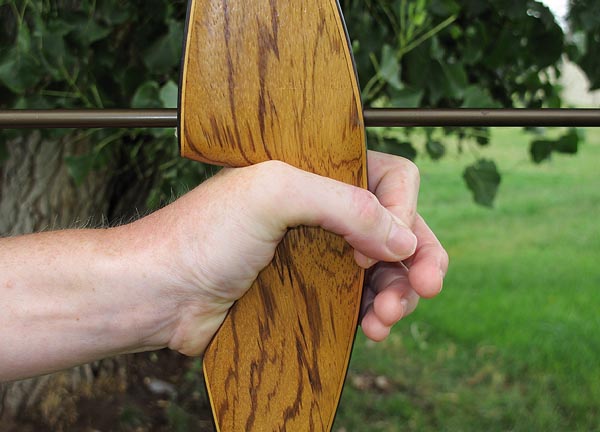
The best way I’ve found to avoid over-gripping the bow is to simply touch your thumb and index finger together and let your other fingers float in front of the bow (see photo).
Conclusion
With enough practice, anyone can master the art of archery. Just remember that hitting the bulls-eye is a long-term goal. Your short-term goal should to master the basic fundamentals. I promise you, hitting the bullseye will come naturally given enough time.
Enjoy the process and don’t get discouraged. If you have any questions at all, please leave a comment.
Never underestimate a buck! If you hunt long enough, this will ring loudly in your head. Bowhunting is a game of patience. Rushing in on any animal usually results in failure. Here are some examples.
Patience Example 1
A few years ago I went elk hunting with a person whose name isn’t Joe, but let’s call him Joe. After a long, fruitless, half-day hunt, we finally spotted a herd of cow elk bedded on a steep hillside. Since I was holding out for a bull, I let Joe lead the charge on the unsuspecting elk. What transpired was a little ridiculous.
I crouched behind Joe as he steadily climbed through the thick scrub oak towards the elk. There were probably 20-30 animals total, but we could only see bits and pieces of them. As we got closer, a bedded cow came into full view at about 90 yards and was looking right at us. I pleaded with my Joe to slow down and wait for one to feed into view, but he persisted forward, trusting in his camo to fool the elk’s eyes. At about 40 yards the bedded cow leapt from its bed and blasted away, taking the whole herd with it. Surprise, surprise.
Had Joe been just a little patient, I’m certain he would have gotten a shot. The wind was perfect and the cows couldn’t see us crouched in the brush. Some of them were even feeding around us. They felt safe and weren’t going anywhere. Even if it took two or three hours, inevitably one of the cows would have wandered close enough for an easy shot. Instead, we went home empty-handed.
Patience Example 2
In 2012 I was hunting the extended hunt for deer. On the second day I spotted a massive, tall-racked, mature 4×4 buck. He was a true giant. Unfortunately, I spotted him late in the morning as he was bedding down with a group of does. The ground was blanketed with crunchy snow and I knew it would be nearly impossible to stalk close. But I had to try. For the next seven hours I worked carefully into the area. As I got closer I literally had to break the frozen ground with my hand before placing my foot down. It was the most arduous stalk of my life. Finally, I knew I was close, but the thick oak brush made it impossible to see anything. So I just sat and waited.
Right around 4 pm I heard the crunching of hooves in the snow. By some miracle, the group of deer were up and feeding in my direction. Long story short, the buck appeared briefly in the only window I had. I misjudged the distance and sent an arrow sailing harmlessly over the giant buck’s back. Game over.
Although I failed with my shot, I succeeded in my stalk—a stalk that burned up then entire day. The failure still stings today, but not as bad as if I’d simply rushed in and blew out the deer.
Conclusion
In bowhunting, the hunt only just begins when a deer is spotted. Having patience and getting close is the real challenge. But if you are patient, there is almost no buck you can’t get close to. Since hunters are really predators, we can learn from studying other predators. Have you ever watched a lion stalk a gazelle on TV? Have you noticed how carefully, calculated, and slowly it’s done? Wild predators have innate and instinctual patience. Otherwise they will starve.
Next time you’re on a stalk, remember the lion in the grass. He might not be successful every time, but he never gives up and he moves with eternal patience. Be a predator; be patient and let nature unfold at its own pace.
It took me half a lifetime to really understand that success in bowhunting is a decision. Failure comes not from luck, but from failure to commit to the goal. The decision to succeed is not made a week or two before the hunt, but the very second the last season ends.
Setting Goals
In sharing this insight with other bowhunters, I’m usually met with some hesitation. They want to agree with the premise, but don’t really understand it. So let me explain:
When I make the decision to succeed—to arrow a great buck—I set a goal for the entire year. And it’s not just any goal, but the most difficult goal to reach. It’s so difficult because there are just too many variables in bowhunting and no guarantees. What if I simply can’t find a good buck this season?
By setting such a lofty goal, one’s mind begins making immediate preparations to accomplish it. Throughout the year, this goal is broken down into planning, studying, shooting, equipment preparations, mind-set, and a myriad of other sub-goals.
Keeping this primary goal in the forefront of my mind, I find myself making daily decisions to achieve it. One example is to block out my intended hunting dates on the calendar. No matter what opportunity or responsibility arises, I absolutely refuse to alter my schedule. This year alone I’ve turned down two potentially profitable jobs that would’ve interfered with my hunt dates.
Admittedly this can be very difficult for some people. Most jobs will allow one week off work, or two if you’re lucky. The sad fact is, if you let your all-important job interfere with your hunting schedule, then you can’t set the goal in the first place. The decision isn’t yours to make.
Setting such big goals sets a precedence upon which failure is not an option. If you are truly committed to a goal, subconsciously you will make mental and spiritual goals which you aren’t even aware of; goals which will seemingly magically bring you and your quarry together into a single space and time. I believe there are unseen forces in the universe that want you to succeed; that are willing to help you if you let them. You just have to want it bad enough. This is the only way to beat bad luck.
Conclusion
As mentally and physically prepared as I might be, bowhunting often feels overwhelming at times. I believe that bowhunting trophy bucks–both successfully and consistently–is the hardest thing a person can do. I also know that there are greater forces at work than I can ever understand which increase my odds. Some call it the power of positive thinking. Some call it Zen hunting.
There is nothing more magical than the breaking dawn of a season opener. And there is nothing more deflating than last light of an unsuccessful season closer. I have no intention of ever experiencing a failed season again. I’ve made the decision!
After nearly two hours of coaxing the massive bull elk in, exchanging bugles and blowing cow calls, he’s finally within bow range. But as I raise my bow ever so slightly, he catches my movement and whirls away. The charade is up. I’m busted; but I don’t care. Just to be part of such an exciting experience up here in the High Uinta Mountains has been worth it. Desperately, I blast another cow call. The bull stops and looks back in my direction. It’s not over yet…
It all started a year ago when my brother, Brent, and I hunted this area for a week with hardly a response from the nearly nonexistent elk. On the last day of that hunt I jumped over to the next drainage where I found myself literally surrounded by elk. Unfortunately, it got dark before I could get a shot. But it gave us hope for next year—actually, it gave Brent hope. As for me, I realized long ago that the only way to avoid a disappointing elk hunt was to stay home.
For fifteen years I felt detached from the prospect of actually shooting a bull. In the years that deer came easily, elk remained ghosts in the woods that I hardly ever saw. A great chasm had grown between me and the majestic elk. Seeing their caricatures in magazines, artwork, and free mailing labels never connected with me.
Just getting away from work and my relentless projects was nearly impossible this year. As the hunt drew near, I worked seventeen hours a day just so I could get away for five days. On Monday morning I finally managed to escape the cold, steely claws of responsibility, and literally ran out the door to my awaiting 4×4.
Three hours later, I was standing on the side of the worst dirt road I ever saw, watching my rear tire deflate in front of me. Suddenly a truck came ambling over the hill; lo and behold, it was brother Brent. He climbed out of his truck wearing an ear-to-ear grin that only a successful elk hunter could wear. While loading my tire with Fix-a-Flat, Brent recounted the exciting details of his hunt and how he was able to call his bull in for a fifty-five yard shot.
At that moment, any rivalry we had about “who’s the better hunter?” was gone. I was just glad somebody finally nailed down a branch-antlered elk after twenty years of hard hunting. I was honestly very proud of him, however, as I prepped my pack to head into the hills, I turned and said half-jokingly, “Well, I’ll just have to find a bigger one!” He replied, “Do it!”
Three and a half miles up the mountain I’ve located two bright yellow tents hidden in the trees: my new home for the week. It appears no one’s home, but I let out a little “locater bugle” just in case. My other brother, Russell, suddenly jumps out of his tent with bow in hand, and I laugh. He’s seen so much action up to this point, that he’s sure a bull has just wandered into camp.
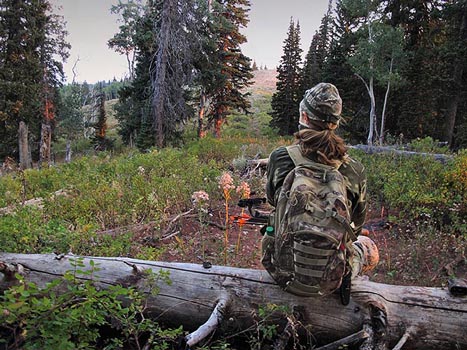
Elk Camp, 2009
We have about two hours of good light, so after catching me up on all his recent elk encounters, we head off to a nearby meadow. The evening falls quickly, and as expected we get no response from our calling. I sleep well that night with nary a vision of antlers dancing in my head.
5 a.m. comes way too soon, but I’m ready. Bowhunting is what I practice year-round for—it’s what I live for. We head out in the dark up a steep and rocky trail leading to a large meadow a mile away. This is where we’ll begin our first “set-up.” Our typical set-up goes something like this: Russ and I sit down about 50 yards apart and begin a series of cow-mew calls to imitate a herd of elk. After a minute, one of us lets out a series of estrus (cow in heat) calls followed by a lone bugle. Then we wait for a response. We repeat this process every five minutes for up to forty-five minutes. Then, as is usually the case, we look at each other in disappointment and try again somewhere else. This set-up is no different.
Farther up the mountain, we do our second set-up and again, there’s no response. Now this is the elk hunting I’m used to, and I’m thinking this trip will be just like all the rest…whoo-hoo! Most years, I’m cold and shivering half-way through the first routine, but this morning is surprisingly warm, even at 9000 feet. This will likely force the elk to bed down early and probably hurt our odds. Again, I prepare for disappointment.
By disappointment, I’m purely talking about my yearly lack of elk steaks and back-straps that a lowly artist needs in order to survive the winter. Don’t get me wrong, every minute spent traipsing through Utah’s gorgeous backcountry is savored. It’s what keeps me coming back each year, even after eating “tag soup.” I love the smell of the woods, the truly fresh air, and especially the quietness. I love sitting beneath the lodge pole pines that reach forever upward towards the clear skies, bald peaks, and fast moving clouds. There are pinkish rocks and boulders strewn everywhere, which provide a quiet foothold on an otherwise crunchy, pine-needled forest floor.
I love watching all the wildlife too: the moose, the deer, the odd high-altitude birds with their strange songs, and even the annoying squirrels and chipmunks that jump from branch, barking at us for invading their territory. They’re all here with the elk, living together in harmony. I soak it all in, becoming happily alienated from the contrived reality back in the city.
A little while later we’ve arrived at Chuckles Point. It’s a high mountain point named by Brent who once got a great response from a bull he affectionately named Chuckles because of its distinctive bugle that ended with a series of chuckle-laughs, as if to mock his efforts.
Russell at Chuckles Point.
There’s fresh elk sign here, so we get set up again. This time, halfway through the routine we get a clear return bugle. Game on! Suddenly I remember what I’m doing up here. Russ and I alter our routine with a series of cow calls to draw him in. The wise old bull is interested, but hangs up and refuses to come closer. Each return bugle becomes quieter, indicating that he’s moving farther away. If we cows aren’t coming to him, he’s not coming to us. Eventually, the bull is gone.
It doesn’t help that each time we set up, the wind changes—swirling one way, then the other. As luck would have it, the wind continues to shift like this all day. Later, when the wind has driven Russ completely nuts, I tell him, “Who cares [how we set up], the wind is just gonna change anyway…” But being a newbie to the elk hunting arts, he still has hope, which I find amusing.
Our next three set-ups are uneventful as we manage only an occasional, far-off call back. It’s 3:30 p.m. now; it’s hot and we’re exhausted. It’s nap time. My dusty day pack makes for a fine pillow; the thick pine-needled ground makes for a soft bed. At this elevation dreams are strange:
A giant bull appears at twenty yards, but as I draw back for an easy shot, I notice an old woman riding atop the beast like a horse. She’s okay with me shooting though, and moves her leg so I don’t hit her…
The sun is dropping and shadows are getting long; it’s wakeup time. Russ and I make our way to Rub City, so-named for the abundance of trees rubbed and thrashed by mighty elk antlers over the years. When the elk are in this drainage, this is their bedroom; it’s where they live and rest during the day.
To begin our routine, I split off from Russ and head uphill. Thirty yards uphill, I am surprised by an explosion of animals as a group of bedded elk jump to their feet and go crashing through the timber. I make an immediate cow call which stops one large cow at forty yards. She stands there staring back, but then the wind swirls. Just as Russ catches up, the cow lets out a strange alarm bark and trots away. It’s exciting to actually see elk, but at the same time I’m disappointed that we busted them. Well, that’s elk hunting. This has actually been the most exciting elk day ever; we actually saw and heard elk, which is truly special.
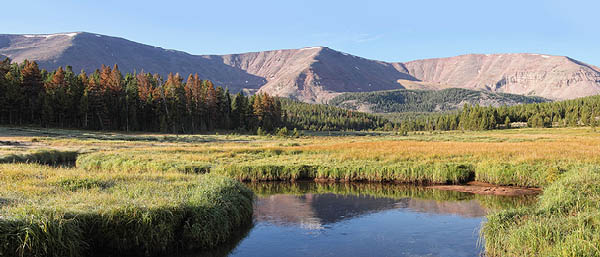
High mountain stream.
It’s around 6 p.m. now, and we have time for maybe one or two set-ups before dark. We finally arrive at our destination: the far eastern end of a large meadow we call Eight-Cow Meadow. It’s a secluded east-to-west meadow, very long and oval-shaped, widening to about 200 yards at the middle. Russ and I set up fifty yards apart at the edge of the tree line in hopes of drawing an elk across the meadow from the opposite wooded side.
Our call routine goes on and on and eventually my ears can no longer take the barrage of squeaks and squeals from the loud calls. I love quietness in the woods and this grand cacophony is the thing I hate most about elk hunting. Annoyed, I proceed to stuff wads of toilet paper into my ears.
So here I am sitting flat on my butt with my bow lying on the ground, and after forty-five minutes of calling, I’m looking back towards Russ and wondering when we can finally surrender to the empty woods. As I finish yet another routine bugle, suddenly BOOM, a big nasty bull screams at us from the left. In one fluid motion I hop to my knees, snatch up my bow, knock an arrow, and swing around to face the noise. He’s close and should erupt from the woods at any second. All senses are on high alert and my first thought is, the wind is bad, blowing steadily in the bull’s direction; he’ll surely blow out of here.
A minute later, everything is still quiet. Our eyes are transfixed on the thick woods. The bull has hung up and is silent, staring back at us and listening. We have to do something quick or he’ll leave. Russ blows a couple estrus calls, and I let out a small bull bugle. Since the bugle got him to respond in the first place—and since he sounds like a big bull—he’ll probably be happy to fight off a smaller bull for some cows. Another minute passes. Then suddenly, the same throaty bellow shatters the air; same distance, different direction. It sounds as if he’s circled around to the trees on the opposite side of the meadow. Russ scrambles over to me as we try to figure out exactly where the bugle came from. I’m certain that it came from the opposite side of the meadow, but Russ thinks it might be behind us…but he’s not sure.
We decide to sprint across the meadow to close some distance and try to draw him down from the trees above. Russ offers to do the calling while I sneak up into the steep woods to intercept the bull. Not gonna happen. As I go sneaking into the woods, we get the same bugle and chuckle, only now it’s coming from the side of the meadow we were just on! It occurs to me that the bull was actually behind us (as Russell previously thought) and his bugle was reflecting off of the wall of trees across the meadow (where we are now). In other words, we’re on the wrong side. Oh well, we’re here now, and in a millisecond my role changes from hunter to caller in hopes of drawing the bull back across the meadow towards Russell who’s waiting at the meadow’s edge.
I am completely energized, certain I can coax the bull in to the shooter. I run farther up into the dark woods and make more calls. I want to make the big bull think I’m a little bull running off with the cows. The bull keeps responding to my calls, but the farther I go up the mountain, the more distant his bugle sounds. He knows something isn’t right and isn’t coming any closer—smart bull.
I blow more calls, then grab a tree branch and begin smashing the limbs off a dead tree, attempting to mimic a frustrated bull tearing up a tree with his antlers. Next, I grab a bunch of large rocks and roll them down the hill to mimic hoof sounds. There’s no hesitation; this craziness is absolutely necessary to convince the bull that I’m a herd of elk. But all remains quiet, and I’m afraid he’s not buying it.
BOOM, anther bugle sounds, only now it’s coming from farther up the meadow. The bull has outsmarted us and is moving away, skirting just inside the tree line on the opposite side of the meadow. I run through the trees on my side, paralleling his movements and stopping occasionally to make cow calls. His response is becoming less frequent. I have no idea where Russ is at this point, so it’s every hunter for himself. Russ tells me later how he crossed back to the bull’s side of the meadow in attempt to close some distance.
At mid-meadow I’ve managed to mirror the bull’s movements according to his calls. The sun has dropped behind the mountain and darkness looms. My chances of ever seeing the bull are shrinking by the minute. Oh well, the excitement thus far is more than you could ask for. But it’s not over yet; I blow more calls, break more sticks, and roll more rocks. The next bugle is very loud and much closer. I can’t believe it; the bull has actually entered the meadow and is coming my way! Quickly I descend towards the meadow edge. Fifty yards from the meadow, another bugle erupts and I freeze. Through an opening I see a massive, tan elk body and dark antlers moving towards me. My eyes widen, my heart races. I don’t have to count tines. This is a wily old herd bull—a real monarch.
At the edge of the meadow there’s a giant pine tree that I can keep between me and the bull. When I get there, I crouch behind the massive trunk and mess of lower branches. From this vantage I can see not one, but two elk; the big noisy bugle-boy and a smaller elk (probably a cow) holed up on the opposite side of the meadow. The bull is walking back and forth in the middle of the meadow.
I hear Russell’s estrus cow call farther down-meadow and I’m relieved. It keeps the wary bull interested and distracts him from his even warier cow. The big bull turns and walks towards Russ, then changes his mind and walks back towards the cow. I take a yardage measurement: 114 yards away, twice the distance I need for a clean shot. To make things worse, the cow turns and trots back to the trees with the big bull following behind. He’s about to exit the meadow altogether and in ten minutes my sight pins go dark.
Pointing my elk calls toward the forest behind me, I start making desperate cow calls. The bull pauses, looks in my direction, then slowly turns and begins zigzagging towards me. He’s in no hurry and keeps stopping to look around. When he stops, I let out a call: estrus, bugle, mew, bugle, mew, estrus—whatever keeps him coming. This intense game of cat and mouse is working! Half-way across the meadow he lowers his head and tears at the ground with his giant rack, ripping up grass and mud and tossing it in the air. Frustrated and ready to fight, he keeps coming steadily to my calls. He’s almost within bow range now. Kneeling behind the big pine tree, I’m frozen like a statue with one crazy eyeball peeking through the branches.
After nearly two hours of calling I’m once again focused and calm. Closer and closer the bull comes, staring right through me. I can’t range him; I can’t even move. His head goes down and my rangefinder goes up. It reads 40 yards exactly. But as I raise my bow ever so slightly, he catches the movement, jumps, and whirls away. The charade is up; I’m busted! Desperately I blast another cow call from my Hoochie-Mama. He stops and looks back. Unsure of what I am, he veers left and starts quartering away quickly. It’s now or never. I figure he’ll probably see me draw my bow, but it’s my only chance. The sight pins scroll over his ribs, 20, 30, 40, 50; 50 yards is about right. Through a little twelve-inch opening in the branches, my arrow is off, streaking through the growing darkness.
Shot location.
THUMP. A strange sound rings out and the elk takes off trotting through the meadow. I didn’t see where my arrow went, but it sounded like a hit. Immediately, I blow a couple shaky estrus calls. The bull slows down and glances back at me occasionally as he continues away. Did I miss? About eighty yards into the meadow the bull suddenly jumps to his right like he’s losing balance, takes two more steps and just tips over. A weird cloud of surrealism washes over me. When I see that he’s not getting up, I burst from my cover and run into the meadow yelling, “HE’S DOWN! HE’S DOWN!”
Russ yells back from across the meadow, “WHAT?”
“HE’S DOWN! I GOT HIM!”
Russ appears running through the meadow towards me. “WHERE?” he shouts.
“Right there in the middle of the meadow; that’s him,” I say, pointing to a light colored pile sticking up out of the grass.
We exchange a very excited high-five and begin poring over a myriad of questions, trying to make sense of the last two hours. As we approach the mighty beast, I’m still in a daze. Russ begins counting tines, “Five-by-six,” he says. I have to reach out and touch one of the massive antlers to convince myself it’s real—but it doesn’t work. This situation, the intensity, the timing, the sheer lethality of a perfectly placed shot—the whole event is unquantifiable. There’s no way to ground my thoughts and feelings in an impossible situation that I don’t even trust. I give Russ my camera for documentary reasons, like when you see a UFO or Sasquatch. It’s not until I sit upon the bull’s massive body and feel its warmth in the cold night air that I feel a connection with reality again.
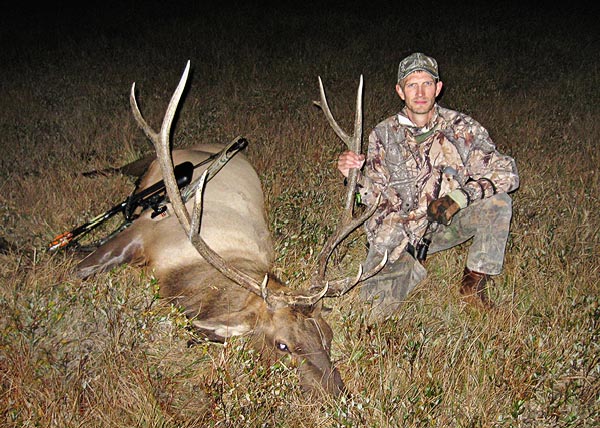
My first bull elk.
The arrow hit just behind the last rib, angled perfectly through the vitals, and lodged in the opposite front shoulder just under the hide. An absolutely perfectly placed arrow at fifty yards adds even greater mystery to a perfect hunt that still perplexes me today. Admittedly, I am a decent shot, but under that kind of pressure, not to mention shooting through tree branches and low light, maybe I was just lucky. To my credit, I think my year-long practice paid off. Too many botched shots on the previous year’s deer hunt caused me to obsess over shot placement all year long. And in the process of refining my skills, archery evolved from a fun hobby-sport to a way of life.
As we quartered the animal out by headlamp, I mentioned to Russ that this hunt had happened on a razor’s edge of perfection. It couldn’t have happened any other way; there were just too many variables. For example, a week-and-a-half earlier I had taken a perfect, fifty-yard broadside shot at a deer and missed wildly, only to learn that my new broadheads flew erratically outside of thirty yards. Thus, I replaced them right before this hunt. On that same hunt, I put a stalk on a small bull and was ready to take a forty yard shot when the wind changed and blew the herd out. Had the wind been different just a week earlier, none of this would have happened.
Special thanks are in order to the following people who made this hunt possible: Mom and Dad for packing the meat off the mountain, Brent for letting me use all his fancy camping gear, and Russell for all the extra elk calling, water filtering, meat hanging, and BS’ing. Unlike deer hunting, elk hunting is a great opportunity to spend quality time with family and friends in the great outdoors.
(Story published in Huntin’ Fool Magazine, Aug. 2011, Vol.16, Issue 8)
My Droptine Buck Hunting Story
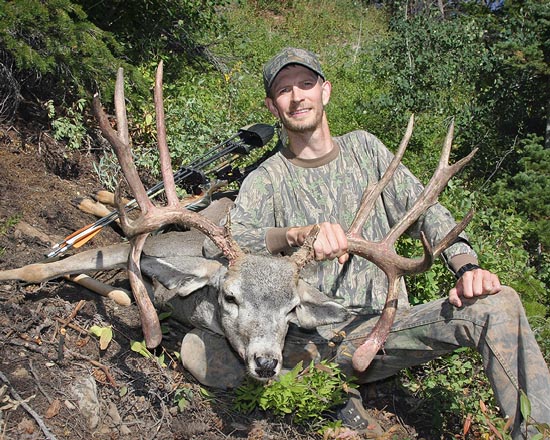
I first spotted the great buck, which I simply called “The Droptine,” during the 2008 archery season while hunting public land in the Wasatch-Cache National Forest in Northern Utah (known as Monte Cristo by the locals). He was the most amazing buck I’d ever seen, with a wide sweeping rack and long, matching, club-like drop tines hanging down below his ears.
I was exploring a steep, wooded hillside that morning when I bumped the incredible buck from his bed at the edge of some pines. As he quartered away I was able to get off a quick shot, but in my haste I misjudged the yardage and my arrow flew low. The arrow hit some dead-fall, splintered, twirled through the air, and bounced off the deer’s rump. I merely spanked him and then he was gone.
Having never seen a buck of this magnitude in the wild before, I became instantly obsessed. But for the remainder of the season I was unable to relocate him.
Monte Cristo is your standard north/south rocky mountain range in Northern Utah. It has everything mule deer love: tall mountains covered in aspen and pine trees, steep canyons with long ridges that drop into rolling sagebrush hills. Water is scarce, but adequate enough to support plenty of deer and elk.
For decades Monte Cristo was one of Utah’s premier deer hunting areas, but in recent years deer populations have declined due to high hunting pressure and diminishing winter range. With very few peaks from which to glass, and covered in dense timber, Monte Cristo is not a spot-and-stalk area. Big bucks are only found by busting brush in steep wooded areas, making it very difficult to locate them with any consistency.
Round 2
In 2009 I planned to hunt exclusively for The Droptine for six days, beginning where I left off in 2008. But the great monarch eluded me until the third evening when he busted out of some trees 40 yards uphill, stood for a second atop a sagebrush knoll silhouetted against the twilight sky, and then disappeared before I could raise my bow.
By the sixth and last day I was getting desperate. My plan was to carefully still-hunt the entire mile-long ridge where he lived. For twelve hours I snuck slowly through the woods without rest, glassing every inch of forest for antlers. But he was nowhere to be found.
I was both physically and mentally exhausted when I reached the end of the ridge. With my head hung low, I turned back towards camp. Seconds later, as I rounded the end of the ridge, The Droptine suddenly exploded from a bed 40 yards below me in a thicket of trees. Through a cloud of dust I watched the big barrel-bodied deer bound away. I could hear him running for half a mile, down the canyon and up the other side.
I thought I was going to cry as I plopped down on a dusty game trail and dug my GPS out of my backpack. That day he had bedded half a mile from the last place I saw him. How do you hunt a deer that doesn’t move in the open during daylight; that is never found in the same place twice and instead, shows up at random like a ghost? The wise old buck lived a life without pattern; that is how he eluded hunters for so long.
The 2009 season was over. Every night for the following year, when I turned out the lights before bed, the image of The Droptine silhouetted against the sky would pop into my head. I lay awake night after night pondering the mistakes I made and planned new strategies for taking the mystical beast the following year. I was Ahab, and he was my white whale.
In the summer of 2010, as soon as the snow melted off the mountain, I went scouting for The Droptine, but wasn’t able to locate him. A week before the August archery opener, my brother Brent spotted The Droptine while checking trail cameras in the area. Those trail cameras, by the way, never did capture the ghost’s image.
Meanwhile, back home the Great Recession was taking its toll on my photography business, leaving me with a lot more time than money. I decided to use this to my advantage, planning to hunt The Droptine on two separate trips totaling ten days.
Round 3
The archery opener started off slowly, but on the fourth morning, while sneaking to one of The Droptine’s old bedding areas, he, along with two smaller bucks, busted out of some new beds fifty yards below me. That was the last time I saw him that week.
A second five-day outing the following week turned up nothing and I finally accepted the fact that the old buck had grown tired of my chasing him and moved to another mountain. There was no choice but to give up. He was clearly a buck beyond my caliber, and I had already wasted too much time and too many tags pursuing him. I thought about all the other hunting opportunities I’d sacrificed just to chase this one deer. I was ready to make peace with my failure once and for all.
The next weekend, which happened to be the last day of the archery deer season, my girlfriend (now my wife) Esther and I embarked on a two-day elk hunt on a ridge parallel to the Droptine ridge. I’d seen more elk in this area and was hoping for a cow or spike bull. But all I could think about was The Droptine buck and how dejected I was. Esther lent a sympathetic ear to my rant:
“No one’s going to kill that buck. He’s gonna die of old age in a field one winter and there’s nothing I can do about it.” I didn’t digress. “I wish I’d never seen him, at least then I could enjoy deer hunting again. And yet, I’ll return again next year to chase a ghost through empty woods. I have no choice…”
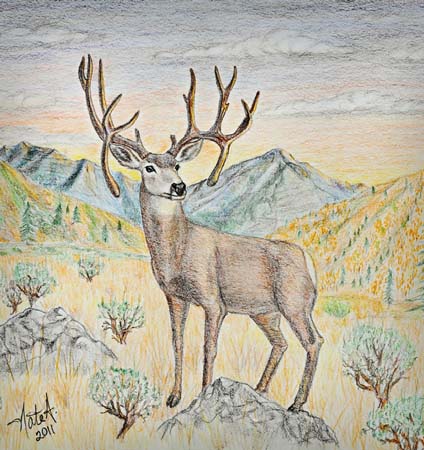
The Droptine Buck painted by Utah artist Gina Bryson.
The next morning we woke before light and snuck into the elk area, setting up on opposite ends of a steep timber swathe used as a bedding area. Everything was still and silent as I sat watched the big September sun slowly rise above the horizon. I was beginning to question our setup when I suddenly caught movement of wide antler tips swaying through the brush 50 yards downhill.
“Great,” I thought while raising my binoculars, “The elk are finally coming in!” But through the glass a deer’s head appeared, then two huge droptine clubs! I couldn’t believe it. Three years spent hunting for this creature, and now here he is walking right towards me!
The buck slanted behind a sparse line of pine trees, offering no shot. I was frantically searching for a shooting lane when I realized the tree line he was following ended abruptly right in front of me. If he kept his course, he’d pop out 20 yards away!
A quick glance at the grass to my left indicated the wind was starting to swirl. This is never going to happen, I thought. He’s too close. But the buck kept coming, slowly and cautiously at first, then picking up speed.
At that point I was a nervous wreck; my hands were shaking uncontrollably and my heart pounded so loudly that I was sure the buck could hear it too. In a full-on panic I glanced down at a sticker on my old Browning bow which reads, Stay Calm, Pick a Spot. Okay, at least I can pick a spot, I thought as I drew my bow back.
A second later the buck’s shoulder appeared and the arrow was off; I don’t even remember releasing it. As the huge buck spun and blasted out of sight, I caught a glimpse of my orange-fletched arrow sticking out of his side.
Shot location and distance.
Suddenly everything was quiet again, as if nothing had happened. I sat dumbfounded for a second, awash in a swirling mix of disbelief and adrenaline surging through my body.
In an instant, I dropped my bow and went sprinting back through the woods towards Esther. She hopped out from behind a stand of pines, bewildered at the sight of a crazy man flailing towards her.
“I just shot my Droptine buck!” I yelled. At that moment, The Droptine had finally become My Droptine.
A tedious, half-hour tracking job over a sparse blood trail eventually led to the downed deer. The arrow had pierced both lungs, but the huge buck still covered 150 yards in great bounds down a nearly vertical slope. He expired in a brushy area, landing on landing on top of his sprawling antlers which anchored him from sliding down the mountain.
At the sight of the downed deer, a sense of relief and accomplishment washed over me that can never be equaled. After three years of failure, my wildest dreams had come true. I was finally liberated from my obsession.
Still in a daze, Esther and I pried the mighty buck free of its tangle and marveled at his majesty. I’d watched, even in fleeting glimpses, as The Droptine grew bigger and more spectacular than I ever could have imagined.
~ The End ~
*** Incidentally, the Droptine’s rack measured nearly 33-inches wide and gross-scored 201 5/8 (194 6/8 net P&Y). ***
In this article I’m going to address weight issues. No, I’m not talking about your waiste line. I’m talking about unnecessary items we carry into the field that may be hampering our success.
Utah offers a great opportunity for bowhunters who still have unused archery tags at the end of the general elk and deer seasons. It’s called the Wasatch Extended Archery Hunt. The “extended hunt” runs from the middle of September through the end of December, and encompasses the entire Wasatch Front and the deer rut. I usually see more giant bucks during the extended hunt than the whole general season. The biggest downside to the extended hunt—particularly in November and December—is the steepness of terrain coupled with deep snow and cold weather.
In November of 2012, I hunted the extended hunt for a few days alone. There’s always a little apprehension about venturing into those freezing mountains alone; I really never know where I’ll end up exactly either. To feel more secure on that trip, I brought tons of extra gear, including extra clothing, food, water, hand warmers, boots, and even some reading materials. In other words I over-packed, and that was a big mistake. Instead of taking three hours to drag my sled to camp, it took five hours and I didn’t get to bed until 1:00 am.
For the duration of the trip, my legs cramped, I blew through my water, ate more food than usual, and was forced to rest more frequently. Although it was warmer than previous years, I was more tired and miserable. Miraculously I arrowed a decent buck two days in, but with so much camp weight on top of my deer, I had to leave half my gear on the mountain and return the next day to retrieve it. Not fun!
Extended Hunt Redo
In 2013 I returned to the same spot, only this time I brought my brain. Before the trip I went over the list of junk I hauled up the mountain last year and then crossed out almost half of it. Most of that extra stuff served only to make me feel safer and had no real use for hunting. Some of the items included extra food, water (I could just filter water as I went and /or eat snow), extra boots, a pillow, books, propane, extra knives, hand warmers, utensils, batteries, archery tools, a handgun, extra flashlights, lighters, etc.
I also noticed that my big, leather hunting belt weighed twice as much as my skinny “church belt,” so I wore that one instead. I even cut the tags off my clothes and the handle off my toothbrush. All in all, I probably removed 30% of my original pack weight, and man did it pay off. I got up the mountain in record time, ate less food, and covered more ground. You might be surprised at how difficult it is to be quiet while wearing a heavy day pack. In the end, I didn’t miss any of the junk I left home. Well, I did miss my handgun when I learned there was an active cougar den with kittens only 300 yards of my tent!
It’s hard to believe that such small items matter so much. It’s the result of the compounding effect. You never know which erroneous item will be the straw that breaks your back.
Weight and Snow Hunting
Weight is especially a negative factor when hunting in snow. More than anything else, a pair of heavy boots will fatigue you out in the snow. For years I had two boot options: First, a heavy, high-top, insulated cold-weather boot, and second, a lightweight, breathable, un-insulated stalker-style boot. In 20I3 I stopped using heavy boots altogether. What I found was the heavy boots always got too hot due to the extreme terrain. They were also noisy and very heavy compared to my stalker boots.
Now, the stalker boots weigh half as much (similar to tennis shoes), but there are two minor drawbacks. First, my feet always got cold when I wasn’t moving, and second, they had minimal traction, or tread. To counter the cold, I simply wore two layers of wool socks. As for traction, I simply strapped on a pair of lightweight ice cleats which worked wonders in the snow.
Conclusion
The next time you return from a grueling backcountry bowhunt, I suggest you empty everything in your backpack onto the living room floor and make a list of whatever you didn’t use. Is there still a tag on your tent? Why did you pack it into the woods? Were you going to eat it? Is there half a tube of toothpaste left in your toiletries pocket? Extra paste is a waste of space.
Weight is everything. That was the lesson I learned in 2013. And surprise, surprise, fear is your worst enemy. Fear is why we over-pack. The more afraid of the mountain we are, the more extra stuff we cram in our packs. And then there’s the great gear paradox: the more we fear failure, the more hunting gear we tend to carry around in our daypacks.
Bowhunters need to realize that they are the predator, not the gear on your back. You are too be feared, not the mountain. All that extra weight is an anchor keeping you from your goal. Pack light. Don’t be your own worst enemy. Be prepared, not over-prepared.
Three years ago I took my son Jake to the Sawtooth Range in Northwestern Utah for his first muzzleloader deer hunt. It was a bust. There were too many people and not enough deer.
While bowhunting on Monte Cristo last year I stumbled upon a promising new area that few people know about. There’s a secret meadow there, on a steep slope surrounded by dense woods. The first time I came across this meadow I found a nice 3-point buck feeding leisurely along. I passed up this buck in hopes that he would still be there for Jake’s fall muzzleloader hunt.
In September of 2011 I took Jake to that little meadow, but lo, there was no 3-point. Instead, there was a giant, heavy racked 4-point bedded on the opposite side of the meadow’s edge. At the same instant we spotted him, he spotted us and stood up, offering a perfect broadside shot at only 75 yards.
Well, Jake had only practiced shooting square targets, and as much as he struggled to get this mighty beast in his sights, he just couldn’t do it. Frantically, I whispered, “SHOOT, SHOOT, SHOOT, SHOOT…” But didn’t. Instead, the buck turned and disappeared into the trees.
At that point I almost blew my lid. “Why, WHY didn’t you shoot?!” I implored. Jake replied, “I couldn’t see it in my sights good enough.” I wasn’t entirely sure what that meant, but what could I do? I was a frazzled mess as we trudged back down the hill towards camp. The next day was a bust and we went home empty-handed.
The following year, in spring of 2012, I went to Sportsman’s Warehouse and bought Jake a life-size, cardboard deer target. Never again would we shoot at a square paper target. A square target looks nothing like a deer or anything else you might find in the wild. So, he practiced on that deer-shaped target during the summer as we made plans to return to Monte Cristo and our secret little feeding meadow in fall.
On the second evening of the hunt, we climbed up the mountain and sat in the trees at the edge of the meadow. Just as the evening light was fading, we heard a rustling in the brush. Sure enough, a respectable 3×4 buck with tall antlers slowly materialized at 75 yards away. It wasn’t the same great buck as last year, but it was just fine for us.
Jake got into shooting position, but the cover was too thick for a shot. Fortunately, the buck continued feeding along right towards us. At fifty yards the buck suddenly jerked his head up as it recognized us as humans. Jake was ready and shot. As the smoke cleared we could see the deer prancing down the hill unscathed.
We walked over to where the buck was standing and there was no blood. Jake missed, plain and simple. This time I wasn’t upset and just asked him what went wrong. After thinking about it for a minute, he figured he must have dropped the gun at the shot, causing the bullet to travel beneath the buck. In other words, he didn’t follow through. At that moment, the feeding meadow would forever be called, “The Learning Meadow,” as Jake was learning valuable lessons there with each trip.
The next day, there were no bucks anywhere near the Learning Meadow. Another lesson: You can’t shoot at a deer one day and expect him to return the next.
On Monday, we sat in a promising new area with lots of deer sign. But Monte is a tough place to hunt and we saw not deer. Shooting light was fading fast when we decided pack it up and move uphill towards the Learning Meadow. Maybe we’d catch a last minute buck in the open. As we approached the top of the draw opposite the Learning Meadow, a deer suddenly jumped out of the trees in front of us and bounded across the open sagebrush hillside.
Right away, I could tell it was a buck; a small buck, but a legal buck nonetheless. I asked Jake if he wanted to shoot it, and he said yes. Unfortunately, the buck was bounding directly away from us and offered no shot. Jake dropped to one knee while I set up the shooting sticks in case it stopped. Near the top of the ridge, 120 yards away, the buck paused and turned broadside to look back at us. Jake was ready. Through a cloud of white smoke we watched the buck drop straight down like a sack of potatoes. Neither of us could believe it!
Jake’s eyes were wide with excitement as he stood over his beautiful trophy. I congratulated him and told him I was proud. The buck fell only a hundred yards from the Learning Meadow. Later that night, we dragged that little buck right through the Learning Meadow on our way back to camp. We took a break there. The meadow was dark and mysterious, but the lessons Jake learned were still there, burning bright as day.
How to Release an Arrow: Traditional Recurve and Compound Bow
In this lesson you will learn how to properly release an arrow.
Nocking an Arrow with Traditional Bows
The end of the arrow has a notch in it called an arrow “nock”. The nock attaches to the string just below the “nocking point.” The nocking point is a fixed point on the string that aligns the arrow with the bow for every shot. On most bows, the nocking point is a small brass bead clamped onto the string. The arrow attaches–or nocks–onto the string right below the nocking point. (see photo below)
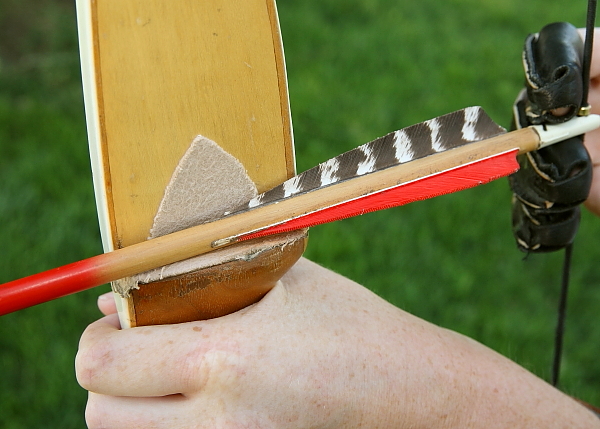
With traditional archery (longbows and recurves), the arrow has three feathers One feather is a different color and is called the “cock” feather. When you nock an arrow, be sure the cock feather always points out, away from the bow. This keeps the feather from deflecting off the bow. (see photo below)
Odd-colored feather always points out.
Nocking an Arrow with Compound Bows
With compound bows, the orientation of the cock “vane” (compound bows have plastic vanes instead of feathers) depends on your arrow rest. The most common arrow rest for compound bows is the drop-away rest. With drop-away rests, the orientation of the cock vane isn’t important as there is no contact with the bow.
With shoot-through, containment style rests like the Whisker Biscuit (as seen below), the cock vane must point upwards. The Whisker Biscuit has stiff bristles on the bottom that support the arrow.
Compound bow with a Whisker Biscuit arrow rest. Notice how the cock vane points upward to avoid contact with the lower stiff bristles.
Anchor Point
The next step is to acquire an “anchor point”. Anchor points are two or more spots on your face where your release hand or string comes in contact with your face. Anchor points are vitally important to consistent shooting and accuracy. Therefore you must establish consistent anchor points from the outset.
Anchor points are different for everyone, but most commonly are:
the string on the tip of your nose
a finger touching the corner of your mouth
side of thumb touching your jaw bone
arrow fletching touching the face
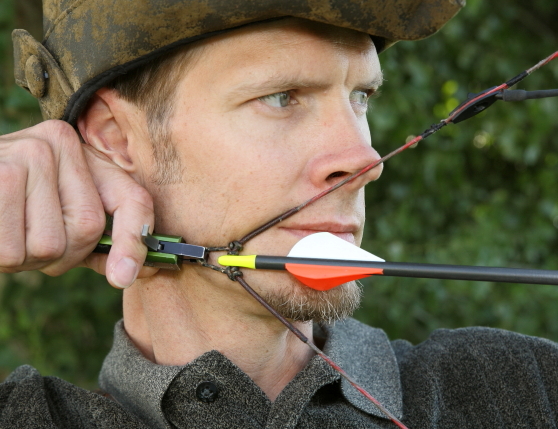
When shooting a compound bow I make sure the string touches the tip of my nose and the side of my thumb touches the back of my jaw.
On traditional bows, the string touches the side of my nose and my first (or middle) finger touches the corner of my mouth.
Compound bow anchor points are: String on nose and thumb at back of jaw bone.Traditional recurves bow anchor points are: String touches die of nose, finger touches corner of my mouth.
Note: Many beginner students are afraid to have string contact with their face. This is totally unwarranted because when you release the arrow, all the energy leaves your face unscathed.
Now we are ready to shoot an arrow!
How to Release the Arrow
Here are the steps to releasing an arrow:
Nock an arrow on the string below the nocking point. You should hear a soft “click” as it locks onto the string. On compound simply attach the mechanical release aid to the D-loop.
Grasp the string with three fingers. Your three fingers will hook onto the string at the first joints of your fingers.
Pull the string across your chest, not towards it, and align the string with your eye. Essentially you should split the target with the string and look down the arrow to aim, but keeping your focus on the target, not the arrow.
Back tension release: As you draw the bow, your back muscles are doing all the work. Squeeze your shoulder blades together as you bring the string to your face. At the same time, you are pushing the bow forward with your bow arm.
Establish your anchor points on your face.
Aim with the point of your arrow while looking through the string at the target. With a compound bow, place the appropriate sight pin on the target.
Release the arrow by simply relaxing and opening your hand. With compound bows you simply touch the trigger of the release.
Follow through. Follow through means that both arms (bow arm and release arm) continue in opposite directions on the shot. This is called “finishing the shot.” Your release hand should continue straight back towards your ear. The last thing you should feel is your release hand brushing past your face and touching your ear. This will reduce oscillation and increase accuracy.
Anchor, release, and follow through.Traditional bow follow-through: Hand brushes face and stops at your ear.
Final Thought
Archery is a complex skill that cannot be mastered in a day, any more than other muscle-memory skills such as golf or skiing. In the movies they make it look easy, and many of my students have the misconception that they can simply pick up a bow and start hitting bullseyes. But without spending a lot of time on the basics, you’ll immediately develop bad habits which will take a long time to break.
Accuracy comes by focusing on each step, one at a time. After many hours–maybe even months–these steps will gradually become one subconscious step called form. Once proper form is established, your only focus will be on aiming. This is should be your goal.
For previous steps on the archery shot sequence, see:
The release arm, (aka the string arm or shooting arm), is the arm/hand that holds the string while drawing the bow. If you are right handed, then it’s your right hand.
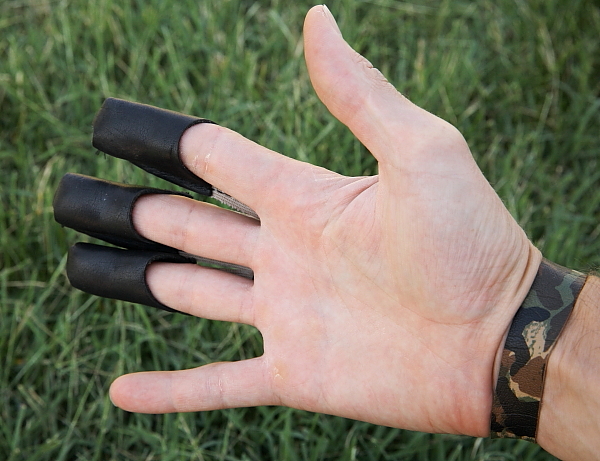
In traditional archery you have the option of wearing a shooting glove or finger tab to protect your shooting fingers (index, middle, and ring finger).
Although it is perfectly fine to shoot with bare fingers on a light-poundage bow, it can be very painful with a heavier-poundage bow. A release “aid” or glove also allows the string to slide off the fingers evenly and with less friction.
Glove-style release aid.Finger tab release aid.
All newer-model compound bows should be shot with a mechanical release aid. Unlike traditional bows (longbows and recurves), compound bows are designed to be shot in-line with the arrow, string, and rest.
With traditional bows, the string naturally oscillates from side to side as it comes off your fingers. This is normal, and the arrow will straighten itself out in flight.
With compound bows, the arrow leaves the bow at a much higher speeds, and therefore, oscillation will cause the arrow to wobble and shed energy as it tries to re-adjust itself in flight. Therefore, the arrow should be shot with perfect alignment to avoid any oscillation.
Compound Bow Release
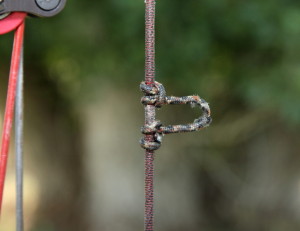
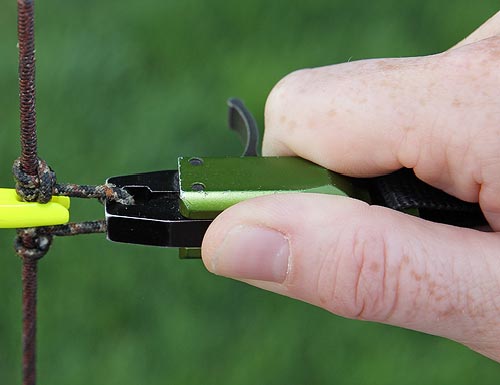
In order to accomplish this, the arrow attaches to the bowstring inside of a D-loop that’s tied to the bowstring. Next, a mechanical release aid attaches to the D-loop to draw the bow back. This keeps the shooters arm aligned perfectly with the arrow.
Compound bow D-Loop.Mechanical release aid for compound bows.
As an aside, my person favorite release is the Fletcher .44 Caliper Release (no longer in production, but still available sometimes on Ebay. This is the smoothest, most reliable, and least expensive release I’ve used.
Traditional Archery Release
With traditional archery, you have two options for grasping the string: 1) One finger above and two below the arrow nock, or 2) Three fingers below the nock.
The advantage of having three fingers below is that it brings the arrow closer to your eye. This helps with aiming. I’ve personally found that three fingers below dramatically increases my accuracy. Try it both ways and see which method works best for you.
One finger above and two below.Three fingers below. This brings the string closer to your eye.